Aperçu en situationAperçu en situation Aperçu en RAAperçu en RA Passer au format impression Passer au format impressionPasser au format image numérique Passer au format image numérique PartagerPartager
DétailsDétails Ajouter aux favoris Ajouter aux favoris TéléchargerTélécharger Articles similairesArticles similaires RadiographieRadiographie Voir le diaporamaVoir le diaporama StatistiquesStatistiques

Convent near Rome

Discover George Henry Yewell’s ‘Convent near Rome’ (1870). A monochrome landscape painting showcasing realism & impressionism. Explore its serene beauty & historical context.

Découvrez le portrait imposant de William Henry Cavendish Bentinck, 3ème Duc de Portland, par Éric Romney. Un chef-d'œuvre du XVIIIe siècle capturant dignité et pouvoir.

Reproduction à l'huile faite à la main

Huile sur toile peinte à la main, avec cadre et dimensions personnalisés, réalisée sur commande par nos artistes. (Passer au format impression Passer au format impressionPasser au format image numérique Passer au format image numérique)

P118B $10
P118H $10
P118W $10
P438Z $10
P508JH $12
P508YH $12
P805H $10
P805Z $10
P919BZ $10
P919G $10
P919XJ $10
P959ZH $10
P968JZ $12
W106C $8
W218G $10
W218JH $8
W218Y $10
W307PJ $10
W316G $10
W316PJ $8
W316Y $10
W398PJ $8
W4111J $10
W500HY $15
W500JH $15
W692G $12
W849H $8
W940BG $15
W953PJ $8

Format standard
personnalisé
CM
INCH

Choisissez parmi nos formats prédéfinis qui respectent les proportions originales de l’œuvre.

largeur
hauteur

Vous pouvez saisir vos propres dimensions pour l'adapter à un cadre ou à un espace spécifique. Si la taille sélectionnée ne correspond pas aux proportions de l'image d'origine, nous recadrerons l'œuvre ou prolongerons la peinture avec des éléments peints à la main supplémentaires. Une maquette numérique vous sera envoyée pour approbation avant le début de la production.
Veuillez noter que l'aperçu à l'écran ne reflète pas le recadrage ou l'extension réels. Seule la maquette montrera fidèlement la composition finale.
Bien que des tailles personnalisées soient disponibles, nous vous recommandons de sélectionner une dimension dans la liste prédéfinie afin de préserver les proportions d'origine.

Exemples de personnalisation possibles : remplacer un visage par la photo du client ; ajouter un animal de compagnie (par exemple, remplacer un chat par un chien) ; inclure un message caché en arrière-plan ; modifier le paysage ou les éléments de l'arrière-plan.
Après la commande, l’équipe WahooArt.com contactera le client par e-mail pour recueillir ses instructions et lui fournira une maquette d’aperçu

Livraison dans le monde entier () en 3 à 4 semaines au lieu des 5 semaines habituelles. (14 septembre). Aucun compromis sur la qualité.

why_choose_icon
Livraison express gratuite dans le monde entier
why_choose_icon
Toile de lin de haute qualité
why_choose_icon
Assurance transport complète
why_choose_icon
Garantie de remboursement des droits de douane
why_choose_icon
Garantie de fidélité des couleurs
why_choose_icon
Garantie de retour de 100 jours (uniquement en cas de défaut)
why_choose_icon
Garantie de remboursement à 100%
why_choose_icon
Tarifs dégressifs sur quantité

Prix total

$ 272

reproduction

Convent near Rome

Technique de reproduction

Format de la reproduction

-

Prix total final

$ 272

L'essentiel de l'œuvre

  • Year: 1870
  • Dimensions: 5.5 x 9 in.
  • Subject or theme: Rural Italian scene
  • Artistic style: Realism/Impressionism
  • Medium: Oil on canvas
  • Influences:
    • Cole
    • Hicks
  • Artist: George Henry Yewell

Quiz d'art

Chaque question ne comporte qu'une seule bonne réponse.

Question 1:
What is the primary subject matter depicted in George Henry Yewell’s ‘Convent near Rome’?
Question 2:
The painting ‘Convent near Rome’ is primarily executed in which style?
Question 3:
What year was George Henry Yewell’s ‘Convent near Rome’ painted?
Question 4:
Which of the following best describes Yewell’s artistic background before moving to Rome?
Question 5:
The muted color palette and loose brushstrokes of ‘Convent near Rome’ contribute to which overall effect?

A Moment of Tranquil Reflection: George Henry Yewell’s “Convent Near Rome”

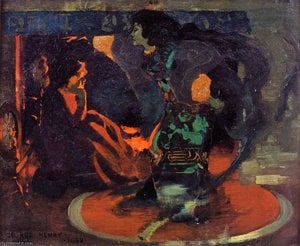
George Henry Yewell's "Convent Near Rome," painted in 1870, isn’t merely a landscape; it’s a carefully constructed tableau of serenity and understated beauty. This monochrome masterpiece, rendered in oil on canvas, transports the viewer to a rural Italian scene—a place where time seems to slow and the spirit finds solace. The painting immediately establishes a mood of quiet contemplation through its muted palette – predominantly cool blues, grays, and browns – that evokes the hazy atmosphere of a distant afternoon. Yewell masterfully employs atmospheric perspective, subtly lightening the tones in the background to create an illusion of depth, drawing the eye towards the imposing yet harmonious structure of the convent itself.

The Artist’s Hand: Technique and Style

Yewell's style is a fascinating blend of realism and impressionism. While rooted in observation—evident in the detailed rendering of the stone wall and the subtle variations in the grassy field—the painting also possesses an expressive quality. Short, broken brushstrokes build texture and volume, particularly noticeable in the foreground, suggesting a dynamic interplay between light and shadow. The loose application of paint contributes to the overall sense of immediacy and captures the fleeting effects of natural light. Notably, Yewell’s technique echoes that of Thomas Cole, whose influence is palpable in the painting's focus on capturing the grandeur and spiritual resonance of the landscape—a connection further solidified by Yewell’s early exposure to Cole’s *The Voyage of Life*. The composition itself is deliberately balanced, with horizontal lines dominating the scene, creating a feeling of stability and grounding.

Historical Context and Artistic Influences

To fully appreciate “Convent Near Rome,” it's crucial to understand Yewell’s artistic journey. Born in Havre de Grace, Maryland, he initially trained as a tailor before dedicating himself to painting. His formative years in Iowa City, influenced by Theodore S. Parvin and the principles of careful draftsmanship, laid the foundation for his later work. A pivotal moment arrived with a political cartoon that catapulted him into local fame, demonstrating an early talent for capturing human character and social commentary. His time in Paris under Thomas Couture and William Makepeace Thackeray further refined his skills, exposing him to European artistic trends. The painting’s subject matter—a rural Italian scene—reflects Yewell's travels and his fascination with the landscapes of Europe, particularly Italy, where he spent several years residing in Rome.

Symbolism and Emotional Resonance

While “Convent Near Rome” avoids overt symbolism, it resonates deeply through its portrayal of tranquility and connection to nature. The convent itself can be interpreted as a symbol of faith, community, and refuge—a place of quiet contemplation amidst the bustle of life. The surrounding landscape evokes a sense of timelessness and serenity, inviting the viewer to step into the scene and experience a moment of peaceful reflection. The muted colors and soft lighting contribute to an emotional atmosphere of gentle melancholy and understated beauty, suggesting a longing for simplicity and connection with something larger than oneself. It’s a painting that speaks not through grand pronouncements but through subtle gestures—a testament to Yewell's ability to capture the essence of a place and evoke a profound sense of feeling.

A Timeless Masterpiece: Reproduction Options

WahooArt offers high-quality reproductions of “Convent Near Rome,” allowing you to bring this captivating artwork into your home or office. Available in various sizes, our prints faithfully capture the painting’s delicate details and atmospheric depth. Whether you're an art collector, interior designer, or simply someone seeking a touch of timeless beauty, a reproduction of Yewell’s “Convent Near Rome” is sure to be a cherished addition to your collection. Explore our options today and experience the serenity of this remarkable landscape firsthand.


Biographie de l'artiste

Early Life and Education

George Henry Yewell (January 20, 1830 – September 26, 1923) était un peintre et dessinateur américain né à Havre de Grâce, Maryland. Son père, Solomon Yewell, décéda lorsqu'il était jeune enfant, laissant derrière lui sa mère pour qu’elle déménage à Cincinnati, Ohio, où Harriet Carver Yewell avait des liens familiaux importants. Reconnaissant l'importance d'une formation artistique, Harriet inscrivit son fils à la école de Theodore S. Parvin à Iowa City, Iowa—Parvin deviendra plus tard un éducateur et éditeur respecté du *The Annals of Iowa*. Cette expérience formative inculqua chez Yewell une appréciation pour l’observation et le dessin précis, qualités qui caractériseraient toute sa œuvre.
  • Iowa City Years: Entre 1841 et 1848, Yewell affina ses compétences artistiques en apprentissage avec un tailleur tout en cultivant sa passion pour l'art.
  • Thomas Cole’s Influence: Un événement déterminant survint lorsqu'il rencontra *The Voyage of Life* de Thomas Cole, suscitant une fascination durable pour la peinture paysagière romantique et son exploration des thèmes spirituels.

Breakthrough Career and Political Cartoons

La carrière artistique de Yewell prit son essor en 1848 lorsqu'il dessina une caricature satirique sur le débat passionné concernant le transfert du siège de l’État d’Iowa à Des Moines—une scène rendue avec une remarquable dynamique et une représentation symbolique. Comme Yewell lui-même raconta, « Au sommet de l'excitation, j'ai dessiné un grand caricature représentant le bâtiment législatif sur roues, et des bœufs tirant dans une direction, dont les épaules étaient chargées de têtes de membres ayant voté pour le transfert. À l’autre extrémité du bâtiment étaient ceux qui avaient voté contre la loi, représentés par des bœufs dont la chaîne faible avait cassé et renversé leurs épaules en tas. » Cette œuvre fut accueillie avec enthousiasme généralisé et consolida la réputation de Yewell comme dessinateur talentueux—une compétence qu’il continuerait à utiliser tout au long de sa carrière.
  • Charles Mason's Patronage: L’influence du juge Charles Mason reconnut le talent de Yewell et lui fournit généreusement des fonds pour son déménagement à New York City, où il inscrivit dans l’atelier de William Makepeace Thackeray.

Formal Studies and Parisian Atelier

Animé par un désir de développement artistique complet, Yewell poursuivit des études formelles à la National Academy of Design entre 1851 et 1853—une période durant laquelle il étudia sous la direction de Thomas Hicks, dont il fut élève. L’atelier d’Hicks favorisa un environnement propice au maîtrise des contrastes tonaux et à la capture de l'essence de la lumière et de l'ombre—principes qui influenceraient ses peintures ultérieures. De plus, il voyagea en voiture diligente et ferroviaire à Manhattan le 9 octobre 1851, s’établissant dans New York City et commençant une nouvelle étape de son parcours artistique.
  • Thomas Hicks’ Influence: Hicks inculqua chez Yewell l'importance d'une observation minutieuse et d'une raffinement stylistique—des compétences affinées grâce à la copie d'œuvres anciennes au Louvre et au Luxembourg Palace.

Mature Artistic Output and Recognition

L’œuvre artistique de Yewell couvrit plusieurs décennies, comprenant des portraits, des scènes urbaines et des paysages orientalistes inspirés par ses voyages en Europe et en Égypte. Il obtint une reconnaissance considérable auprès des critiques contemporains tels que Henry T. Tuckerman, qui loua la capacité de Yewell à représenter les éléments architecturaux avec « une précision élaborée ». Notamment, il fut élu académicien de la National Academy of Design en 1881—une preuve de sa valeur artistique durable et de sa contribution à l'histoire américaine de l’art. Ses paysages, notamment ceux représentant des panoramas paisibles du paysage italien, captivent encore aujourd’hui les yeux des spectateurs.
George Henry Yewell

George Henry Yewell

1830 - 1923 , États-Unis

En bref

  • Artistic Movement Or Style: Orientaliste
  • Artists Or Movements Influenced By This Artist: ['Henry T. Tuckerman']
  • Artists Who Influenced This Artist:
    • Thomas Cole
    • Charles Mason
  • Date Of Birth: 20 janvier 1830
  • Full Name: George Henry Yewell
  • Nationality: Américain
  • Notable Artworks:
    • Convent près de Rome
    • Édifice législatif à Saint Marc
  • Place Of Birth: Havre de Grâce, États-Unis