Aperçu en situation Aperçu en RA Passer au format impression Passer au format image numérique Partager
Détails Guide imprimable Ajouter aux favoris Télécharger Articles similaires Radiographie Voir le diaporama Statistiques

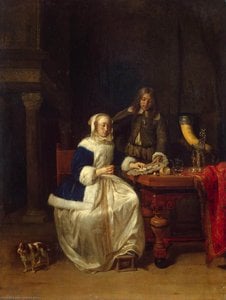
Tavern Scene

Gabriel Metsu's "Tavern Scene" (1655) captures a lively interior with two figures engaged in conversation, showcasing the artist’s meticulous detail and evocative atmosphere of 17th-century Dutch life.

Découvrez Gabriel Metsu (1629-1667), peintre néerlandais du Siècle d'or ! Scènes de genre, portraits & intérieurs captivants. Influencé par Rembrandt et Vermeer.

Reproduction à l'huile faite à la main

Huile sur toile peinte à la main, avec cadre et dimensions personnalisés, réalisée sur commande par nos artistes. ( Passer au format impression Passer au format image numérique)

Corner sample of the P118B picture frame: polystyrène moulé, 5 cm wide and 3 cm thick
P118B 10
Corner sample of the P118H picture frame: polystyrène moulé, 5 cm wide and 3 cm thick
P118H 10
Corner sample of the P118W picture frame: polystyrène moulé, 5 cm wide and 3 cm thick
P118W 10
Corner sample of the P438Z picture frame: polystyrène moulé, 5.5 cm wide and 3.5 cm thick
P438Z 10
Corner sample of the P508JH picture frame: polystyrène moulé, 7 cm wide and 3.5 cm thick
P508JH 12
Corner sample of the P508YH picture frame: polystyrène moulé, 7 cm wide and 3.5 cm thick
P508YH 12
Corner sample of the P805H picture frame: polystyrène moulé, 5 cm wide and 3.5 cm thick
P805H 10
Corner sample of the P805Z picture frame: polystyrène moulé, 5 cm wide and 3.5 cm thick
P805Z 10
Corner sample of the P919BZ picture frame: polystyrène moulé, 7 cm wide and 3.5 cm thick
P919BZ 10
Corner sample of the P919G picture frame: polystyrène moulé, 7 cm wide and 3.5 cm thick
P919G 10
Corner sample of the P919XJ picture frame: polystyrène moulé, 7 cm wide and 3.5 cm thick
P919XJ 10
Corner sample of the P959ZH picture frame: polystyrène moulé, 5 cm wide and 3 cm thick
P959ZH 10
Corner sample of the P968JZ picture frame: polystyrène moulé, 6 cm wide and 4 cm thick
P968JZ 12
Corner sample of the W106C picture frame: bois massif, 5 cm wide and 3 cm thick
W106C 8
Corner sample of the W218G picture frame: bois massif, 5 cm wide and 3 cm thick
W218G 10
Corner sample of the W218JH picture frame: bois massif, 5 cm wide and 3 cm thick
W218JH 8
Corner sample of the W218Y picture frame: bois massif, 5 cm wide and 3 cm thick
W218Y 10
Corner sample of the W307PJ picture frame: bois massif, 6 cm wide and 3 cm thick
W307PJ 10
Corner sample of the W316G picture frame: bois massif, 6 cm wide and 3 cm thick
W316G 10
Corner sample of the W316PJ picture frame: bois massif, 6 cm wide and 3 cm thick
W316PJ 8
Corner sample of the W316Y picture frame: bois massif, 6 cm wide and 3 cm thick
W316Y 10
Corner sample of the W398PJ picture frame: bois massif, 5 cm wide and 3 cm thick
W398PJ 8
Corner sample of the W4111J picture frame: bois massif, 6.5 cm wide and 3.5 cm thick
W4111J 10
Corner sample of the W500HY picture frame: bois massif, 7 cm wide and 5 cm thick
W500HY 15
Corner sample of the W500JH picture frame: bois massif, 7 cm wide and 5 cm thick
W500JH 15
Corner sample of the W692G picture frame: bois massif, 8 cm wide and 4 cm thick
W692G 12
Corner sample of the W849H picture frame: bois massif, 5 cm wide and 3 cm thick
W849H 8
Corner sample of the W940BG picture frame: bois massif, 7.5 cm wide and 4.5 cm thick
W940BG 15
Corner sample of the W953PJ picture frame: bois massif, 6 cm wide and 3.5 cm thick
W953PJ 8

Format standard
personnalisé
CM
INCH

Choisissez parmi nos formats prédéfinis qui respectent les proportions originales de l’œuvre.

largeur
hauteur

Saisissez la largeur et la hauteur souhaitées, pour s'adapter à votre cadre ou à votre mur. Cette œuvre est peinte à la main ; ainsi, pour un format de forme différente, l'artiste peut peindre un peu plus autour du tableau ou réduire légèrement les bords — c'est vous qui choisissez. Nous vous envoyons une maquette numérique pour approbation avant que la peinture ne commence. L'image présentée sur cette page ne reflète pas le résultat réel — seule la maquette le fait.

Exemples de personnalisation possibles : remplacer un visage par la photo du client ; ajouter un animal de compagnie (par exemple, remplacer un chat par un chien) ; inclure un message caché en arrière-plan ; modifier le paysage ou les éléments de l'arrière-plan.
Après la commande, l’équipe WahooArt.com contactera le client par e-mail pour recueillir ses instructions et lui fournira une maquette d’aperçu

Livraison dans le monde entier () en 3 à 4 semaines au lieu des 5 semaines habituelles. (21 octobre). Aucun compromis sur la qualité.

Livraison express gratuite dans le monde entier
Toile de lin de haute qualité
Assurance transport complète
Garantie de remboursement des droits de douane
Garantie de fidélité des couleurs
Garantie de retour de 100 jours (uniquement en cas de défaut)
Garantie de remboursement à 100%
Tarifs dégressifs sur quantité

Prix total

€ 238

Tavern Scene

Technique de reproduction

Format de la reproduction

-

Prix total final

€ 238

Gabriel Metsu’s “Tavern Scene”: A Window into Dutch Golden Age Life

Gabriel Metsu's "Tavern Scene," painted around 1655, isn’t merely a depiction of a room; it’s a meticulously crafted snapshot of 17th-century Dutch society – a microcosm brimming with subtle social commentary and artistic innovation. The painting, now housed in the National Gallery of Ireland, offers a rare glimpse into the daily lives of ordinary people within the opulent context of the Dutch Golden Age, a period renowned for its burgeoning wealth, artistic flourishing, and complex social dynamics. Metsu’s work stands apart from his contemporaries not through grand scale or dramatic gesture, but through an almost unnerving intimacy and a remarkable ability to capture the quiet moments of human interaction.

The scene itself unfolds within a modestly furnished tavern room, bathed in the warm glow of candlelight. Two figures dominate the composition: a man seated at a chair, engaged in conversation with a woman who stands beside him. Around them, a carefully arranged tableau vivant – a bowl and cup on a table, a book resting nearby, a clock hanging on the wall – suggests a comfortable, if slightly cluttered, domestic setting. Yet, it’s not simply a portrait of two individuals; Metsu masterfully employs light and shadow to create a sense of depth and atmosphere, drawing the viewer into this intimate space. The details are astonishingly precise: the texture of the fabrics, the gleam of the pewter cup, the subtle wrinkles on the faces of the figures – all rendered with an almost photographic realism that was characteristic of the Dutch Masters.

The Artist’s Eclectic Style and Early Influences

Gabriel Metsu's artistic identity remains somewhat enigmatic. He resisted categorization, earning the label “a highly eclectic artist,” a testament to his broad range of interests and techniques. While he produced history paintings, portraits, and genre scenes, it was in the realm of domestic interiors – particularly tavern scenes – that he truly excelled. His work reflects a deep engagement with the artistic currents of his time, drawing inspiration from masters like Rembrandt and Vermeer, yet forging his own distinct style. Early influences are believed to have come from his upbringing in Leiden, where he was exposed to diverse cultural traditions and artistic practices.

Metsu’s approach was marked by a meticulous attention to detail and an uncanny ability to capture the nuances of human emotion. He frequently employed small-scale panels, allowing him to focus on intimate scenes and individual characters. His use of light is particularly noteworthy – it's not merely functional but serves to illuminate the subjects and create a sense of drama within the confined space of the tavern. The composition itself is carefully balanced, with each element contributing to the overall harmony of the scene.

Symbolism and Social Commentary

Beyond its technical brilliance, “Tavern Scene” is rich in symbolic meaning. The arrangement of objects – the bowl, cup, book, and clock – speaks to the rhythms of daily life and the importance of leisure activities within Dutch society. The presence of a world map on the wall hints at the burgeoning global trade networks that fueled the nation’s prosperity. However, Metsu doesn't simply offer a straightforward depiction of tavern life; he subtly critiques the excesses and moral ambiguities of the era.

The inclusion of a gambling scene, with dice and playing cards scattered on the table, suggests the prevalence of gambling and its potential for ruin. The presence of a woman in a provocative pose, alongside a young man engaged in conversation, hints at the complexities of social relationships and the temptations of the flesh. Even seemingly innocuous details – such as the old shoes near the doorway – carry symbolic weight, reminding us of the passage of time and the inevitability of aging. The painting’s final detail, the letter addressed to the painter, is a clever device that invites the viewer to contemplate the artist's own role within this social tableau.

A Legacy of Intimacy and Observation

“Tavern Scene” stands as a testament to Gabriel Metsu’s extraordinary talent and his profound understanding of human nature. It’s a painting that rewards careful observation, inviting viewers to linger over its details and decipher its subtle symbolism. More than just a depiction of a tavern, it's a window into the social, cultural, and psychological landscape of 17th-century Holland – a period of remarkable artistic achievement and profound societal change. Reproductions of this captivating work offer a tangible connection to this fascinating era, allowing us to appreciate Metsu’s unique vision and his enduring legacy as one of the most accomplished artists of the Dutch Golden Age.

Questions et réponses

Qui a créé "Tavern Scene" ?

« Tavern Scene » a été créé par Gabriel Metsu. Les informations présentes sur cette page décrivent l'œuvre originale de Gabriel Metsu.

À quelle période de la carrière de Gabriel Metsu se situe « Tavern Scene » ?

« Tavern Scene » représente la période Mature Period de Gabriel Metsu.

Comment puis-je obtenir un fichier numérique de «Tavern Scene» de Gabriel Metsu ?

Une image numérique de «Tavern Scene» de Gabriel Metsu peut être achetée sur sa page Image numérique : un téléchargement d'image numérique haute résolution.


Biographie de l'artiste

Une Vie D'Exploration Artistique : Gabriël Metsu

  • Né : Leiden, Pays-Bas (1629)
  • Décédé : 1667

Jeunesse et Influences

Gabriël Metsu a vécu une vie marquée par l'exploration artistique et l'innovation. Né en 1629, il était le fils de Jacques Metsu, travailleur du métier de tapissier et peintre originaire d’Hainault. Cet héritage diversifié a probablement influencé son intérêt précoce pour diverses techniques artistiques. Le déménagement de la famille à Leyde l'a exposé à de nombreuses influences culturelles.

Carrière Artistique : Un Style Éclectique

La carrière de Metsu s’est caractérisée par une absence d’adhésion à un style ou une technique unique, ce qui lui a valu le titre d'"artiste hautement éclectique". Son œuvre comprenait des peintures historiques, des natures mortes, des portraits et des œuvres de genre. Notamment, seulement 14 de ses 133 œuvres sont datées, laissant beaucoup à découvrir sur son processus créatif.

  • Influences Précoces : L'influence de Rembrandt van Rijn sur les premiers travaux de Metsu est évidente dans son utilisation de la lumière et de la couleur.
  • Période Amsterdamienne (à partir de 1655) : Son déménagement à Amsterdam a marqué un tournant vers des intérieurs domestiques et des scènes de genre, avec une plus grande emphase sur le détail et le réalisme.
  • Formation et Mentorat : Il a formé Michiel van Musscher et Joost van Geel, reflétant son engagement envers la communauté artistique.

Œuvres Notables et Développement Artistique

Les peintures de Metsu comportaient souvent de jeunes femmes, des scènes de marché et des personnes âgées, puisant dans les emblèmes populaires de l’époque. Son style a évolué au cours de sa carrière, démontrant une maîtrise de diverses techniques.

  • L'Enfant Malade (c. 1664) : Cette œuvre reflète l'admiration de Metsu pour le détail méticuleux et l'utilisation de la lumière par Johannes Vermeer.
  • Portrait de la Famille Hinlopen : Un chef-d'œuvre combinant peinture de genre et portrait, mettant en valeur sa capacité à capturer à la fois le caractère individuel et la vie domestique.
  • Le Fils Prodigue (c. 1640) : Démontre une influence baroque avec sa composition dramatique et ses détails riches.
  • Thèmes Récurrents : Metsu dépeignait fréquemment des scènes de la vie quotidienne, souvent empreintes de sens symbolique.

Signification Historique et Héritage

L'héritage de Gabriël Metsu réside dans sa polyvalence et sa contribution à l’âge d’or néerlandais. Son style éclectique, bien que parfois énigmatique, a influencé les générations futures d'artistes. Aujourd'hui, ses œuvres sont conservées dans des musées prestigieux du monde entier.

  • Peintre de l’âge d’or néerlandais : Il est reconnu comme une figure importante au sein du paysage artistique dynamique du XVIIe siècle aux Pays-Bas.
  • Collections Muséales : Ses peintures se trouvent dans divers musées, dont le Rijksmuseum à Amsterdam.
  • Appréciation Continue : L’art de Metsu continue de fasciner et d'inspirer les spectateurs par son réalisme, ses détails et ses récits subtils.
Gabriel Metsu

Gabriel Metsu

1629 - 1667 , Pays-Bas

En bref

  • Artistic Movement Or Style: Âge d'or néerlandais
  • Artists Or Movements Influenced By This Artist: ['Pieter de Hooch']
  • Artists Who Influenced This Artist: ['Rembrandt van Rijn']
  • Date Of Birth: 1629
  • Date Of Death: 1667
  • Full Name: Gabriël Metsu
  • Nationality: Néerlandais
  • Notable Artworks:
    • L’Enfant malade
    • Portrait de la famille Hinlopen
    • Vendeur de volaille
  • Place Of Birth: Leiden, Pays-Bas
Explorez des œuvres d'art classées par thèmes, styles et caractéristiques.