Impressions giclées ou sur toile de qualité musée, avec une production rapide et des finitions au choix. ( Commander la reproduction peinte à la main Passer au format numérique)





























Choisissez parmi nos formats prédéfinis qui respectent les proportions originales de l’œuvre.

Saisissez la largeur et la hauteur souhaitées pour qu'elles s'adaptent à votre cadre ou à votre mur. Une impression peut être recadrée, mais jamais agrandie au-delà de l'image originale ; ainsi, un format de forme différente entraînera la perte d'une partie de l'image. Nous vous envoyons une maquette numérique pour approbation avant toute impression. L'image présentée sur cette page ne montre pas le recadrage réel — seule la maquette le permet.
Livraison dans le monde entier () en 2 semaines au lieu des 4/5 semaines habituelles. (8 novembre)
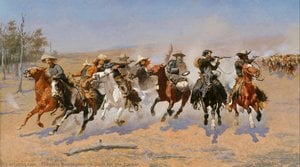
The Grass Fire
Format de la reproduction
Frederic Remington's "The Grass Fire," painted in 1908, is more than just a depiction of Native Americans on horseback; it’s a poignant snapshot of a vanishing era and a testament to an artist’s profound engagement with the American West. Measuring 101 x 68 cm, this artwork captures a moment of raw energy and quiet resilience as a group of riders navigate a landscape consumed by wildfire – a visual metaphor for both destruction and renewal. Remington, born in Canton, New York, in 1861, wasn’t simply observing the West; he was actively constructing its image through meticulous study and a deep understanding of the narratives surrounding it. His upbringing, steeped in military tradition and fueled by a romanticized vision of frontier life, profoundly shaped his artistic output.
Remington's artistic style is characterized by a robust realism, heavily influenced by his experience as a military artist. “The Grass Fire” exemplifies this approach through detailed depictions of the horses’ musculature, the rugged terrain, and the weathered faces of the riders. His brushwork is deliberately textured, conveying a sense of immediacy and capturing the harshness of the environment. The use of color – predominantly earthy tones punctuated by flashes of red from the fire – further enhances the painting's dramatic impact. Remington employed oil paints on canvas, utilizing layering techniques to build up depth and create a palpable sense of volume within the scene.
Beyond its immediate depiction of Native Americans on horseback, “The Grass Fire” carries significant symbolic weight. The burning landscape can be interpreted as representing both destruction – the loss of traditional ways of life – and renewal – a potential for rebirth and adaptation. The kneeling figure, possibly tending to an injury, introduces an element of vulnerability and humanity into the scene, reminding us of the personal cost of survival in this unforgiving environment. Remington’s work frequently engaged with themes of courage, resilience, and the enduring spirit of the American West.
"The Grass Fire" resonates deeply due to its evocative portrayal of a pivotal moment in American history. It captures not just a visual scene but also a powerful emotional response – a sense of awe, respect, and perhaps even melancholy for a way of life that was rapidly disappearing. As one of Frederic Remington’s most iconic works, “The Grass Fire” remains a significant contribution to the canon of American art, offering a valuable glimpse into the complexities of the West and cementing Remington's legacy as a chronicler of its vanishing beauty.
«The Grass Fire» de Frédéric Remington dégage une atmosphère Nostalgique et s'intègre parfaitement dans une Salon. Cette ambiance reflète l'émotion que l'œuvre apporte à l'espace qui l'entoure.
Frédéric Remington a réalisé « The Grass Fire » en 1908.
Une page Statistiques est disponible pour « The Grass Fire ». Elle présente l'évolution mensuelle des visites de l'œuvre ainsi que des autres créations de l'artiste, avec une répartition par pays et par langue.


1861 - 1909 , États-Unis d'Amérique

Maîtrisez les secrets techniques de l'impression Giclée et des encres pigmentaires. Devenez un expert en conservation d'art dès maintenant.
 Aperçu en situation
 Envoyer
 Partager
 Détails de l'œuvre
 Guide
Guide

 Télécharger l'image
 Articles similaires
 Radiographie
 Diaporama
 Questions et réponses
 Statistiques


 Lire la suite









 L'option verre n'est disponible que pour les dimensions inférieures à 110 cm.