


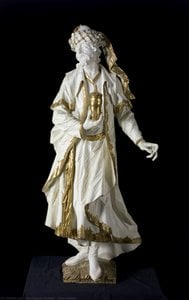
 1765
1765 173.0 x 86.0 cm
Acquérez une image numérique haute résolution et optimisée, d'une qualité bien supérieure à l'aperçu en ligne.
Chaque fichier est méticuleusement préparé par nos spécialistes internes à l'aide d'outils avancés et d'une retouche manuelle experte. Nous garantissons que chaque image possède une clarté exceptionnelle, une précision des couleurs irréprochable et un niveau de détail fin.
Le fichier final est livré par e-mail sous 72 heures, optimisé pour une utilisation immédiate dans des contextes professionnels, éditoriaux et d'impression. Il offre la même qualité de confiance que celle utilisée par les plus grands studios de création, éditeurs et galeries.
Téléchargez un fichier haute résolution pour votre usage personnel, l'impression et vos projets créatifs. ( Commander l'impression Commander la reproduction peinte à la main)
En choisissant WahooArt.com, vous n'obtenez pas seulement une simple image : vous recevez une œuvre numérique sublimée avec professionnalisme, conçue avec précision et accompagnée d'une garantie de satisfaction. Voici tout ce qui accompagne automatiquement votre commande :

Votre fichier d'image numérique haute résolution vous sera envoyé par e-mail sous 72 heures après votre commande — prêt à un usage immédiat.

Votre œuvre d'art bénéficie d'une optimisation professionnelle grâce à des outils d'IA avancés et une retouche manuelle, garantissant un niveau maximal de détail, de clarté et de fidélité chromatique.

Vous avez accidentellement supprimé ou perdu votre fichier ? Pas d'inquiétude — nous vous le renverrons gratuitement, quand vous le souhaitez.

Profitez de votre œuvre d'art instantanément sans frais de douane ni de livraison — les téléchargements numériques sont toujours exonérés de taxes.

Nous garantissons que votre image numérique reproduit les couleurs de l'original aussi fidèlement que possible grâce à des outils professionnels et une gestion rigoureuse des couleurs.

Si vous n'êtes pas satisfait de votre image numérique, nous la retoucherons ou vous rembourserons 100% sous 100 jours - sans poser de questions.

Pas satisfait ? Obtenez un remboursement intégral dans les 100 jours suivant la réception de votre fichier numérique - sans poser de questions.

Achetez 3 images, économisez 10% - Achetez 5, économisez 15% - Achetez 10+, économisez 20%. Idéal pour les projets créatifs, les galeries et les agences.

In the heart of eighteenth-century Bavaria, a period defined by the exuberant grace of the Rococo, the name Franz Ignaz Günther emerged as a beacon of sculptural brilliance. Born in 1725 in Altmannstein, Germany, Günther’s journey into the world of fine art began not in an academy, but within the humble, aromatic confines of his father's carpenter and cabinetmaker workshop. This early immersion in the tactile reality of wood and grain provided him with a foundational mastery over his medium that would later allow him to breathe life into seemingly static timber. His formative years were shaped by the rhythmic precision of craftsmanship, a skill set that would eventually evolve into a profound artistic language capable of expressing the most delicate spiritual ecstasies.
The trajectory of his talent led him from the local workshops of Altmannstein to the prestigious studios of Munich, where between 1743 and 1750, he studied under the renowned court sculptor Johann Baptist Straub. This mentorship was pivotal, connecting Günther to the lineage of great German sculptors and refining his ability to manipulate form and light. His Wanderjahre—the essential period of wandering and learning—further expanded his artistic horizons as he traveled through Salzburg, Olmütz, Vienna, and Mannheim. In each city, he absorbed the nuances of the European Rococo style, studying under masters like Paul Egell. By the time he reached the Vienna Academy of Fine Arts in 1753, Günther was no longer merely a skilled carver but a rising virtuoso, a fact cemented when he won the academy's annual students' competition.
Returning to Munich in 1754, Günther established his own workshop, which became a crucible for some of the most breathtaking religious sculptures of the era. His work is characterized by an unparalleled ability to capture movement and emotion through elongated proportions and the intricate, angular arrangement of drapery. To gaze upon a Günther sculpture is to witness a dance of light and shadow; his figures often possess an ecstatic quality, where the heavy folds of carved wood seem to flutter with a life of their and divine inspiration. While much of his work was carved from wood and subsequently polychromed by skilled artisans, the structural soul of each piece remained his singular achievement.
His contributions to sacred spaces are perhaps his most enduring legacy. Throughout Bavaria, his altars and statues transformed churches into celestial theaters. Notable works include:
Beyond the church walls, Günther’s influence reached even the highest echelons of society and art production. His large porcelain crucifix, commissioned for the Munich Residenz, remains a marvel of technical complexity, with its pattern still honored by the Nymphenburg Porcelain Manufactory today. This ability to translate his sculptural vision into different media underscores his versatility and the lasting impact of his aesthetic. Even centuries later, the reverence for his skill is reflected in the profound respect shown to his legacy, such as when a wooden crucifix in his style was presented as a gift to Pope Benedict XVI. Franz Ignaz Günther remains not just a sculptor of wood, but a sculptor of the Bavarian soul, leaving behind a trail of grace that continues to captivate the modern eye.
1725 - 1775

 Aperçu en situation
 Envoyer
 Partager
 Détails de l'œuvre

 Télécharger
 Articles similaires
 Radiographie
 Diaporama
 Lire la suite


