Aperçu en situation Aperçu en RA Acheter la peinture faite à la main Passer au format image numérique Partager
Détails Guide imprimable Ajouter aux favoris Télécharger Articles similaires Radiographie Voir le diaporama Statistiques

The Bather

Admire François Lemoyne's 'The Bather,' a captivating Rococo masterpiece showcasing classical beauty and serene landscapes. Explore the artistry & details of this iconic Hermitage Museum painting.

Découvrez François Lemoyne (1688-1737), peintre rococo français majeur ! Explorez ses plafonds allégoriques, son héritage et son rôle dans l'art du XVIIIe siècle.

Giclées et impressions d'art

Impressions giclées ou sur toile de qualité musée, avec une production rapide et des finitions au choix. ( Acheter la peinture faite à la main Passer au format image numérique)

Corner sample of the P118B picture frame: polystyrène moulé, 5 cm wide and 3 cm thick
P118B €10
Corner sample of the P118H picture frame: polystyrène moulé, 5 cm wide and 3 cm thick
P118H €10
Corner sample of the P118W picture frame: polystyrène moulé, 5 cm wide and 3 cm thick
P118W €10
Corner sample of the P438Z picture frame: polystyrène moulé, 5.5 cm wide and 3.5 cm thick
P438Z €10
Corner sample of the P508JH picture frame: polystyrène moulé, 7 cm wide and 3.5 cm thick
P508JH €12
Corner sample of the P508YH picture frame: polystyrène moulé, 7 cm wide and 3.5 cm thick
P508YH €12
Corner sample of the P805H picture frame: polystyrène moulé, 5 cm wide and 3.5 cm thick
P805H €10
Corner sample of the P805Z picture frame: polystyrène moulé, 5 cm wide and 3.5 cm thick
P805Z €10
Corner sample of the P919BZ picture frame: polystyrène moulé, 7 cm wide and 3.5 cm thick
P919BZ €10
Corner sample of the P919G picture frame: polystyrène moulé, 7 cm wide and 3.5 cm thick
P919G €10
Corner sample of the P919XJ picture frame: polystyrène moulé, 7 cm wide and 3.5 cm thick
P919XJ €10
Corner sample of the P959ZH picture frame: polystyrène moulé, 5 cm wide and 3 cm thick
P959ZH €10
Corner sample of the P968JZ picture frame: polystyrène moulé, 6 cm wide and 4 cm thick
P968JZ €12
Corner sample of the W106C picture frame: bois massif, 5 cm wide and 3 cm thick
W106C €8
Corner sample of the W218G picture frame: bois massif, 5 cm wide and 3 cm thick
W218G €10
Corner sample of the W218JH picture frame: bois massif, 5 cm wide and 3 cm thick
W218JH €8
Corner sample of the W218Y picture frame: bois massif, 5 cm wide and 3 cm thick
W218Y €10
Corner sample of the W307PJ picture frame: bois massif, 6 cm wide and 3 cm thick
W307PJ €10
Corner sample of the W316G picture frame: bois massif, 6 cm wide and 3 cm thick
W316G €10
Corner sample of the W316PJ picture frame: bois massif, 6 cm wide and 3 cm thick
W316PJ €8
Corner sample of the W316Y picture frame: bois massif, 6 cm wide and 3 cm thick
W316Y €10
Corner sample of the W398PJ picture frame: bois massif, 5 cm wide and 3 cm thick
W398PJ €8
Corner sample of the W4111J picture frame: bois massif, 6.5 cm wide and 3.5 cm thick
W4111J €10
Corner sample of the W500HY picture frame: bois massif, 7 cm wide and 5 cm thick
W500HY €15
Corner sample of the W500JH picture frame: bois massif, 7 cm wide and 5 cm thick
W500JH €15
Corner sample of the W692G picture frame: bois massif, 8 cm wide and 4 cm thick
W692G €12
Corner sample of the W849H picture frame: bois massif, 5 cm wide and 3 cm thick
W849H €8
Corner sample of the W940BG picture frame: bois massif, 7.5 cm wide and 4.5 cm thick
W940BG €15
Corner sample of the W953PJ picture frame: bois massif, 6 cm wide and 3.5 cm thick
W953PJ €8

Format standard
personnalisé
CM
INCH

Choisissez parmi nos formats prédéfinis qui respectent les proportions originales de l’œuvre.

largeur
hauteur

Saisissez la largeur et la hauteur souhaitées pour qu'elles s'adaptent à votre cadre ou à votre mur. Une impression ne peut être que découpée, elle ne peut jamais être agrandie au-delà de l'image originale ; ainsi, un format de forme différente entraînera la perte d'une partie de l'image. Nous vous envoyons une maquette numérique pour approbation avant toute impression. L'image présentée sur cette page ne montre pas le recadrage réel — seule la maquette le permet.

Livraison dans le monde entier () en 2 semaines au lieu des 4/5 semaines habituelles. (23 octobre)

Livraison express gratuite dans le monde entier
Toile de lin de haute qualité
Assurance transport complète
Garantie de remboursement des droits de douane
Garantie de fidélité des couleurs
Garantie de retour de 100 jours (uniquement en cas de défaut)
Garantie de remboursement à 100%
Tarifs dégressifs sur quantité

Prix total

€ 60

The Bather

Giclées et impressions d'art

Format de la reproduction

-

Prix total final

€ 60

L'essentiel de l'œuvre

  • Subject or theme: Nude bathing scene
  • Artist: François Lemoyne
  • Movement: Rococo
  • Medium: Oil on canvas
  • Dimensions: 137 x 105 cm

Quiz d'art

Chaque question ne comporte qu'une seule bonne réponse.

Question 1:
What artistic movement is most closely associated with François Lemoyne’s ‘The Bather’?
Question 2:
In the painting 'The Bather', what is depicted in the background landscape?
Question 3:
According to the description, what is a key characteristic of Lemoyne’s style as demonstrated in ‘The Bather’?
Question 4:
What year was François Lemoyne born?
Question 5:
The painting ‘The Bather’ is housed in which museum?

François Lemoyne’s “The Bather”: A Baroque Embrace of Form and Nature

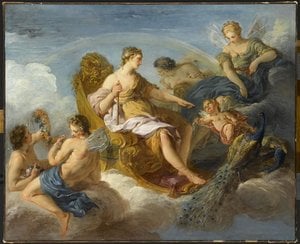
François Lemoyne's "The Bather," housed within the venerable halls of the Hermitage Museum in St. Petersburg, is more than a simple depiction of two women enjoying a tranquil moment; it’s a masterful distillation of 18th-century Rococo aesthetics, imbued with the grandeur and intellectual depth sought by its creator. Painted around the mid-1720s, this oil on canvas work offers a glimpse into a world where classical ideals intertwined with the burgeoning sensuality of the era, showcasing Lemoyne’s skill in capturing both human form and the harmonious relationship between figure and landscape.

Lemoyne, born in Paris in 1688, was a dedicated revivalist. He sought to resurrect the monumental allegorical paintings that had fallen out of favor since the time of Charles Le Brun, viewing himself as a worthy successor to this illustrious tradition. Unlike mere decorative works, Lemoyne aimed for pieces possessing significant intellectual weight and emotional resonance – a reflection of the complex spirit of the Rococo period while simultaneously drawing upon the stability and balance of classical art. The painting’s composition immediately establishes this duality; the figures are presented within a carefully constructed natural setting, yet their poses and gazes convey a subtle interplay of observation and intimacy.

A Study in Drapery and Light

The immediate impact of “The Bather” lies in its exquisite rendering of form and texture. Lemoyne’s mastery of drapery is particularly noteworthy. The flowing garments enveloping the figures are not merely decorative; they actively contribute to the sense of movement and life within the scene. Each fold, pleat, and drape appears sculpted with meticulous detail, suggesting a tactile quality that invites the viewer to almost reach out and feel the fabric’s weight and texture. This is further enhanced by Lemoyne's skillful use of light and shadow – a hallmark of Baroque technique—which models the curves of the bodies and creates a sense of depth within the landscape.

The background, depicting a serene woodland scene with trees and foliage rendered in soft blues and greens, provides a tranquil counterpoint to the figures. The sky, dotted with clouds, reinforces this atmosphere of peaceful contemplation. Notice how Lemoyne subtly integrates the natural elements into the composition; the branches of the trees frame the women, creating a sense of enclosure and intimacy while simultaneously emphasizing their connection to the surrounding environment. Research reveals that Lemoyne’s time in Venice and Rome profoundly influenced his approach, evident in the vibrant local colors used to depict the foliage – a departure from the more muted palettes often favored in Parisian art at the time.

Symbolism and the Rococo Ideal

While seemingly simple in its subject matter, “The Bather” is rich in symbolic potential. The act of bathing itself held multiple meanings during the 18th century – representing purification, renewal, and a connection to nature. The two women, positioned in close proximity yet engaged in distinct activities, invite speculation about their relationship. One appears to be lost in thought, while the other observes her companion with a gentle curiosity. This subtle dynamic speaks to the complexities of human interaction and the enduring fascination with the mysteries of the female psyche – themes frequently explored within the Rococo style.

The painting’s overall mood is one of understated elegance and quiet beauty. It's a testament to Lemoyne’s ability to capture not just the physical likeness of his subjects, but also their inner lives—a skill that cemented his place as a significant figure in the transition from Baroque formality to the more playful sensibilities of the Rococo era. WahooArt offers meticulously crafted hand-painted reproductions that faithfully recreate this exquisite work, allowing you to experience its timeless beauty and intellectual depth firsthand.

Bringing “The Bather” Home

Reproductions of "The Bather" by WahooArt are available in a range of sizes, ensuring that you can find the perfect piece to complement your interior design. Whether adorning a formal salon or adding a touch of classical grace to a more casual space, this painting’s serene beauty and masterful technique will undoubtedly captivate viewers for years to come. Explore our collection today and bring a touch of 18th-century French artistry into your home.

Questions et réponses

Quelle couleur ressort le plus dans « The Bather » ?

La couleur dominante de «The Bather» de François Lemoyne est le Espresso (#5a4933).

Quelle palette et quel sentiment "The Bather" associe-t-il ?

La palette Earthy de «The Bather» de François Lemoyne s'harmonise avec son ton émotionnel Tranquil. La couleur est l'un des moyens par lesquels une œuvre transmet une émotion.

L'œuvre « The Bather » se trouve-t-elle dans le pays de son créateur ?

Non - l'œuvre est conservée à l'étranger. Le pays de naissance de François Lemoyne est France, et le musée qui détient l'original de « The Bather » se trouve en Russia.


Biographie de l'artiste

François Lemoyne : Une Vie au Service de la Peinture Rococo

  • Né: Paris, France (1688)
  • Décédé: 1737

François Lemoyne fut un peintre rocaille français éminent du début et du milieu du XVIIIe siècle. Il est reconnu pour ses plafonds allégoriques grandioses et ses scènes mythologiques, contribuant de manière significative au paysage artistique du règne de Louis XV. Bien qu'il soit souvent éclipsé par des contemporains tels que Boucher et Watteau, Lemoyne cherchait à s'établir comme l'héritier de Charles Le Brun, une figure de proue de l'histoire de l'art français.

Jeunesse et Formation

  • Apprentissage: Lemoyne étudia initialement sous la direction de Robert le Vrac, son beau-père.
  • Académie Royale: Il suivit une formation formelle à l'Académie Royale de peinture et de sculpture à partir de 1701, étudiant avec Louis Galloche puis recevant les conseils de Pierre-Jacques Cazes. L’influence de Cazes est particulièrement notée dans l’utilisation de la couleur par Lemoyne.
  • Prix de Rome: En 1711, il réalisa une étape importante en remportant le Prix de Rome, un prix qui accordait généralement un voyage en Italie pour étudier l'art. Cependant, des contraintes financières l'ont empêché de profiter immédiatement de cette opportunité.

Développement Artistique et Influences

  • Influence Italienne: Son voyage éventuel en Italie en 1723/24, accompagné de François Berger, s’avéra crucial. Il étudia les œuvres de Raphaël, du Corrège et de Titien, absorbant les techniques et l'esthétique artistiques italiennes.
  • Impact de Rubens: Une forte influence sur Lemoyne fut l'œuvre de Pierre Paul Rubens, particulièrement évidente dans son utilisation vibrante de la couleur et ses compositions dynamiques.
  • École Vénitienne: L’exposition à la peinture vénitienne, notamment au sein de la collection de Pierre Crozat, façonna davantage son style artistique.
  • Style Rocaille: Bien qu'influencé par des maîtres antérieurs, l'œuvre de Lemoyne appartenait fermement à la période rococo, caractérisée par l’élégance, l’ornementation et un accent sur la beauté décorative.

Œuvres Majeures et Réalisations

  • Plafonds Fresques: Lemoyne est surtout connu pour ses plafonds fresques monumentaux, notamment L'Apothéose d'Hercule au Salon d’Hercule du Palais de Versailles. Cette œuvre démontra sa maîtrise des techniques illusionnistes et fut largement saluée par les contemporains, dont Voltaire et le Cardinal Fleury.
  • Peintures Religieuses: Il créa également des œuvres religieuses importantes, telles que La Transfiguration dans le chœur de l'église du Jacobin (aujourd’hui église paroissiale Saint-Thomas d’Aquin) à Paris.
  • Premier Peintre du Roi: En 1736, Lemoyne atteignit le sommet de sa carrière en étant nommé Premier peintre du roi sous Louis XV.

Signification Historique et Héritage

François Lemoyne a joué un rôle essentiel dans la formation de la peinture rocaille française. Son ambition était de raviver la tradition des plafonds allégoriques à grande échelle, qui étaient tombés en désuétude. Bien que sa carrière ait été tragiquement interrompue par son suicide en 1737, son œuvre a laissé un impact durable sur les générations d'artistes suivantes.

  • Influence sur les Élèves: Lemoyne servit de tuteur à des artistes éminents tels que Charles-Joseph Natoire et François Boucher, transmettant ses connaissances artistiques et influençant leur développement.
  • Déclin de la Peinture de Plafond: Sa mort marqua la fin d'une époque, coïncidant avec le déclin de la popularité des grandes peintures allégoriques sur plafond.
  • Reconnaissance Aujourd’hui: Bien qu'il ne soit peut-être pas aussi largement reconnu que certains de ses contemporains, les contributions de Lemoyne à l'art rocaille français sont de plus en plus appréciées pour son habileté technique et son ambition artistique.
François Lemoyne

François Lemoyne

1688 - 1737 , France

En bref

  • Artistes Influents:
    • Charles Le Brun
    • Rubens
  • Date De Décès: 1737
  • Date De Naissance: 1688
  • Influence Sur Les Artistes:
    • François Boucher
    • Charles-Joseph Natoire
  • Lieu De Naissance: Paris, France
  • Mouvement Artistique: Rococo
  • Nationalité: Français
  • Nom Complet: François Lemoyne
  • Oeuvres Notables:
    • L'Apothéose d'Hercule
    • La Transfiguration
Explorez des œuvres d'art classées par thèmes, styles et caractéristiques.