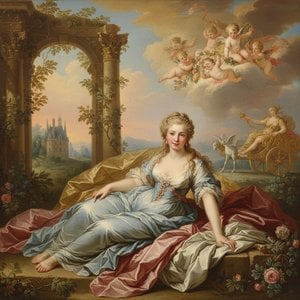
A Renaissance Dialogue of Desire and Virtue
In the quiet, shadowed corridors of the French Renaissance, few works capture the delicate tension between public propriety and private longing as poignantly as François Clouet’s "The Love Letter." Executed around 1570, this oil on panel masterpiece serves as a profound window into the psychological complexities of the sixteenth century. The painting does not merely present a scene; it orchestrates a silent drama. At its heart lies a young woman, draped in luxurious, shimmering fabrics that catch the light with a tactile brilliance, embodying a breathtaking synthesis of beauty and vulnerability. She is caught in a pivotal moment of transition, where the written word becomes a bridge between the known world and the hidden depths of the heart.
The composition is masterfully structured in a triangular arrangement, a classical technique that directs the viewer’s gaze upward toward the central figure, ensuring her emotional state remains the focal point. Flanking this ethereal woman are two figures who ground the scene in human experience: an older procuress on the left, whose weathered features suggest a lifetime of shrewd observation and worldly wisdom, and a lover on the right, whose intense, admiring gaze reflects the raw, unbridled passion of youth. This grouping creates a dynamic energy, a triangular dance of characters that explores the intersection of experience, desire, and the societal structures that govern them.
The Artistry of Light and Texture
Clouet’s technical prowess is on full display through his innovative use of chiaroscuro. By employing dramatic light sources that illuminate the central figures while allowing the background to recede into an undefined, dark void, he achieves a palpable sense of three-dimensional volume. This technique, reminiscent of the great masters of the Fontainebleau School, lends the skin tones a luminous quality and gives the heavy folds of the drapery a sculptural weight. For the discerning collector or interior designer, this interplay of light and shadow offers an unparalleled depth that can transform the atmosphere of any room, providing a sophisticated focal point that commands attention through subtlety rather than noise.
Beyond the play of light, the painting is a triumph of meticulous detail. Clouet’s ability to render diverse textures—the crispness of the parchment, the soft sheen of silk, and the intricate patterns of the man's doublet—demonstrates the Flemish naturalism he inherited from his lineage. Every brushstroke serves to heighten the sensory experience of the viewer, making the tactile reality of the scene almost palpable. This level of detail ensures that a high-quality reproduction remains a captivating subject for close study, revealing new nuances of craftsmanship with every glance.
Symbolism and Emotional Resonance
Every element within "The Love Letter" is imbued with symbolic weight. The letter itself, held aloft by the procuress, acts as more than just a prop; it is a conduit for unspoken anxieties and secret hopes. It represents the power of communication to both reveal truth and create tension within the confines of societal expectations. The contrast between the older man’s experience and the younger man’s ardent admiration invites the viewer to contemplate the cyclical nature of human emotion—the movement from the heat of passion to the calculated wisdom of age.
For those seeking to adorn a space with art that speaks to the soul, this work offers an enduring emotional impact. It is a painting of intimacy and intrigue, perfect for creating a sophisticated, contemplative environment. Whether placed in a grand library or a contemporary living space, Clouet’s masterpiece brings with it a sense of historical gravity and a timeless exploration of the human condition, making it an exquisite choice for anyone looking to invest in art that transcends mere decoration to become a true narrative centerpiece.



 Aperçu en situation
 Passer au format impression
 Partager
 Partager
 Détails
 Guide
Guide

 Télécharger
 Articles similaires
 Radiographie
 Voir le diaporama
 Statistiques


 Afficher la suite






































 L'option verre n'est disponible que pour les dimensions inférieures à 110 cm.