A Symphony of Form and Texture: The Vision of Fernand Léger
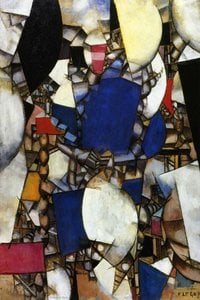
In the quiet dialogue between geometry and reality, Fernand Léger’s 1952 masterpiece, "The Two Women, Two Sisters," emerges as a profound meditation on the mid-century aesthetic. This striking black and white cubist composition transcends mere depiction; it is a carefully constructed encounter with the burgeoning sensibilities of an era defined by industrial progress. Unlike the Impressionists, who sought to capture the fleeting shimmer of light, or the Expressionists, who prioritized raw emotion, Léger deliberately stripped away the superfluous. He focused instead on the structural essence of his subjects—planes intersecting planes—to convey a sense of rhythmic dynamism that feels both ancient and modern.
The artwork immediately captivates the viewer with its bold simplification of figures and space. Within this monochrome universe, Léger utilizes a meticulous approach to texture and tone. Through a sophisticated etching process involving zinc plates treated with mordant, he achieved an exceptional level of tonal precision. This technique allows for subtle gradations of grey that are essential for conveying the interplay of light and shadow, giving the flat geometric shapes a sculptural weight that commands attention in any curated space.
The Dance of Geometry and Human Connection
At the heart of the composition stand two women, their postures subtly mirroring one another in a way that suggests a deep, intrinsic bond. This visual echo creates a sense of harmony amidst the fractured perspectives characteristic of Cubism. One woman wears an elongated necklace that serves as a vital visual anchor, drawing the eye upward and emphasizing the verticality of the canvas. This movement is complemented by the presence of smaller, secondary figures—a man to the left and another near the center—which layer the composition and suggest the bustling energy of an urban environment.
Léger’s genius lies in his ability to weave symbolic motifs into this mechanical landscape. A single apple rests prominently in the upper right corner, a recurring element in his oeuvre that symbolizes fertility and the organic cycle of life. This small, rounded form provides a soft counterpoint to the sharp, angular lines of the figures, reminding the observer of the enduring connection between humanity and the natural world even amidst the rise of the machine age. For the collector or interior designer, this tension between the organic and the industrial offers a sophisticated narrative depth that elevates a room from mere decoration to a space of intellectual inquiry.
An Enduring Legacy for the Modern Interior
To possess a reproduction of "The Two Women, Two Sisters" is to invite the spirit of the 20th-century avant-garde into one's home. Léger’s work, often characterized by his unique "tubism" and fascination with the mechanical, serves as a forerunner to Pop Art, making it remarkably versatile for contemporary decor. The stark, monochromatic palette allows this piece to integrate seamlessly into minimalist, industrial, or mid-century modern interiors, acting as a focal point that stimulates conversation without overwhelming the surrounding environment.
The emotional impact of the piece is one of structured tranquility. There is a rhythmic, almost musical quality to the way the shapes are arranged, providing a sense of order and strength. Whether viewed by an art historian or a lover of fine aesthetics, Léger’s ability to find beauty in the precision of form remains unparalleled. This artwork is not merely a window into the past; it is a timeless celebration of the resilience and elegance of the human form within a changing world.



 Aperçu en situation
 Passer au format impression
 Partager
 Partager
 Détails
 Guide
Guide

 Télécharger
 Articles similaires
 Radiographie
 Voir le diaporama
 Statistiques


 Afficher la suite






































 L'option verre n'est disponible que pour les dimensions inférieures à 110 cm.