A Symphony of Form and Color: The Modernist Vision of Fernand Léger
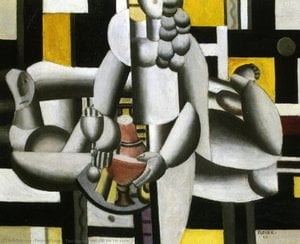
In the vibrant tapestry of early twentieth-century modernism, few works capture the rhythmic pulse of the machine age as evocatively as Fernand Léger’s "Postcard." Painted during his most prolific creative era between 1925 and 1930, this masterpiece serves as a profound meditation on the intersection of human tradition and technological progress. At first glance, the viewer is greeted by three women, poised in a moment of quiet contemplation as they hold books to their chests. Yet, beneath this serene surface lies Léger’s signature Tubism—a style that celebrates the beauty of cylindrical forms and the geometric precision of an industrializing world. The painting does not merely depict a scene; it constructs a visual language where the organic and the mechanical dance in a delicate, colorful equilibrium.
The technique employed by Léger is nothing short of transformative. While his contemporaries often retreated into pure abstraction, Léger utilized a sophisticated blend of Cubist fragmentation and bold, saturated color palettes to create an illusionistic depth that defies simple representation. The figures are rendered with simplified, almost sculptural shapes, yet they possess a weight and presence that feels remarkably tangible. Through masterful tonal modulation, he breathes life into the canvas, allowing light to play across the geometric planes of the women’s garments and the surrounding environment. This approach creates a sense of movement and vitality, making the artwork feel less like a static image and more like a living, breathing fragment of a modern metropolis.
Symbolism and the Harmony of Contrasts
Beyond its striking aesthetic, "Postcard" is rich with symbolic layers that invite deep intellectual engagement. Léger masterfully weaves elements of nature into an otherwise mechanized composition to suggest a world where progress and biology coexist. The inclusion of two birds—one soaring near the top left and another nestled toward the bottom right—acts as a poignant metaphor for freedom and the boundless aspirations of the human spirit. These organic flourishes are balanced by the presence of a potted plant, which embodies resilience and the enduring strength of life amidst the steel and stone of urban existence. Even the prominent clock positioned at the upper center serves as a silent narrator, reminding us of the relentless march of time that shapes both our personal histories and the evolution of art itself.
For the discerning collector or interior designer, this artwork offers more than just visual splendor; it provides an emotional anchor. The juxtaposition of the women’s intellectual pursuits—symbolized by their books—against a backdrop of industrial geometry creates a narrative of intellectual grace within a fast-paced world. It is a piece that commands attention in any sophisticated space, offering a sense of structured calm and historical depth. Whether placed in a contemporary gallery setting or a classic study, "Postcard" inspires a sense of wonder, reminding us that even in an age of machines, the human soul remains the ultimate architect of beauty.
Questions et réponses
Où puis-je trouver un guide pour « Postcard » ?
Une page Guide est disponible pour «Postcard» de Fernand Léger : une fiche d'information imprimable sur l'œuvre, conçue pour les étudiants et un usage pédagogique en classe.
Dans quel mouvement et à quelle époque s'inscrit «Postcard» de Fernand Léger ?
« Postcard » appartient au mouvement Geometric Abstraction, et son créateur a œuvré à l'époque Époque moderne.
Quelle émotion «Postcard» de Fernand Léger exprime-t-il au sein du mouvement Geometric Abstraction ?
L'émotion Reflective de « Postcard » accompagne son style Geometric Abstraction.



 Aperçu en situation
 Passer au format impression
 Partager
 Partager
 Détails
 Guide imprimable

 Télécharger
 Articles similaires
 Radiographie
 Voir le diaporama
 Statistiques

 Afficher la suite






































 L'option verre n'est disponible que pour les dimensions inférieures à 110 cm.