Une Intimité Silencieuse : Décryptage du Tableau « Anniversaire, Deux Femmes » de Léger
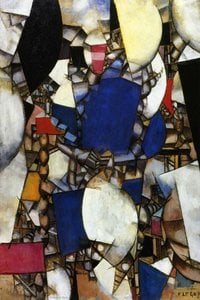
Fernand Léger's 1950 ink wash drawing, “Birthday, Two Women”, is a work that belies its modest dimensions. Measuring just 19 x 15 cm, it possesses an emotional weight and visual impact far exceeding its size. It’s not a grand statement of post-war optimism, nor a flamboyant display of artistic virtuosity; instead, it's a deeply personal exploration of human connection, rendered with the characteristic boldness and sensitivity that define Léger’s mature style. The artwork draws us into an intensely private moment, a glimpse of intimacy shared between two nude female figures locked in a close embrace. This isn’t a scene presented for voyeuristic pleasure; rather, it feels like stumbling upon something profoundly personal, a quiet exchange shielded from the outside world.
L'Évolution des Formes : Du Cubisme à Tubisme et Au-delà
Léger's artistic journey was one of constant evolution. Beginning with Impressionist leanings, he quickly became a pivotal figure in the development of Cubism, before forging his own distinct path with what came to be known as “Tubism.” In “Birthday, Two Women”, we see this legacy beautifully distilled. The figures are constructed not through realistic representation, but through simplified geometric forms – cylinders, cones, and planes interlock and overlap, creating a sense of volume and solidity without adhering to traditional perspective. This flattening of form isn’t merely stylistic; it intensifies the focus on the interplay between the bodies, emphasizing their physical connection and shared space. The deliberate cropping of the composition further enhances this effect, eliminating any distracting background elements and forcing the viewer to confront the raw emotional core of the scene. The technique itself – ink wash with visible brushwork – adds a dynamic texture, suggesting spontaneity and a gestural approach that belies the careful construction underlying the image. Bold lines convey urgency and emotion.
La Technique et l'Expression Emotionnelle
The artist’s masterful use of ink wash is paramount to understanding Léger’s vision. Visible brushstrokes contribute to the artwork’s tactile quality, mirroring the physicality of Léger’s early life spent in rural Normandy—a stark contrast to the industrialized future he sought to depict. The monochromatic background – a pale pink or lilac hue – serves as an anchor for the figures and amplifies their expressive power. Léger eschewed meticulous detail, prioritizing instead the conveyance of feeling through abstracted forms and bold lines. This deliberate simplification aligns with the principles of Cubism, where the essence of the subject is prioritized over accurate depiction. The resulting image exudes a palpable sense of vulnerability and intimacy—a testament to Léger’s ability to capture profound human emotion within a deceptively understated composition.
Un Contexte Historique et Symbolique Riche
Created in 1950, “Birthday, Two Women” emerged from the aftermath of World War II, reflecting a broader cultural preoccupation with themes of resilience and optimism. Léger’s Tubism style—characterized by geometric abstraction—represents a significant departure from traditional artistic conventions, mirroring the anxieties and aspirations of the era. The vase or pot held by the women symbolizes fertility and celebration – an element deeply rooted in humanist traditions. Furthermore, the cropped composition compels contemplation on the significance of human connection amidst the complexities of modern life. Léger’s work stands as a poignant reminder that beauty can be found even in moments of quiet solitude.
L'Impact Émotionnel et l'Éloge de la Simplicité
Ultimately, “Birthday, Two Women” transcends mere visual representation; it communicates an unspoken narrative of tenderness and companionship. Léger’s bold stylistic choices—flattened forms, expressive brushstrokes, and a muted color palette—invite viewers to engage with the artwork on an emotional level. It's a piece that speaks volumes without uttering a word, embodying Léger’s belief in the transformative power of art to illuminate the human condition. Like many works from his oeuvre, it celebrates the beauty inherent in everyday life – a legacy that continues to resonate with audiences today.



 Aperçu en situation
 Acheter la peinture faite à la main
 Partager
 Partager
 Détails

 Télécharger
 Articles similaires
 Radiographie
 Voir le diaporama
 Statistiques


 Afficher la suite






































 L'option verre n'est disponible que pour les dimensions inférieures à 110 cm.