
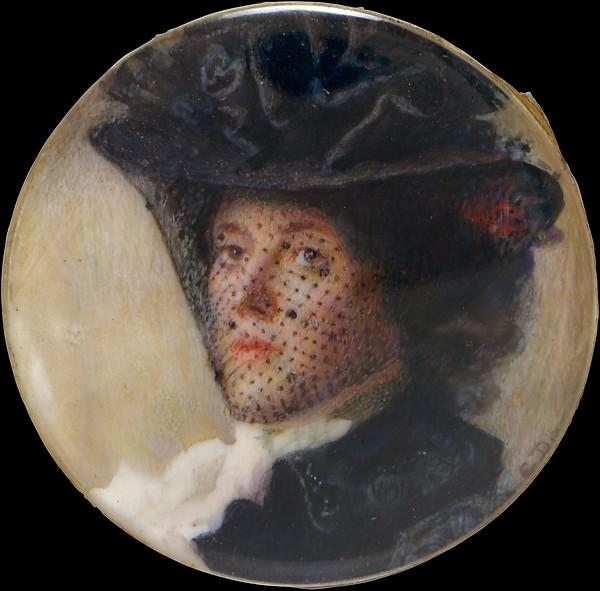
Mrs. Cox (1907) par Eulabee Dix, reproduction de peinture à l'huile réalisée à la main par un maître artiste
Aperçu en situation Visualiser en RA Passer au format impression Passer au format numérique Envoyer
Détails de l'œuvre Guide Ajouter aux favoris Télécharger l'image Articles similaires Radiographie Diaporama Questions et réponses Télécharger la présentation Statistiques

Mrs. Cox Reproduction de peinture à l'huile faite à la main

Eulabee Dix (1878-1961): Artiste américaine célèbre pour ses portraits miniatures sur ivoire, elle revitalisa l'art de la petite peinture au début du XXe siècle avec une précision et une sensibilité remarquables.

L’œuvre d'art présentée sur cette page est protégée par le droit d'auteur, ce qui signifie que nous ne pouvons légalement créer ou vendre de reproduction identique. Cette protection est appliquée en vertu d'accords internationaux tels que la Convention de Berne et par les lois nationales, notamment celles énoncées par le Loi américaine sur le droit d'auteur - Titre 17.

En tant qu'alternative respectueuse et légale, nous proposons des œuvres d'art personnalisées, peintes à la main et inspirées de l'original. Nos artistes talentueux et professionnels étudient avec soin le style, l'ambiance et l'essence artistique de l'œuvre originale pour créer une pièce nouvelle et unique qui évoque la même émotion — tout en restant une création originale en soi.

Cette méthode est pleinement conforme aux réglementations sur le droit d'auteur car elle ne repose pas sur la copie ou la duplication de l'œuvre protégée. Il s'agit plutôt d'une réinterprétation créative — une nouvelle peinture qui s'inspire de l'original sans pour autant lui être identique.

Reproduction à l'huile faite à la main

Huile sur toile peinte à la main, avec cadre et dimensions personnalisés, réalisée sur commande par nos artistes. ( Passer au format impression Passer au format numérique)

Format standard
sur mesure
CM
INCH

Choisissez parmi nos formats prédéfinis qui respectent les proportions originales de l’œuvre.

largeur
hauteur

Saisissez la largeur et la hauteur souhaitées, pour s'adapter à votre cadre ou à votre mur. Cette œuvre est peinte à la main ; ainsi, pour un format de forme différente, l'artiste peut peindre un peu plus autour du tableau ou réduire légèrement les bords — c'est vous qui choisissez. Nous vous envoyons une maquette numérique pour approbation avant que la peinture ne commence. L'image présentée sur cette page ne reflète pas le résultat réel — seule la maquette le fait.

Exemples de personnalisation possibles : remplacer un visage par la photo du client ; ajouter un animal de compagnie (par exemple, remplacer un chat par un chien) ; inclure un message caché en arrière-plan ; modifier le paysage ou les éléments de l'arrière-plan.
Après la commande, l’équipe WahooArt.com contactera le client par e-mail pour recueillir ses instructions et lui fournira une maquette d’aperçu

Livraison dans le monde entier () en 3 à 4 semaines au lieu des 5 semaines habituelles. (8 novembre). Aucun compromis sur la qualité.

Livraison express gratuite dans le monde entier
Toile de lin de qualité supérieure
Assurance transport complète
Garantie de remboursement des droits de douane
Garantie de fidélité des couleurs
Politique de retour de 100 jours (uniquement en cas de défaut)
Garantie de remboursement à 100%
Offre de tarifs dégressifs

Prix total

€ 243

Mrs. Cox

Technique de reproduction

Format de la reproduction

-

Prix total

€ 243


Biographie de l'artiste

A Delicate Revival: The Life and Art of Eulabee Dix

Eulabee Dix Becker, a name perhaps less instantly recognizable than those of her contemporaries, nevertheless occupies a significant place in the history of American art. Born in Greenfield, Illinois, in 1878, she emerged during a period ripe for rediscovery – a time when the exquisite intimacy of portrait miniatures was experiencing a remarkable resurgence. While larger-scale painting dominated the artistic landscape, Dix dedicated herself to this demanding and delicate craft, becoming one of its most celebrated practitioners. Her story is not merely that of an artist mastering technique; it’s a narrative interwoven with ambition, social navigation, and a determined pursuit of recognition in a world often resistant to female achievement. While larger-scale painting dominated the artistic landscape, Dix dedicated herself to this demanding and delicate craft, becoming one of its most celebrated practitioners. Her story is not merely that of an artist mastering technique; it’s a narrative interwoven with ambition, social navigation, and a determined pursuit of recognition in a world often resistant to female achievement.

Early Life and Artistic Beginnings

Dix's formative years were marked by considerable movement due to her father’s itinerant career as a traveling salesman—a circumstance that instilled within her an early resilience and adaptability. Recognizing her innate talent for art from a young age, her parents fostered her passions with encouragement and resources, providing the bedrock upon which her artistic journey would unfold. Her family relocated several times during her adolescence, reflecting the economic realities of the era but simultaneously exposing her to diverse cultural influences. Despite these challenges, Dix pursued formal training at Washington University in St. Louis and the St. Louis School of Fine Arts, where she quickly distinguished herself—earning accolades for her burgeoning talent and demonstrating a prodigious aptitude for observation and representation. The St. Louis School of Fine Art recognized her skill with two medals, validating her dedication to honing her craft.

New York Studies and Mastery of Miniature

The decisive step toward establishing herself as an artist occurred in 1899 when Dix moved to New York City—a move driven by a desire for advanced instruction and a yearning to immerse herself within the vibrant artistic milieu of the burgeoning metropolis. Initially drawn to William Merritt Chase’s focus on oil painting, she soon recognized that her artistic sensibilities leaned toward the more nuanced and intimate medium of watercolor on ivory. This realization led her to pursue further studies with George Bridgman at the Art Students League—a partnership that proved invaluable in refining her technique and deepening her understanding of anatomical representation. Crucially, Dix benefited from the mentorship of William J. Whittemore and Isaac A. Josephi—both founding members of the American Society of Miniature Painters (ASMP)—who instilled within her the meticulous precision required for mastering this exacting craft. Under their guidance, she honed her skills, achieving renown for her ability to capture subtle expressions and conveying profound emotion through miniature portraits.

European Influences and Recognition

Dix’s artistic vision extended beyond the confines of American art; she embraced the legacy of European masters—particularly the traditions of portraiture established by artists such as Rembrandt and Hals—drawing inspiration from their masterful use of light, shadow, and texture. Her travels to Europe provided her with firsthand exposure to historical miniatures, shaping her stylistic preferences and informing her artistic approach. This engagement with European art fostered a deep appreciation for craftsmanship and a commitment to capturing the essence of her subjects—a dedication that resonated throughout her oeuvre. She achieved considerable success abroad, securing solo exhibitions in London and garnering recognition at the Paris Salon in 1927—establishing herself as a respected artist on an international stage. Her reputation grew further when she was commissioned by prominent figures—including European nobility and celebrated actresses—who sought to immortalize their likenesses in exquisitely rendered miniatures.

A Legacy of Delicate Detail

Eulabee Dix’s contribution to the revival of miniature painting is undeniable—a testament to her unwavering commitment to technique, artistic sensitivity, and a profound understanding of human psychology. Her portraits are characterized by meticulous detail—each brushstroke carefully considered—and infused with an ethereal quality that transcends mere likeness. She excelled at capturing not only physical appearance but also inner character—revealing glimpses of personality and emotion through subtle gestures and expressions. Dix’s miniatures stand as enduring symbols of artistic excellence—a celebration of craftsmanship, observation, and the transformative power of art. Her legacy continues to inspire artists today—serving as a reminder that beauty can be found in the smallest of forms and that true artistry resides in capturing the essence of human experience with unwavering precision and compassion. Her dedication to detail and mastery of watercolor on ivory continue to inspire artists today.
Eulabee Dix

Eulabee Dix

1880 - 1961 , États-Unis d'Amérique

L'essentiel de l'artiste

  • Artistic Movement Or Style: Miniaturism, Watercolor
  • Artists Or Movements Influenced By This Artist: ['American miniaturists']
  • Artists Who Influenced This Artist:
    • William Merritt Chase
    • George Bridgman
  • Date Of Birth: October 5, 1878
  • Date Of Death: June 14, 1961
  • Full Name: Eulabee Dix Becker
  • Nationality: American
  • Notable Artworks:
    • Mrs. John Bertram
    • Woman on Bed
    • Mrs. James Cox
  • Place Of Birth: Greenfield, USA


































