Blue Trees: A Symphony of Color and Symbolism
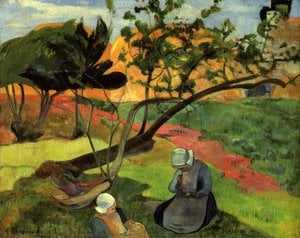
Paul Gauguin’s Blue Trees stands as a cornerstone of Post-Impressionist art, transcending mere representation to embody a profound exploration of emotion and spirituality. Created in 1888 during Gauguin’s formative years in Tahiti, this oil on canvas painting—measuring 92 x 73 cm and currently residing within The Ordrupgaard Collection—immediately captivates the viewer with its audacious palette and distinctive compositional choices.
The artist's stylistic approach leans heavily into Cloisonnism, a technique championed by Georges Seurat and others, prioritizing bold outlines and flattened planes of color. This deliberate simplification serves not to diminish the scene’s beauty but rather to heighten its expressive power, directing attention towards the dominant hues—deep blues and vibrant yellows—that dominate the canvas.
Composition and Technique
Gauguin meticulously crafted Blue Trees with a keen awareness of visual harmony. The towering blue trees—rendered in thick impasto—are juxtaposed against a warm sunset backdrop, creating a dynamic interplay between coolness and warmth. This careful arrangement reinforces the painting’s sense of balance while simultaneously conveying an underlying tension.
Furthermore, Gauguin employed a masterful use of color to imbue his artwork with emotional resonance. The yellows radiate optimism and vitality, contrasting sharply with the blues which evoke feelings of melancholy and contemplation. These colors are not merely decorative; they serve as conduits for expressing Gauguin’s inner state—a preoccupation with themes of solitude, faith, and the primal forces of nature.
Significance Within Post-Impressionism
Blue Trees represents a pivotal moment in the evolution of Post-Impressionism, marking a decisive break from Impressionistic realism. Gauguin’s artistic vision aligns with the broader movement's desire to delve into subjective experience and capture the essence of human emotion.
As evidenced by his other celebrated works—such as Dahlias and Mandolin and Les Alyscamps, Arles—available on https://WahooArt.com, Gauguin’s singular style and technique have exerted a lasting influence on subsequent generations of artists.
Ultimately, Blue Trees remains an enduring testament to Gauguin’s artistic genius—a captivating exploration of color, form, and emotion that continues to inspire awe and admiration.



 Aperçu en situation
 Acheter la peinture faite à la main
 Partager
 Partager
 Détails
 Guide
Guide

 Télécharger
 Articles similaires
 Radiographie
 Voir le diaporama
 Statistiques
 Afficher la suite






































 L'option verre n'est disponible que pour les dimensions inférieures à 110 cm.