Ernst Ludwig Kirchner : Vie et Héritage
Jeunesse et Formation
Ernst Ludwig Kirchner, figure centrale de l'Expressionnisme allemand, est né le 6 mai 1880 à Aschaffenburg, en Bavière. Son héritage prussien familial et la lignée huguenote de sa mère ont profondément façonné son identité artistique. Des déménagements fréquents pendant son enfance – dus à la recherche d'emploi par son père – ont conduit Kirchner à fréquenter des écoles à Francfort et Perlen avant de s'installer à Chemnitz lorsque son père a obtenu un poste au collège technique local.
En 1901, Kirchner commence ses études d'architecture à la Königliche Technische Hochschule (École Royale Technique) de Dresde. Cependant, il se dirige rapidement vers la peinture, trouvant l'inspiration dans les œuvres d'artistes comme Albrecht Dürer et développant une vision radicale de l'art aux côtés de son ami Fritz Bleyl.
La Formation du Die Brücke (Le Pont)
Un tournant dans la carrière de Kirchner survient en 1905 lorsqu'il cofonde Die Brücke (“Le Pont”) avec Bleyl, Karl Schmidt-Rottluff et Erich Heckel. Ce groupe visait à combler le fossé entre les styles académiques traditionnels et une forme d'expression plus moderne et chargée d'émotion. Ils ont cherché l'inspiration dans l'art primitif, en particulier de l'Afrique et de l'Océanie, ainsi que dans les œuvres de Vincent van Gogh et Edvard Munch.
Style Artistique et Caractéristiques Principales
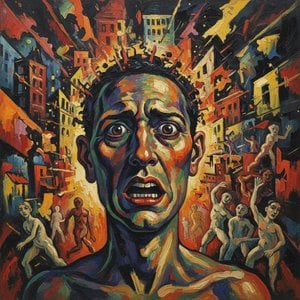
Le style artistique de Kirchner se caractérise par ses couleurs audacieuses, ses coups de pinceau expressifs et ses compositions souvent déconcertantes. Il représentait fréquemment des scènes urbaines, dépeignant l'aliénation et les angoisses de la vie moderne au début du XXe siècle en Allemagne. Son œuvre comprend également un nombre important de nus féminins dans des paysages naturels, mettant en valeur sa fascination pour le mouvement et la forme.
- Palettes de Couleurs Audacieuses : Kirchner employait des couleurs vibrantes, souvent non naturalistes, pour exprimer l'émotion.
- Travail du Pinceau Expressif : Ses coups de pinceau sont énergiques et visibles, contribuant à l'intensité émotionnelle globale de ses peintures.
- Formes Distordues : Les figures et les objets sont souvent déformés ou allongés, reflétant une réalité subjective plutôt qu'objective.
- Thèmes Urbains : De nombreuses œuvres représentent des rues animées et l’impact psychologique de la vie urbaine moderne.
Œuvres Majeures et Réalisations
Parmi les œuvres les plus notables de Kirchner, on trouve :
- La Rue (1908) – Une représentation emblématique de la vie dans les rues de Berlin, capturant son énergie et son aliénation.
- Danseuse Sautillante, Gret Palucca (1912) – Met en valeur son intérêt pour le mouvement expressif et la forme humaine.
- Autoportrait avec un modèle (1910) - Un exemple frappant de son auto-exploration à travers l'art.
- Cinq Femmes dans la Rue (1913)
Vie Tardive, Défis et Héritage
La vie de Kirchner a été marquée par des tourments personnels. Il a subi un effondrement mental pendant la Première Guerre mondiale et s'est ensuite retiré en Suisse. L'ascension du nazisme a apporté d'autres difficultés ; plus de 600 de ses œuvres ont été confisquées et qualifiées d'"art dégénéré". Confronté à la persécution et au déclin de sa santé, Kirchner s'est tragiquement suicidé à Davos, en Suisse, le 15 juin 1938.
Malgré cette fin tragique, l’héritage d’Ernst Ludwig Kirchner perdure. Il reste une figure centrale de l'Expressionnisme allemand, influençant des générations d'artistes par son style audacieux et ses représentations émotionnellement résonantes de la vie moderne. Son œuvre continue d'être exposée dans les principaux musées du monde et est très recherchée par les collectionneurs.
Influences & Impact
Influencé Par : Albrecht Dürer, Vincent van Gogh, Edvard Munch, Art Primitif (Africain & Océanien)
A Influencé : Le travail de Kirchner a profondément influencé les générations suivantes d'artistes expressionnistes et modernes. Son exploration des thèmes psychologiques et son utilisation innovante de la couleur et de la forme continuent d’inspirer les pratiques artistiques contemporaines.



 Aperçu en situation
 Passer au format impression
 Partager
 Partager
 Détails

 Télécharger
 Articles similaires
 Radiographie
 Voir le diaporama
 Statistiques


 Afficher la suite






































 L'option verre n'est disponible que pour les dimensions inférieures à 110 cm.