Aperçu en situation Aperçu en RA Passer au format impression Acheter la peinture faite à la main Partager
Détails Guide Ajouter aux favoris Télécharger Articles similaires Radiographie Voir le diaporama Statistiques

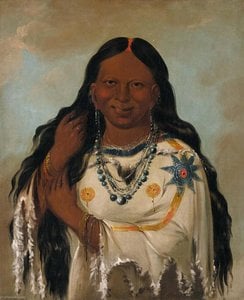
The Fur Traders

Discover "The Fur Traders" by Elizabeth Davey Lochrie – a stunning WPA mural depicting early Idaho trade & culture. Regionalist art, Native American themes, & historical significance.

Explorez l'art d'Elizabeth Davey Lochrie (1890-1981), peintre et muraliste américaine célèbre pour ses portraits, la vie amérindienne dans le Montana/Idaho et ses fresques WPA. Découvrez son style unique !

Acquérez une image numérique haute résolution et optimisée, d'une qualité bien supérieure à l'aperçu en ligne.

Chaque fichier est méticuleusement préparé par nos spécialistes internes à l'aide d'outils avancés et d'une retouche manuelle experte. Nous garantissons que chaque image possède une clarté exceptionnelle, une précision des couleurs irréprochable et un niveau de détail fin.

Le fichier final est livré par e-mail sous 72 heures, optimisé pour une utilisation immédiate dans des contextes professionnels, éditoriaux et d'impression. Il offre la même qualité de confiance que celle utilisée par les plus grands studios de création, éditeurs et galeries.

Image numérique

Téléchargez un fichier haute résolution pour votre usage personnel, l'impression et vos projets créatifs. ( Passer au format impression Acheter la peinture faite à la main)

Prix total

$ 24,90

Inclus avec chaque commande d'image numérique

Livraison numérique experte, garantie.

En choisissant WahooArt.com, vous n'obtenez pas seulement une simple image : vous recevez une œuvre numérique sublimée avec professionnalisme, conçue avec précision et accompagnée d'une garantie de satisfaction. Voici tout ce qui accompagne automatiquement votre commande :

shipping_icon
Livraison rapide par e-mail

Votre fichier d'image numérique haute résolution vous sera envoyé par e-mail sous 72 heures après votre commande — prêt à un usage immédiat.

canvas_icon
Fichier numérique optimisé par l'IA

Votre œuvre d'art bénéficie d'une optimisation professionnelle grâce à des outils d'IA avancés et une retouche manuelle, garantissant un niveau maximal de détail, de clarté et de fidélité chromatique.

insurance_icon
Réexpédition gratuite à vie

Vous avez accidentellement supprimé ou perdu votre fichier ? Pas d'inquiétude — nous vous le renverrons gratuitement, quand vous le souhaitez.

tax_icon
Aucuns frais de douane — À jamais

Profitez de votre œuvre d'art instantanément sans frais de douane ni de livraison — les téléchargements numériques sont toujours exonérés de taxes.

color_icon
Garantie de fidélité des couleurs

Nous garantissons que votre image numérique reproduit les couleurs de l'original aussi fidèlement que possible grâce à des outils professionnels et une gestion rigoureuse des couleurs.

return_icon
Garantie de satisfaction de 100 jours

Si vous n'êtes pas satisfait de votre image numérique, nous la retoucherons ou vous rembourserons 100% sous 100 jours — sans poser de questions.

guarantee_icon
Garantie de remboursement à 100%

Pas satisfait ? Obtenez un remboursement intégral dans les 100 jours suivant la réception de votre fichier numérique — sans aucune question posée.

discount_icon
Remises sur les commandes groupées

Achetez 3 images, économisez 10% - Achetez 5, économisez 15% - Achetez 10+, économisez 20%. Idéal pour les projets créatifs, les galeries et les agences.

Elizabeth Lochrie, born July 1, 1890 in Butte, Montana was the artist commissioned for the mural The Fur Traders located at the post office in the St. Anthony, Idaho. At a very early age Elizabeth’s artistic talents were evident to her mother, May Davey, an accomplished musician and teacher, and made every effort to ensure her daughter had a good education. Lochrie was also heavily influenced by her father Frank Davey, a civil engineer, who was adventurous in cultivating a personal relationship with area tribes like the Blackfeet, Lochrie would inherit both parental traits. Her formal artistic training began in 1903-1905 with Vonnie Owings, a local instructor who had studied in San Francisco and Chicago before returning to Deer Lodge, Montana to teach. Upon graduation from the Pratt Art Institute in Brooklyn, NY, in 1911, Elizabeth returned home to Montana to teach art and raise her family. Much of her early work consisted of commercial art for local publications, paintings of the never-ending mountainous terrain, and portraits of the Blackfeet tribal members she had come to revere. Although classically trained while at the Pratt Institute, returning to Montana would allow her to break away from the restraints of popular styles and develop her own style known as ’Regionalism,’ which focused on the common themes of industrial, social, and human development of the United States. In her later years she would continue to paint portraits of Native Americans and become a sought after lecturer regarding tribal histories and recognized for her philanthropic efforts in defense of them until her death in 1981.In the 1930’s, after already completing a series of murals commissioned by the State of Montana, she was invited by Department of Treasury to submit pieces of her work for inclusion in the WPA-era mural project, three of which are still on display in Idaho and Montana. The mural The Fur Traders is representative of Idaho’s first permanent American fur trading post, Ft. Henry, was established in 1810 on the Snake River near St. Anthony’s, also the site of the first annual rendezvous between traders and Indians in the region. The painting reflects one of the most important and early scenes defining relationships between Native people and those from European cultures; trade and the convergence of cultures. The main body of the painting is a scene familiar to the beginnings of the economic and social development of Idaho and Wyoming, focused on trade between the Natives American tribes in the area, most notably the Shoshone, and the mountain men or trappers.The Snake River Watershed runs east and west through parts of Wyoming, Montana, Idaho, Utah, Oregon, and Washington throughout the Great Basin culture area providing the nomadic Shoshone with an extensive trade network of different tribal groups and non-Indian traders. The Shoshone or “Snake” Indians were originally named for the shape of their riverine homelands and snake-like motion they made with their hand, representing the salmon in the river. Salmon, made up a large part of their diet, this hand signal distinguished individual bands they belonged to. The Shoshone have four different ways of differentiating themselves; the Agaidukas, the salmon eaters “lemhi Shoshone” of the Salmon/Snake River; the Pohgues, “People of the Sage” in the Fort Hall area and made up of Shoshone/Bannock mixed bloods; the Kogohues “Green River Shoshones” who are also mixed bloods, and the Tukadukas, or “sheep eaters,” who live in the mountains of the Teton and Yellowstone ranges. The Louisiana Purchase in 1803 extended the U.S. land base to Idaho resulting in the Lewis and Clark Expedition in 1804-1806 in an effort to navigating navigate the Missouri River to Oregon Territory and the Pacific Ocean. After the Lewis and Clark Expedition, other explorers like John Colter and Jedediah Smith came through the Teton and Yellowstone ranges opening the way for settlement across the mountain pass in the valleys of Fremont County, Idaho where St. Anthony is located. The European demand for beaver fur top hats expanded the fur trade to the point of animal extinction in areas like the Snake River area. The Treaty of 1818 opened British lands further into Oregon and Washington and exposed the territories for even more new economic opportunities of competing British and American interests. The Hudson Bay Company was ordered by the British crown to send out brigades of trappers known as Snake River Brigades to exhaust the animal populations and use natural boundaries, like the Rocky Mountains, to serve as a buffer to dissuade people from moving and settling into newly opened territory. By 1830s the demand for animal furs, beaver in particular, had dwindled in favor of the use of silk. In Hudson Bay Company’s drive to monopolize trade in the area they either built or bought-out other traders establishing forts all along the western end of the Oregon Trail following the Snake R../..

Biographie de l'artiste

Les années de formation et les racines académiques

Le voyage artistique d'Elizabeth Davey Lochrie fut une tapisserie profonde, tissée de fils de formation classique et d'une immersion culturelle intense. Née en 1890, son évolution en tant que peintre, sculptrée et muraliste commença loin des paysages sauvages qui allaient plus tard définir son âme. Grâce à ses études rigoureuses au prestigieux Pratt Institute de New York, elle fut guidée par des luminaires tels que Winold Reiss et Victor Arnautoff, des figures qui lui inculquèrent une maîtrise du portrait et un regard aiguisé sur la condition humaine. Ce socle académique, enrichi par son passage à l'Université de Stanford, lui apporta la discipline technique nécessaire pour passer du statut d'étudiante dévouée à celui de voix significative de l'art américain.

Les fresques de l'esprit américain

Durant une époque de profonde transformation nationale, Lochrie trouva sa véritable vocation au sein du Federal Art Project. En tant que membre de la Treasury Section of Fine Arts, elle contribua à la trame même de la vie civique américaine à travers ses fresques monumentales. Son travail dans l'Idaho — plus précisément à Burley et St. Anthony — témoigne de sa capacité à capturer l'essence d'une communauté. Dans le Montana, sa fresque News from the States, peinte pour le bureau de poste de Dillon, sert de chronique historique vibrante. Ces œuvres n'étaient pas de simples décorations ; elles étaient des fenêtres ouvertes sur l'existence quotidienne et l'esprit indomptable de la frontière occidentale, rendues avec une sensibilité qui honorait à la fois la terre et ses habitants.

Un lien sacré avec les Blackfeet

Le chapitre le plus transformateur de la vie de Lochrie survint peut-être en 1932, lorsque son regard artistique rencontra une connexion spirituelle profonde avec la Nation Blackfeet. Ce lien fut si puissant qu'elle fut formellement adoptée par la tribu, recevant le nom de Netchitaki, ce qui se traduit par « femme seule en chemin ». Cette identité a fondamentalement remodelé sa production créative. Ses œuvres ultérieures devinrent célèbres pour leurs portraits intimes et respectueux de la vie amérindienne, capturant la dignité, les traditions et les rythmes quotidiens des régions du Montana et de l'Idaho. À travers ses portraits, Lochrie a fait bien plus que documenter une culture ; elle a honoré un mode de vie, veillant à ce que les visages et les récits du peuple Blackfeet soient gravés dans l'histoire permanente de l'art américain.
Elizabeth Davey Lochrie

Elizabeth Davey Lochrie

1890 - 1981 , États-Unis d'Amérique

En bref

  • Artistic Movement Or Style: Peintre, sculptrice et muraliste
  • Artists Who Influenced This Artist:
    • Winold Reiss
    • Victor Arnautoff
  • Date Of Birth: 1er juillet 1890
  • Date Of Death: 17 mai 1981
  • Full Name: Elizabeth Davey Lochrie
  • Nationality: Américaine
  • Notable Artworks: ['News from the States']
  • Place Of Birth: Del Norte, USA