**Jeunesse et formation**
El Greco (Domenikos Theotokopoulos), un peintre, sculpteur et architecte grec renommé, est né en 1541 à Crète, alors sous domination vénitienne. Son nom de naissance était
Domenikos Theotokopoulos. La formation précoce d'El Greco en tant que peintre d'icônes de l'école crétoise, un centre majeur de l'art byzantin post-byzantin, a jeté les bases de ses futurs efforts artistiques.
**Évolution artistique et influences**
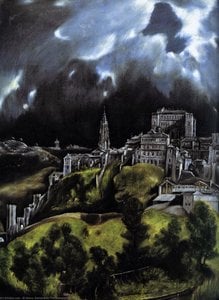
Le style artistique d'El Greco s'est façonné par ses voyages à Venise et Rome, où il a absorbé les styles maniéristes et du Renouveau, influencé notamment par Tintoret et Titien. Son déménagement à Tolède, en Espagne, en 1577 a marqué une période de création prolifique, donnant naissance à des chefs-d'œuvre tels que
La Vue de Tolède et
L'ouverture du cinquième sceau.
**Œuvres notables et style**
*
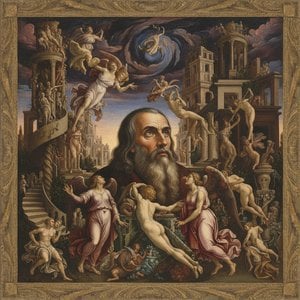
L'allégorie de l'ordre des Camalodites (méroristique, huile) - témoignant du mélange unique d'El Greco entre les traditions byzantines et les éléments stylistiques occidentaux. * Fable (méroristique, huile) – démontrant son utilisation de choix de couleurs vibrantes et inhabituels. *
Giacomo Bosio (méroristique, huile) – mettant en valeur la maîtrise d'El Greco du style méroptique.
**Héritage et influence**
Le style dramatique et expressionniste d'El Greco, caractérisé par des figures allongées et une pigmentation fantastique, a été une source d'inspiration pour les poètes et les écrivains. Il est considéré comme un précurseur de l'expressionnisme et du cubisme. Pour en savoir plus sur la vie et les œuvres d'El Greco, visitez [https://WahooArt.com/@/el-greco-(domenikos-theotokopoulos)](https://WahooArt.com/@/el-greco-(domenikos-theotokopoulos)).
- **Consultez les peintures d'El Greco** sur [https://WahooArt.com/@@/85fr95-el-greco-(domenikos-theotokopoulos)-allegory-of-the-camaldolite-order](https://WahooArt.com/@@/85fr95-el-greco-(domenikos-theotokopoulos)-allegory-of-the-camaldolite-order)
- **Apprenez-en davantage sur la vie et les œuvres d'El Greco** sur [https://en.wikipedia.org/wiki/el_greco](https://en.wikipedia.org/wiki/el_greco)
- **Explorez l'Institut hellénique des études byzantines et post-byzantines**, qui présente une large gamme d'artefacts reflétant le riche patrimoine artistique de Byzance, sur /fr/art/show/art-d3b8bv-fr/
**Le style innovant et le mélange idiosyncratique d'influences multiculturelles d'El Greco ont laissé une marque indélébile sur le monde de l'art.**



 Aperçu en situation
 Acheter la peinture faite à la main
 Partager
 Partager
 Détails

 Télécharger
 Articles similaires
 Radiographie
 Voir le diaporama
 Statistiques


 Afficher la suite






































 L'option verre n'est disponible que pour les dimensions inférieures à 110 cm.