Annunciation by El Greco
Doménikos Theotokópoulos, universally known as El Greco (meaning “The Greek”), stands as one of the most singular figures in the history of Western art. His dramatic and intensely emotional paintings transcended the boundaries between Renaissance and Baroque aesthetics while forging a distinctly personal artistic vision.
The Composition
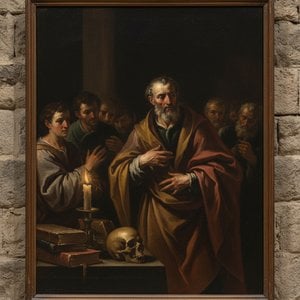
“Annunciation” by El Greco, created in 1568, is a tempera on panel artwork measuring 24 x 18 cm housed at the Galleria Estense in Modena, Italy. The painting depicts a pivotal religious scene: the Annunciation of Mary by the angel Gabriel. At the center of the composition sits Mary, seated at a table with her hands folded in prayerful contemplation—she listens intently to Gabriel’s divine message.
Around Mary and Gabriel are several other figures contributing to the artwork's intricate narrative. To Mary’s left stand two individuals, one positioned prominently near the upper right corner, while another occupies the lower right area. A fourth figure appears in the center-right section of the canvas. An ornate archway serves as a backdrop, amplifying the scene’s depth and adding to its visual richness.
Artistic Style
El Greco's style is characterized by dramatic elements that initially puzzled his contemporaries but garnered admiration in the 20th century. He achieved this distinctive aesthetic through a masterful blend of Byzantine traditions with Western painting techniques—a fusion that earned him recognition as an artist who defied conventional categorization.
His signature technique involved elongated figures, conveying movement and emotion with unprecedented expressiveness. Furthermore, El Greco employed vibrant pigmentation, departing from the muted palettes favored by his peers, creating a visual experience that captivated viewers. This stylistic boldness foreshadowed movements like Expressionism and Cubism, cementing El Greco’s place as an influential precursor to modern art.
El Greco's Life and Work
Born in Crete (then under Venetian rule) in 1541, El Greco honed his artistic skills within the Byzantine tradition. He traveled to Venice at age 26, immersing himself in the artistic fervor of the city and absorbing influences from Mannerism and the Venetian Renaissance.
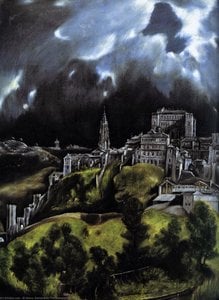
In 1577, he settled in Toledo, Spain, where he received substantial commissions and produced some of his most celebrated works—including “View of Toledo” and “Opening of the Fifth Seal.” These paintings exemplify El Greco’s ability to convey profound spiritual themes with breathtaking visual impact.
Relevance to Modern Art Movements
El Greco's oeuvre has served as inspiration for poets and writers such as Rainer Maria Rilke and Nikos Kazantzakis. His stylistic innovations—particularly the elongated figures and expressive coloration—anticipated developments in Expressionism and Cubism, establishing him as a pivotal figure in shaping the trajectory of modern art.
For those seeking to explore El Greco’s artistic legacy further, we invite you to visit Painting by 'El Greco (Doménikos Theotokopoulos)' | El Greco (Doménikos Theotokopoulos):Annunciation on WahooArt.com.
To delve deeper into El Greco’s life and artistic journey, consult El Greco on Wikipedia.
Questions et réponses
Quelle est la forme de «Annunciatio» de Él Greco et quelles sont ses dimensions ?
«Annunciatio» de Él Greco est une composition en Portrait mesurant 24 x 18 cm dans l'original.
Quelle harmonie de couleurs «Annunciatio» de Él Greco présente-t-il ?
«Annunciatio» de Él Greco présente une harmonie de couleurs Forte unité chromatique.
«Annunciatio» de Él Greco fait-il partie des œuvres Other les plus recherchées ?
Au sein du mouvement Other, « Annunciatio » affiche un niveau de popularité Iconique.
Quel type d'œuvre d'art est «Annunciatio» de Él Greco ?
Dans le catalogue, «Annunciatio» de Él Greco est répertorié comme Art mural. Cette catégorie permet de trouver des œuvres similaires.
Quelle est la technique et les dimensions de «Annunciatio» de Él Greco ?
La technique de «Annunciatio» de Él Greco est Acrylique sur toile, et ses dimensions sont de 24 x 18 cm.
Quelle est l'atmosphère générale de «Annunciatio» de Él Greco ?
«Annunciatio» dégage une atmosphère Dramatique.
L'œuvre « Annunciatio » se trouve-t-elle dans le pays de son créateur ?
Non - l'œuvre est conservée à l'étranger. L'artiste est né en Grèce ; l'œuvre originale se trouve en Italie.
«Annunciatio» est-il l'une des œuvres les plus populaires de Él Greco ?
« Annunciatio » est classé comme Iconique.



 Aperçu en situation
 Acheter la peinture faite à la main
 Partager
 Partager
 Détails
 Guide imprimable

 Télécharger
 Articles similaires
 Radiographie
 Voir le diaporama
 Statistiques


 Afficher la suite






































 L'option verre n'est disponible que pour les dimensions inférieures à 110 cm.