A Fragment of Intensity: Examining Egon Schiele’s ‘Poem’
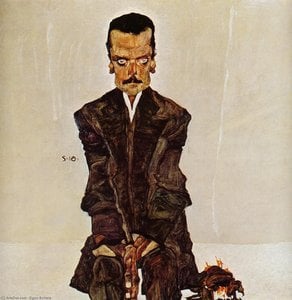
Egon Schiele’s “Poem,” completed in 1910, stands as a deceptively simple yet profoundly resonant testament to the artist's signature style and his preoccupation with themes of vulnerability and unspoken emotion. This unassuming watercolor—measuring 29 x 19 cm—captures a moment frozen in time: a sheet of paper bearing handwritten words, rendered in muted tones that amplify rather than diminish their impact.
The photograph itself presents a deliberate ambiguity. The blurry texture of the paper suggests age and preservation, hinting at a history unseen but felt nonetheless. It’s not merely an image of text; it's an emblem of communication—or perhaps its absence—a subtle invitation to contemplate what lies beneath the surface.
The Expressionist Palette: Technique and Style
- Watercolor Medium: Schiele favored watercolor for its ability to achieve delicate gradations of color and luminosity, qualities perfectly suited to conveying psychological states. Unlike oil paints which offer bolder hues and textural richness, watercolor allows for a softer, more ethereal quality that mirrors the artist’s introspective gaze.
- Linear Emphasis: Characteristic of Schiele's oeuvre is his masterful use of line—thick, agitated strokes that delineate forms with unsettling precision. These lines aren’t merely descriptive; they embody movement and tension, mirroring the inner turmoil he sought to express.
- Monochromatic Undertones: Despite its apparent simplicity, “Poem” employs a carefully considered monochromatic palette dominated by shades of grey and brown. This deliberate restraint serves to heighten the emotional intensity of the piece, focusing attention on the contours of the paper and the subtle nuances of light and shadow.
Historical Context: Vienna’s Artistic Crucible
Schiele's work emerged during Vienna’s vibrant artistic milieu—a period marked by experimentation and a fervent embrace of Expressionism. Influenced heavily by Gustav Klimt, Schiele wrestled with anxieties surrounding sexuality, mortality, and the human condition. The painting reflects this broader cultural preoccupation with confronting uncomfortable truths about existence.
Vienna at the turn of the century was undergoing rapid social change—industrialization, urbanization, and burgeoning intellectual currents challenged traditional values. Artists like Schiele responded to these shifts by rejecting academic conventions in favor of emotionally charged imagery that prioritized subjective experience over objective representation. “Poem” embodies this spirit of rebellion against established norms.
Symbolism Beyond the Surface: The Weight of Words
The handwritten words on the paper are deliberately obscured, adding another layer of complexity to the artwork’s symbolic significance. They represent unspoken thoughts—perhaps desires, fears, or confessions—that remain hidden from view. This deliberate concealment underscores Schiele's fascination with psychological depth and his ability to convey emotion through visual suggestion.
The paper itself serves as a metaphor for fragility—a vulnerable surface bearing the marks of time and experience. Like Schiele’s own life, “Poem” confronts us with the inevitability of decay and loss, prompting contemplation on the ephemeral nature of beauty and consciousness. It's a piece that lingers in the mind long after viewing, inviting repeated observation and rewarding careful consideration.
Questions et réponses
À quel âge Egon Schiele a-t-il créé « Poème » ?
Egon Schiele a réalisé « Poème » à l'âge de 20. L'artiste est né en 1890 et l'œuvre date de 1910.
Quelle est la saturation des couleurs de «Poème» de Egon Schiele ?
Les couleurs de «Poème» de Egon Schiele présentent une saturation Désaturé. La saturation décrit si les couleurs sont vives ou atténuées.
À quelle période de la carrière de Egon Schiele appartient « Poème » ?
«Poème» appartient à la période Mature Period de la carrière de Egon Schiele. Cette classification relie l'œuvre à l'évolution de l'artiste.



 Aperçu en situation
 Acheter la peinture faite à la main
 Partager
 Partager
 Détails
 Guide imprimable

 Télécharger
 Articles similaires
 Radiographie
 Voir le diaporama
 Statistiques


 Afficher la suite






































 L'option verre n'est disponible que pour les dimensions inférieures à 110 cm.