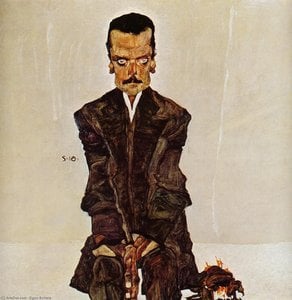
Dead Mother: A Portrait of Grief and Decay
Egon Schiele’s “Dead Mother,” completed in 1910, stands as one of the artist's most hauntingly beautiful and psychologically complex works—a testament to his mastery of Expressionist technique and a profound exploration of themes surrounding mortality and maternal love. This oil on panel painting immediately confronts the viewer with an unsettling juxtaposition: a woman’s lifeless body lies prone upon a dark bed, while her child clings desperately to her hand, bathed in an eerie luminescence. It's a scene that transcends mere depiction; it embodies palpable sorrow and speaks volumes about the fragility of life itself.
Stylistic Innovation and Expressionist Influence
Schiele’s style is undeniably rooted in Expressionism, a movement born from the turbulent artistic landscape of early 20th century Vienna. Influenced by Gustav Klimt's opulent ornamentation and Vincent van Gogh’s vibrant brushstrokes—as well as Edvard Munch’s visceral depiction of anxiety—Schiele rejected academic conventions in favor of raw emotion and distorted forms. The painting’s distinctive lines, characterized by jagged contours and restless energy, convey a sense of unease and instability. Color is employed sparingly but powerfully; the muted palette – dominated by browns, blacks, and pale yellows – contributes to the overall atmosphere of decay and despair. Schiele's meticulous attention to detail—particularly in rendering the textures of skin and fabric—further enhances the painting’s impact.
Symbolism: Blood, Light, and Maternal Sacrifice
“Dead Mother” is laden with symbolic significance. The prominent depiction of blood emanating from the woman’s mouth isn’t merely gruesome; it represents vitality drained away – a poignant reminder of life's inevitable end. Simultaneously, the child’s radiant luminescence symbolizes hope amidst darkness—a fragile assertion of life persisting despite overwhelming grief. Schiele deliberately positions the figures in an embrace that conveys both vulnerability and defiance. The woman’s slumped posture suggests defeat, while her hand gripping the child signifies a desperate attempt to protect him from oblivion. This gesture is fraught with emotion: it speaks to the profound sorrow of loss and the agonizing dilemma faced by mothers who must confront their own mortality while safeguarding their offspring's future.
Historical Context and Artistic Legacy
The painting emerged during a period marked by significant artistic experimentation and intellectual ferment—the dawn of Expressionism challenged traditional aesthetic ideals, prioritizing emotional truth over formal beauty. Schiele’s unflinching portrayal of human suffering resonated deeply with contemporaries grappling with anxieties about the changing world. His work continues to captivate audiences today, prompting contemplation on themes of grief, vulnerability, and the enduring power of maternal love. Reproductions of “Dead Mother” offer a unique opportunity to experience Schiele's artistic vision—a masterpiece that transcends time and speaks directly to the human condition.
To explore more about Egon Schiele’s oeuvre or discover similar artworks, consider visiting the Österreichische Galerie Belvedere in Vienna, Austria, where you can immerse yourself in the rich tapestry of Austrian art history. Alternatively, delve into the Leopold Museum's collection—a treasure trove showcasing Schiele alongside other prominent Expressionist artists. And for inspiration and insight into artistic techniques, consult “Light in Painting”—a fascinating exploration of how light shapes visual perception and contributes to the emotional impact of artworks. Finally, don’t hesitate to visit WahooArt.com to commission a stunning handmade oil painting reproduction of “Dead Mother” – bringing Schiele's evocative artistry into your home.
Questions et réponses
Quelle taille et quel format sont recommandés pour un tirage de «Dead Mother» de Egon Schiele ?
Format Grand format, orientation Format portrait : voici la configuration d'impression suggérée pour «Dead Mother» de Egon Schiele.
Dans quelle pièce recommanderiez-vous d'exposer «Dead Mother» de Egon Schiele ?
Une reproduction de « Dead Mother » s'intègre parfaitement dans une Salon.
Quelle technique a été utilisée pour « Dead Mother » et quand cette œuvre a-t-elle été créée ?
« Dead Mother » a été réalisé en 1910 selon la technique du Acrylique sur toile. Le matériau et la date précisent comment et quand l'œuvre originale a été créée.



 Aperçu en situation
 Commander la reproduction peinte à la main
 Envoyer
 Partager
 Détails de l'œuvre
 Guide
Guide

 Télécharger l'image
 Articles similaires
 Radiographie
 Diaporama
 Q&A
Q&A Statistiques

 Lire la suite






































 L'option verre n'est disponible que pour les dimensions inférieures à 110 cm.