


x

 Commander la reproduction Acheter l'image haute résolution
 Partager
 Details
 Ajouter aux favoris
 Télécharger
 Articles similaires
 X-Ray
X-Ray
 Diaporama
Impression giclée ou sur toile de qualité musée, avec une production rapide et des finitions au choix.





























Choisissez parmi nos formats prédéfinis qui respectent les proportions originales de l’œuvre.

Vous pouvez saisir vos propres dimensions pour vous adapter à un cadre ou à un espace spécifique. Si la taille sélectionnée ne correspond pas aux proportions de l'image originale, nous recadrerons l'œuvre ou étendrons l'image avec une bordure en miroir ou une couleur unie. Une maquette numérique vous sera envoyée pour approbation avant le début de la production.
Veuillez noter que l'aperçu à l'écran ne reflète pas le recadrage ou l'extension réelle. Seule la maquette montrera avec précision la composition finale.
Bien que des tailles personnalisées soient disponibles, nous vous recommandons de choisir une dimension dans la liste prédéfinie afin de préserver les proportions originales.
Livraison dans le monde entier () en 2 semaines au lieu des 4/5 semaines habituelles. (2 juillet)


Danae
Format de reproduction
Egon Schiele's "Danae," painted in 1909, is not merely a depiction of a reclining woman; it’s a profoundly unsettling exploration of vulnerability, desire, and the encroaching shadow of mortality – hallmarks of the artist’s intensely personal and emotionally charged style. The painting immediately draws the viewer into a scene of quiet intimacy, yet beneath this surface lies a palpable sense of unease, reflecting Schiele's own struggles with illness, loss, and his deeply ambivalent relationship with the female form.
At first glance, the composition appears deceptively simple. A young woman, identified as Danae from Greek mythology – a figure seduced and ultimately slain by Zeus in the guise of a shower of gold – lies languidly on her side, her head nestled within the lap of an unseen male figure. The setting is ambiguous, suggesting a sheltered outdoor space, perhaps a forest clearing, lending an air of both seclusion and vulnerability to the scene. However, Schiele’s masterful use of line and color immediately elevates the work beyond a straightforward portrait. His lines are not smooth or comforting; they are jagged, restless, and imbued with a nervous energy that mirrors the subject's internal state.
Schiele’s technique is characterized by his distinctive, almost frantic use of line. He employs short, broken strokes to build up form, creating an effect of immediacy and raw emotion. The color palette is muted – predominantly earthy browns, ochres, and a subtle blush of pink – contributing to the painting's somber mood. Yet, within this restrained palette, Schiele introduces flashes of vibrant red in the woman’s garment, drawing attention to her exposed skin and subtly hinting at the source of her vulnerability: the impending threat of unwanted desire.
The figure of Danae herself is rendered with a remarkable sensitivity. Her face is partially obscured, adding to the sense of mystery and suggesting a hidden sadness or resignation. Her body is slightly elongated, almost skeletal in its fragility, emphasizing her physical vulnerability. The way Schiele captures the subtle curves of her limbs and the delicate texture of her skin speaks volumes about his acute observational skills and his ability to convey profound emotion through simple gestures.
"Danae" is deeply rooted in Greek mythology, but Schiele transforms the traditional narrative into something far more personal. The myth of Danae represents betrayal, loss, and ultimately, a tragic fate. Schiele’s painting doesn't glorify the seduction; instead, it focuses on the aftermath – the quiet despair and the lingering sense of violation. It is widely believed that Schiele was inspired by his own difficult relationship with women, particularly his sister Gerti, and this personal turmoil undoubtedly informs the painting’s unsettling atmosphere.
Furthermore, the presence of birds scattered throughout the composition adds another layer of complexity. Birds are often associated with freedom and transcendence in art, but here they seem trapped or watchful, perhaps mirroring Danae's own sense of confinement and vulnerability. They could also be interpreted as symbols of impending doom, foreshadowing her tragic end.
“Danae” is a powerfully evocative work that reveals the depth of Egon Schiele’s artistic vision. It's a testament to his ability to capture not just physical likeness but also the complex emotions and psychological states of his subjects. The painting’s enduring power lies in its unflinching honesty, its willingness to confront uncomfortable truths about desire, vulnerability, and mortality. Reproductions of this haunting masterpiece offer a unique opportunity to experience Schiele's intensely personal style and gain insight into the mind of one of Expressionism’s most tormented and brilliant artists.


1890 - 1918 , Croatie
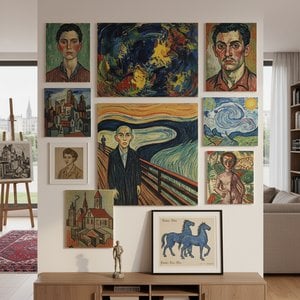
Plongez au cœur de l'Expressionnisme avec les 10 œuvres majeures qui ont marqué ce mouvement puissant. Découvrez Munch, Kirchner, Kandinsky et plus encore. Reproductions d'art de qualité muséale sur – Explorez la collection !
Commandez un portrait à l'huile personnalisé réalisé par des artistes experts. Immortalisez vos souvenirs avec une œuvre d'art unique et de qualité musée. Cadeau original & luxe garanti.

Explorez l'histoire fascinante de l'introspection en peinture ! Découvrez comment les artistes, de Rembrandt aux expressionnistes, ont utilisé l'autoportrait pour révéler leur monde intérieur. Analyse approfondie et reproductions d'exception sur WahooArt.
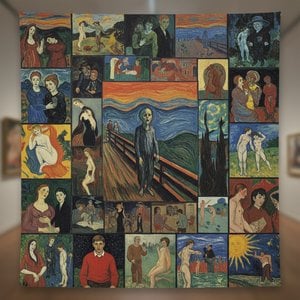
Plongez au cœur de l'univers d'Edvard Munch avec 25 chefs-d’œuvre emblématiques. Explorez les émotions intenses, les couleurs sombres et le symbolisme unique de cet artiste visionnaire. Découvrez des reproductions de qualité musée sur WahooArt.com.

Explorez l'univers poignant d'Egon Schiele : expressionnisme, angoisse et condition humaine. Analyse approfondie de son œuvre, son contexte viennois et son héritage artistique. Découvrez un artiste majeur avec WahooArt.


Restez informé(e) des dernières actualités artistiques, des offres exclusives et des idées de décoration.
Parlez-nous de votre projet et nos experts en art vous proposeront 3 suggestions d'œuvres personnalisées.
Laissez-nous sélectionner 3 œuvres rien que pour vous – Gratuit !

 Partager


 Afficher la suite







 L'option verre n'est disponible que pour les dimensions inférieures à 110 cm.


