Aperçu en situationAperçu en situation Visualiser en RAVisualiser en RA Commander la reproduction peinte à la main Commander la reproduction peinte à la mainPasser à l'image numérique Passer à l'image numérique EnvoyerEnvoyer
Détails de l'œuvreDétails de l'œuvre Ajouter aux favoris Ajouter aux favoris TéléchargerTélécharger Articles similairesArticles similaires RadiographieRadiographie DiaporamaDiaporama StatistiquesStatistiques

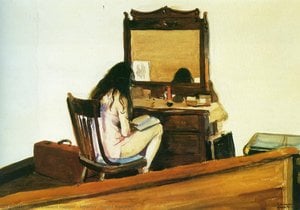
Sunlights in Cafeteria

Edward Hopper's 'Sunlight in a Cafeteria' (1958) captures urban solitude and quiet tension with masterful light & shadow. Explore American Realism’s evocative depiction of modern life – perfect for art lovers.

Explorez les peintures réalistes américaines emblématiques d'Edward Hopper (1882-1967). Connu pour ses scènes urbaines et rurales évocatrices, son utilisation magistrale de la lumière et ses thèmes de solitude et de vie moderne. Découvrez 'House by the Railroad' et bien plus encore chez WahooArt.

Giclées et impressions d'art

Impressions giclées ou sur toile de qualité musée, avec une production rapide et des finitions au choix. (Commander la reproduction peinte à la main Commander la reproduction peinte à la mainPasser à l'image numérique Passer à l'image numérique)

P118B $10
P118H $10
P118W $10
P438Z $10
P508JH $12
P508YH $12
P805H $10
P805Z $10
P919BZ $10
P919G $10
P919XJ $10
P959ZH $10
P968JZ $12
W106C $8
W218G $10
W218JH $8
W218Y $10
W307PJ $10
W316G $10
W316PJ $8
W316Y $10
W398PJ $8
W4111J $10
W500HY $15
W500JH $15
W692G $12
W849H $8
W940BG $15
W953PJ $8

Format standard
personnalisé
CM
INCH

Choisissez parmi nos formats prédéfinis qui respectent les proportions originales de l’œuvre.

largeur
hauteur

Vous pouvez saisir vos propres dimensions pour vous adapter à un cadre ou à un espace spécifique. Si la taille sélectionnée ne correspond pas aux proportions de l'image originale, nous recadrerons l'œuvre ou étendrons l'image avec une bordure en miroir ou une couleur unie. Une maquette numérique vous sera envoyée pour approbation avant le début de la production.
Veuillez noter que l'aperçu à l'écran ne reflète pas le recadrage ou l'extension réelle. Seule la maquette montrera avec précision la composition finale.
Bien que des tailles personnalisées soient disponibles, nous vous recommandons de choisir une dimension dans la liste prédéfinie afin de préserver les proportions originales.

Livraison dans le monde entier () en 2 semaines au lieu des 4/5 semaines habituelles. (10 septembre)

why_choose_icon
Livraison express gratuite dans le monde entier
why_choose_icon
Toile de lin de haute qualité
why_choose_icon
Assurance transport complète
why_choose_icon
Garantie de remboursement des droits de douane
why_choose_icon
Garantie de fidélité des couleurs
why_choose_icon
Garantie de retour de 100 jours (uniquement en cas de défaut)
why_choose_icon
Garantie de remboursement à 100%
why_choose_icon
Tarifs dégressifs sur quantité

Prix total

$ 68

reproduction

Sunlights in Cafeteria

Giclées et impressions d'art

Format de la reproduction

-

Prix total final

$ 68

Informations clés

  • Subject or theme: Cafeteria scene
  • Artistic style: Realist, Melancholy
  • Year: 1958
  • Influences: Hemingway
  • Medium: Oil on canvas
  • Movement: American Realism
  • Title: Sunlight in a Cafeteria

Quiz d'art

Chaque question ne comporte qu'une seule bonne réponse.

Question 1:
What is the primary subject of Edward Hopper’s ‘Sunlight in a Cafeteria’?
Question 2:
The painting ‘Sunlight in a Cafeteria’ is primarily associated with which art movement?
Question 3:
What does the lighting in ‘Sunlight in a Cafeteria’ primarily suggest?
Question 4:
Edward Hopper was born in which city?
Question 5:
The painting ‘Sunlight in a Cafeteria’ was created in which year?

A Moment Frozen: The Poignant Realism of *Sunlight in a Cafeteria*

Edward Hopper's 1958 painting, *Sunlight in a Cafeteria*, isn’t merely a depiction of a diner scene; it’s a distilled essence of modern American loneliness. Captured with his signature mastery of light and shadow, the work transports us to a quiet corner of urban life, where unspoken anxieties and the subtle dance between strangers hang heavy in the air. The painting immediately draws the eye – not towards grand spectacle or dramatic action, but toward the carefully constructed stillness of the interior, bathed in the warm, diffused glow of afternoon sunlight streaming through the large window. Hopper’s deliberate choice to frame the scene through this glass creates a sense of voyeurism, inviting us into a private moment that we are both observers and, perhaps, subtly implicated within.

The composition itself is deceptively simple yet profoundly effective. A man and a woman occupy separate tables, their postures suggesting an awareness of each other’s presence without any overt interaction. The man, clad in a dark suit and holding a cigarette, gazes out the window – a gesture that simultaneously conveys contemplation and detachment. His back is turned to the woman, who sits quietly, her attention focused on a sandwich, her hands folded neatly in her lap. This arrangement immediately establishes a palpable tension—a feeling of potential connection thwarted by an unspoken barrier. Hopper’s use of color further amplifies this mood; the warm yellows and browns of the diner contrast sharply with the cooler tones of the street outside, reinforcing the sense of isolation within the brightly lit space.

The Language of Light and Shadow: Hopper's Technique

Hopper’s technical skill is paramount to the painting’s impact. He was a master of capturing the subtle nuances of light, using it not just to illuminate form but also to evoke mood and atmosphere. Notice how he renders the sunlight – not as a harsh, direct beam, but as a diffused glow that softens edges and casts long shadows. This technique creates a sense of depth and realism while simultaneously contributing to the painting’s melancholic tone. The meticulous detail with which Hopper depicts the diner's interior—the chrome accents, the checkered floor, the worn wood of the tables—adds to the feeling of authenticity and invites us to linger in this carefully constructed world.

Furthermore, Hopper’s use of perspective is particularly noteworthy. The slightly skewed angles of the furniture and the placement of the figures create a sense of unease and disorientation, mirroring the emotional state of the subjects themselves. He employed a technique known as “atmospheric perspective,” subtly blurring details in the distance to suggest depth and recession, further enhancing the painting’s realism and drawing the viewer into the scene.

Echoes of Isolation: Context and Symbolism

*Sunlight in a Cafeteria* is deeply rooted in Hopper's broader exploration of American loneliness and urban alienation. Born in 1882, Hopper witnessed significant social and cultural shifts during his lifetime – the rise of industrialization, urbanization, and the increasing sense of anonymity in modern life. His paintings often reflect these anxieties, portraying individuals adrift in vast cities, struggling to connect with one another. This painting is part of a larger body of work that examines the quiet desperation of the American experience.

The diner itself becomes a potent symbol—a temporary refuge from the outside world, yet also a space of isolation and detachment. It’s a place where strangers briefly encounter one another, but rarely forge lasting connections. The painting's title, *Sunlight in a Cafeteria*, is particularly evocative, suggesting both warmth and an underlying sense of melancholy—a reminder that even in the brightest light, loneliness can persist.

A Timeless Masterpiece: Reproduction and Beyond

WahooArt offers meticulously crafted hand-painted reproductions of *Sunlight in a Cafeteria*, allowing you to bring this iconic work into your home or office. Our artists replicate Hopper’s masterful use of light, shadow, and composition with exceptional detail, ensuring that the painting's emotional impact is fully preserved. Whether you are an art collector, an interior designer seeking to create a sophisticated atmosphere, or simply someone who appreciates the beauty of American realism, a WahooArt reproduction of *Sunlight in a Cafeteria* is a timeless addition to any collection. Explore our gallery today and discover the perfect way to experience this poignant masterpiece.


Biographie de l'artiste

**jeunesse et influences**

Edward Hopper, peintre et graveur américain réaliste de premier plan, est né le 22 juillet 1882 à Upper Nyack, New York. Sa famille, d'ascendance principalement néerlandaise, lui a offert une éducation confortable qui lui a permis de poursuivre ses inclinations artistiques dès son plus jeune âge. - **inspirations :** L’œuvre de Hopper a été influencée par les écrits de Ralph Waldo Emerson et des maîtres impressionnistes français Édouard Manet et Edgar Degas. - **formation précoce :** Il a commencé à étudier l'art grâce à un cours par correspondance en 1899, puis est passé à l’École d'Art et de Conception de New York.

**style artistique et thèmes**

Edward Hopper's rendus sobres et soigneusement calculés reflétaient sa vision personnelle de la vie américaine moderne. Son travail peut être caractérisé par : - **scènes urbaines et rurales :** Les deux ensembles étaient dépeints avec un mélange unique de réalisme et d’émotion profonde. - **lumière :** Maîtrise de la lumière, souvent utilisée pour évoquer des sentiments d'isolement ou de contemplation. - **figures :** Souvent sans visage ou en arrière-plan, mettant l'accent sur l'environnement plutôt que sur les figures.

**œuvres notables et leur signification**

- House by the Railroad (Musée d'Art Moderne, New York, États-Unis), un exemple de la capacité de Hopper à évoquer un sentiment de mélancolie grâce à une composition simple mais puissante. - Reclining Nude (50 x 35 cm, Nouveau Réalisme, aquarelle), mettant en valeur sa versatilité pour capturer la forme humaine.

**Héritage et influence**

- **Influence sur les artistes futurs :** Le style unique de Hopper a influencé de nombreux artistes, dont Pierre Sanford Ross, connu pour ses scènes urbaines et rurales. - **Popularité durable :** Ses œuvres continuent de captiver le public par leurs thèmes intemporels de solitude et de la condition humaine.

**Explorez davantage sur WahooArt**

- [https://WahooArt.com/@/edward-hopper](Œuvres d'Edward Hopper) - /fr/art/show/art-8xyffg-fr/Achetez de l'art inspiré par les maîtres]
  • Plongez dans le monde de l'art grâce à la vaste collection de WahooArt.
  • Découvrez comment l'héritage d' Edward Hopper continue d'inspirer les artistes et les amateurs d'art.

**Références**

- [https://WahooArt.com/@/edward-hopper](Wikipedia : Edward Hopper) - [https://en.wikipedia.org/wiki/edward_hopper](Biographie d'Edward Hopper sur Wikipédia)
Edward Hopper

Edward Hopper

1931 - 1967 , États-Unis d'Amérique

En bref

  • Artistes Influents:
    • Ralph Waldo Emerson
    • Édouard Manet
    • Edgar Degas
  • Date De Décès: 1967
  • Date De Naissance: 22 juillet 1882
  • Influence Sur Les Artistes: ['Pierre Sanford Ross']
  • Lieu De Naissance: Upper Nyack, États-Unis
  • Nationalité: Américaine
  • Nom Complet: Edward Hopper
  • Oeuvres Notables:
    • House by the Railroad
    • Nighthawks
    • Gas
    • Chop Suey
    • Summertime
  • Style Artistique: Réalisme américain
Explorez des œuvres d'art classées par thèmes, styles et caractéristiques.