Aperçu en situation Aperçu en RA Passer au format impression Passer au format image numérique Partager
Détails Ajouter aux favoris Télécharger Articles similaires Radiographie Voir le diaporama Statistiques

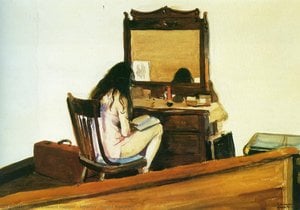
Lighthouse and Building, Portland

Edward Hopper's 'Lighthouse and Building' captures the quiet solitude of modern life with masterful light and shadow—a poignant depiction of Maine’s Split Rock Lighthouse and its surrounding landscape.

Explorez les peintures réalistes américaines emblématiques d'Edward Hopper (1882-1967). Connu pour ses scènes urbaines et rurales évocatrices, son utilisation magistrale de la lumière et ses thèmes de solitude et de vie moderne. Découvrez 'House by the Railroad' et bien plus encore chez WahooArt.

Reproduction à l'huile faite à la main

Huile sur toile peinte à la main, avec cadre et dimensions personnalisés, réalisée sur commande par nos artistes. ( Passer au format impression Passer au format image numérique)

P118B $10
P118H $10
P118W $10
P438Z $10
P508JH $12
P508YH $12
P805H $10
P805Z $10
P919BZ $10
P919G $10
P919XJ $10
P959ZH $10
P968JZ $12
W106C $8
W218G $10
W218JH $8
W218Y $10
W307PJ $10
W316G $10
W316PJ $8
W316Y $10
W398PJ $8
W4111J $10
W500HY $15
W500JH $15
W692G $12
W849H $8
W940BG $15
W953PJ $8

Format standard
personnalisé
CM
INCH

Choisissez parmi nos formats prédéfinis qui respectent les proportions originales de l’œuvre.

largeur
hauteur

Vous pouvez saisir vos propres dimensions pour l'adapter à un cadre ou à un espace spécifique. Si la taille sélectionnée ne correspond pas aux proportions de l'image d'origine, nous recadrerons l'œuvre ou prolongerons la peinture avec des éléments peints à la main supplémentaires. Une maquette numérique vous sera envoyée pour approbation avant le début de la production.
Veuillez noter que l'aperçu à l'écran ne reflète pas le recadrage ou l'extension réels. Seule la maquette montrera fidèlement la composition finale.
Bien que des tailles personnalisées soient disponibles, nous vous recommandons de sélectionner une dimension dans la liste prédéfinie afin de préserver les proportions d'origine.

Exemples de personnalisation possibles : remplacer un visage par la photo du client ; ajouter un animal de compagnie (par exemple, remplacer un chat par un chien) ; inclure un message caché en arrière-plan ; modifier le paysage ou les éléments de l'arrière-plan.
Après la commande, l’équipe WahooArt.com contactera le client par e-mail pour recueillir ses instructions et lui fournira une maquette d’aperçu

Livraison dans le monde entier () en 3 à 4 semaines au lieu des 5 semaines habituelles. (18 septembre). Aucun compromis sur la qualité.

why_choose_icon
Livraison express gratuite dans le monde entier
why_choose_icon
Toile de lin de haute qualité
why_choose_icon
Assurance transport complète
why_choose_icon
Garantie de remboursement des droits de douane
why_choose_icon
Garantie de fidélité des couleurs
why_choose_icon
Garantie de retour de 100 jours (uniquement en cas de défaut)
why_choose_icon
Garantie de remboursement à 100%
why_choose_icon
Tarifs dégressifs sur quantité

Prix total

$ 272

reproduction

Lighthouse and Building, Portland

Technique de reproduction

Format de la reproduction

-

Prix total final

$ 272

L'essentiel de l'œuvre

  • Medium: Watercolor over graphite pencil
  • Notable elements or techniques: Detailed depiction of lighthouse and surrounding structures.
  • Year: 1927
  • Title: Lighthouse and Building, Portland
  • Influences: Romanticism
  • Location: Minnesota State Park
  • Subject or theme: Coastal landscape; Urban isolation

Quiz d'art

Chaque question ne comporte qu'une seule bonne réponse.

Question 1:
What artistic movement is Edward Hopper primarily associated with?
Question 2:
The painting depicts a lighthouse situated in which geographical location?
Question 3:
What is the dominant lighting technique employed by Hopper in this watercolor?
Question 4:
The presence of buildings alongside the lighthouse symbolizes what thematic element?
Question 5:
In what year was this watercolor created by Edward Hopper?

Edward Hopper’s Luminous Solitude: Exploring “Lighthouse and Building”

Edward Hopper's "Lighthouse and Building," painted in 1927, isn’t merely a depiction of a coastal scene; it’s a masterful distillation of the anxieties and quiet contemplations characteristic of American Modernism. Completed during a period marked by rapid urbanization and shifting social mores, this watercolor captures a profound sense of isolation—a feeling Hopper consistently explored throughout his oeuvre—within a deceptively simple composition. The painting resides in the Museum of Fine Arts, Boston’s collection, where it continues to fascinate viewers with its subtle interplay of light and shadow and its evocative portrayal of human experience.
  • Subject Matter: At its core, “Lighthouse and Building” presents a lighthouse perched atop a rugged cliff overlooking the turbulent waters of Lake Superior. Adjacent to it stands a modest building—likely a residential dwelling—adding to the scene’s understated grandeur. The inclusion of two figures – presumably observing the vista – reinforces the theme of solitude and contemplation.
  • Style & Technique: Hopper's signature style is instantly recognizable through his use of flattened perspective, muted color palettes dominated by blues and yellows, and a deliberate avoidance of dramatic chiaroscuro (strong contrasts between light and dark). Watercolor lends itself beautifully to capturing atmospheric conditions—the hazy mist clinging to the cliff face—enhancing the painting’s melancholic mood. Hopper meticulously rendered each element with painstaking detail, prioritizing accuracy over expressive gesture.
  • Historical Context: The painting emerged from a broader artistic movement grappling with themes of alienation and disillusionment following World War I. Hopper's work reflects the anxieties of a society undergoing rapid transformation, mirroring the psychological landscape of individuals navigating uncertainty and searching for meaning amidst urban sprawl. It’s important to note that the lighthouse itself was constructed in response to maritime disasters—specifically, the Mataafa Storm of 1905—underscoring the painting's connection to concerns about safety and vulnerability.
  • Symbolism: The lighthouse serves as a potent symbol of resilience and steadfastness against the forces of nature—a beacon of hope amidst darkness. Simultaneously, it represents isolation and detachment from human companionship. The building alongside it suggests domesticity but also hints at an unspoken separation from the outside world. Hopper’s masterful use of color contributes to this symbolic resonance, conveying a sense of quiet melancholy.
  • Emotional Impact: “Lighthouse and Building” succeeds in eliciting a powerful emotional response—one of contemplative stillness and poignant beauty. The painting invites viewers to ponder questions of existence and connection, prompting reflection on the human condition. Hopper’s ability to convey profound emotion through seemingly unremarkable imagery is what cements its place as an enduring masterpiece of American art.

The MFA Boston Reproduction: Quality & Detail

Reproductions of “Lighthouse and Building” offered by MFA Boston Custom Prints utilize state-of-the-art printing technology to faithfully recreate Hopper’s original watercolor, ensuring exceptional color accuracy and textural nuance. Printed on archival paper—specifically Hahnemühle German Etching 304 —these reproductions guarantee longevity and preserve the painting's delicate luminosity for generations to come. The meticulous attention to detail—captured by skilled artisans—captures every subtle shade of blue and yellow, mirroring Hopper’s original artistic vision. Furthermore, MFA Boston Custom Prints provides a comprehensive selection of framing options allowing collectors to personalize their artwork display and elevate its aesthetic impact.

Exploring Hopper's Legacy: Beyond “Lighthouse and Building”

Edward Hopper’s influence extends far beyond this iconic image. His exploration of urban solitude—evident in paintings like “Nighthawks” and “Monhegan Houses”—continues to resonate with artists and audiences alike. Consider Hopper’s masterful use of light as a tool for conveying emotion, mirroring the way he captured the essence of modern life. To delve deeper into Hopper's artistic journey, explore articles analyzing his stylistic innovations and thematic preoccupations—particularly his profound engagement with psychological realism. Discover more about Hopper’s work at MFA Boston Custom Prints!

Biographie de l'artiste

**jeunesse et influences**

Edward Hopper, peintre et graveur américain réaliste de premier plan, est né le 22 juillet 1882 à Upper Nyack, New York. Sa famille, d'ascendance principalement néerlandaise, lui a offert une éducation confortable qui lui a permis de poursuivre ses inclinations artistiques dès son plus jeune âge. - **inspirations :** L’œuvre de Hopper a été influencée par les écrits de Ralph Waldo Emerson et des maîtres impressionnistes français Édouard Manet et Edgar Degas. - **formation précoce :** Il a commencé à étudier l'art grâce à un cours par correspondance en 1899, puis est passé à l’École d'Art et de Conception de New York.

**style artistique et thèmes**

Edward Hopper's rendus sobres et soigneusement calculés reflétaient sa vision personnelle de la vie américaine moderne. Son travail peut être caractérisé par : - **scènes urbaines et rurales :** Les deux ensembles étaient dépeints avec un mélange unique de réalisme et d’émotion profonde. - **lumière :** Maîtrise de la lumière, souvent utilisée pour évoquer des sentiments d'isolement ou de contemplation. - **figures :** Souvent sans visage ou en arrière-plan, mettant l'accent sur l'environnement plutôt que sur les figures.

**œuvres notables et leur signification**

- House by the Railroad (Musée d'Art Moderne, New York, États-Unis), un exemple de la capacité de Hopper à évoquer un sentiment de mélancolie grâce à une composition simple mais puissante. - Reclining Nude (50 x 35 cm, Nouveau Réalisme, aquarelle), mettant en valeur sa versatilité pour capturer la forme humaine.

**Héritage et influence**

- **Influence sur les artistes futurs :** Le style unique de Hopper a influencé de nombreux artistes, dont Pierre Sanford Ross, connu pour ses scènes urbaines et rurales. - **Popularité durable :** Ses œuvres continuent de captiver le public par leurs thèmes intemporels de solitude et de la condition humaine.

**Explorez davantage sur WahooArt**

- [https://WahooArt.com/@/edward-hopper](Œuvres d'Edward Hopper) - /fr/art/show/art-8xyffg-fr/Achetez de l'art inspiré par les maîtres]
  • Plongez dans le monde de l'art grâce à la vaste collection de WahooArt.
  • Découvrez comment l'héritage d' Edward Hopper continue d'inspirer les artistes et les amateurs d'art.

**Références**

- [https://WahooArt.com/@/edward-hopper](Wikipedia : Edward Hopper) - [https://en.wikipedia.org/wiki/edward_hopper](Biographie d'Edward Hopper sur Wikipédia)

Edward Hopper

Edward Hopper

1931 - 1967 , États-Unis d'Amérique

En bref

  • Artistes Influents:
    • Ralph Waldo Emerson
    • Édouard Manet
    • Edgar Degas
  • Date De Décès: 1967
  • Date De Naissance: 22 juillet 1882
  • Influence Sur Les Artistes: ['Pierre Sanford Ross']
  • Lieu De Naissance: Upper Nyack, États-Unis
  • Nationalité: Américaine
  • Nom Complet: Edward Hopper
  • Oeuvres Notables:
    • House by the Railroad
    • Nighthawks
    • Gas
    • Chop Suey
    • Summertime
  • Style Artistique: Réalisme américain
Explorez des œuvres d'art classées par thèmes, styles et caractéristiques.