Aperçu en situation Visualiser en RA Commander la reproduction peinte à la main Passer au format numérique Envoyer
Détails de l'œuvre Guide Ajouter aux favoris Télécharger l'image Articles similaires Radiographie Diaporama Q&A Statistiques

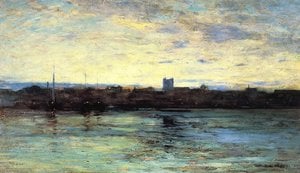
Evening, New Bedford Harbor

Dwight William Tryon's "Evening, New Bedford Harbor" captures the serene beauty of a twilight maritime scene with masterful tonalism and atmospheric detail. Explore this evocative Tonalist painting.

Dwight Tryon (1849-1925), tonaliste américain renommé pour ses paysages & marines évocateurs. Influencé par Whistler, sa palette délicate crée des scènes sereines de la nature.

Giclées et impressions d'art

Impressions giclées ou sur toile de qualité musée, avec une production rapide et des finitions au choix. ( Commander la reproduction peinte à la main Passer au format numérique)

Corner sample of the P118B picture frame: polystyrène moulé, 5 cm wide and 3 cm thick
P118B €10
Corner sample of the P118H picture frame: polystyrène moulé, 5 cm wide and 3 cm thick
P118H €10
Corner sample of the P118W picture frame: polystyrène moulé, 5 cm wide and 3 cm thick
P118W €10
Corner sample of the P438Z picture frame: polystyrène moulé, 5.5 cm wide and 3.5 cm thick
P438Z €10
Corner sample of the P508JH picture frame: polystyrène moulé, 7 cm wide and 3.5 cm thick
P508JH €12
Corner sample of the P508YH picture frame: polystyrène moulé, 7 cm wide and 3.5 cm thick
P508YH €12
Corner sample of the P805H picture frame: polystyrène moulé, 5 cm wide and 3.5 cm thick
P805H €10
Corner sample of the P805Z picture frame: polystyrène moulé, 5 cm wide and 3.5 cm thick
P805Z €10
Corner sample of the P919BZ picture frame: polystyrène moulé, 7 cm wide and 3.5 cm thick
P919BZ €10
Corner sample of the P919G picture frame: polystyrène moulé, 7 cm wide and 3.5 cm thick
P919G €10
Corner sample of the P919XJ picture frame: polystyrène moulé, 7 cm wide and 3.5 cm thick
P919XJ €10
Corner sample of the P959ZH picture frame: polystyrène moulé, 5 cm wide and 3 cm thick
P959ZH €10
Corner sample of the P968JZ picture frame: polystyrène moulé, 6 cm wide and 4 cm thick
P968JZ €12
Corner sample of the W106C picture frame: bois massif, 5 cm wide and 3 cm thick
W106C €8
Corner sample of the W218G picture frame: bois massif, 5 cm wide and 3 cm thick
W218G €10
Corner sample of the W218JH picture frame: bois massif, 5 cm wide and 3 cm thick
W218JH €8
Corner sample of the W218Y picture frame: bois massif, 5 cm wide and 3 cm thick
W218Y €10
Corner sample of the W307PJ picture frame: bois massif, 6 cm wide and 3 cm thick
W307PJ €10
Corner sample of the W316G picture frame: bois massif, 6 cm wide and 3 cm thick
W316G €10
Corner sample of the W316PJ picture frame: bois massif, 6 cm wide and 3 cm thick
W316PJ €8
Corner sample of the W316Y picture frame: bois massif, 6 cm wide and 3 cm thick
W316Y €10
Corner sample of the W398PJ picture frame: bois massif, 5 cm wide and 3 cm thick
W398PJ €8
Corner sample of the W4111J picture frame: bois massif, 6.5 cm wide and 3.5 cm thick
W4111J €10
Corner sample of the W500HY picture frame: bois massif, 7 cm wide and 5 cm thick
W500HY €15
Corner sample of the W500JH picture frame: bois massif, 7 cm wide and 5 cm thick
W500JH €15
Corner sample of the W692G picture frame: bois massif, 8 cm wide and 4 cm thick
W692G €12
Corner sample of the W849H picture frame: bois massif, 5 cm wide and 3 cm thick
W849H €8
Corner sample of the W940BG picture frame: bois massif, 7.5 cm wide and 4.5 cm thick
W940BG €15
Corner sample of the W953PJ picture frame: bois massif, 6 cm wide and 3.5 cm thick
W953PJ €8

Format standard
sur mesure
CM
INCH

Choisissez parmi nos formats prédéfinis qui respectent les proportions originales de l’œuvre.

largeur
hauteur

Saisissez la largeur et la hauteur souhaitées pour qu'elles s'adaptent à votre cadre ou à votre mur. Une impression peut être recadrée, mais jamais agrandie au-delà de l'image originale ; ainsi, un format de forme différente entraînera la perte d'une partie de l'image. Nous vous envoyons une maquette numérique pour approbation avant toute impression. L'image présentée sur cette page ne montre pas le recadrage réel — seule la maquette le permet.

Livraison dans le monde entier () en 2 semaines au lieu des 4/5 semaines habituelles. (29 octobre)

Livraison express gratuite dans le monde entier
Toile de lin de qualité supérieure
Assurance transport complète
Garantie de remboursement des droits de douane
Garantie de fidélité des couleurs
Politique de retour de 100 jours (uniquement en cas de défaut)
Garantie de remboursement à 100%
Offre de tarifs dégressifs

Prix total

€ 60

Evening, New Bedford Harbor

Giclées et impressions d'art

Format de la reproduction

-

Prix total

€ 60

Informations clés

  • Dimensions: 51 x 80 cm
  • Artistic style: Impressionistic influence
  • Subject or theme: Maritime landscape
  • Medium: Oil on wood
  • Title: Evening, New Bedford Harbor
  • Artist: Dwight William Tryon

Quiz d'art

Chaque question ne comporte qu'une seule bonne réponse.

Question 1:
What art movement is most closely associated with Dwight William Tryon’s style, as indicated by the description?
Question 2:
The description highlights a specific characteristic of Tryon’s use of color. What is it?
Question 3:
According to the provided information, what year was Dwight William Tryon born?
Question 4:
The description mentions a benefactor who played a significant role in Tryon’s career. Who was this individual?
Question 5:
What does the description suggest about Tryon’s artistic background and early training?

A Moment of Quietude: The Essence of Dwight William Tryon’s “Evening, New Bedford Harbor”

Dwight William Tryon's "Evening, New Bedford Harbor" isn’t merely a depiction of a maritime scene; it’s an immersion into a specific time and mood. Painted in 1890, this oil on wood canvas captures the profound stillness of twilight over the harbor, offering a glimpse into the lives intertwined with the sea and the quiet dignity of a fading day. The painting immediately draws the viewer in with its monochromatic palette – a carefully orchestrated dance of grays, blacks, and whites that eschews traditional color for an exploration of light, shadow, and atmosphere. It’s a testament to Tryon's mastery of tonalism, an American art movement he embraced wholeheartedly, prioritizing emotional resonance over precise representation.

The composition itself is remarkably balanced, dividing the canvas into distinct yet harmonious zones. The foreground, dominated by the dark, reflective waters of the harbor, anchors the scene and establishes a sense of depth. Beyond this lies the middle ground, populated with several ships – not rendered as individual entities but rather as suggestive forms, blending seamlessly into the hazy distance. Finally, the background reveals the faint outline of New Bedford’s cityscape, softened by atmospheric perspective and appearing almost dreamlike. This careful arrangement creates a feeling of spaciousness and invites contemplation, mirroring the quiet solitude of the scene.

The Language of Tone: Tryon's Tonalist Technique

Tryon’s technique is characterized by an exquisite sensitivity to light and texture. He achieves this through meticulous blending and layering of oil paints – a process that results in surfaces that appear incredibly smooth, almost velvety to the touch. There’s no visible brushstroke; instead, the paint seems to melt into one another, creating subtle gradations of tone that mimic the diffused light of dusk. This deliberate softness contributes significantly to the painting's overall atmosphere of tranquility and melancholy. The artist skillfully utilizes the absence of strong highlights or shadows, relying instead on the nuanced interplay of light and dark to define form and create a sense of volume.

The choice of a monochromatic palette is not arbitrary; it’s integral to Tryon's artistic vision. By stripping away color, he forces the viewer to engage with the painting on a purely sensory level – focusing on the subtle shifts in tone, the play of light and shadow, and the overall mood conveyed by the scene. This approach aligns perfectly with the principles of tonalism, which sought to capture the essence of a subject through its emotional impact rather than its literal appearance.

Symbolism and Emotional Resonance: A Portrait of a Working Harbor

“Evening, New Bedford Harbor” is more than just a landscape; it’s a poignant meditation on labor, community, and the passage of time. The scene evokes the quiet dignity of the fishermen and sailors who worked tirelessly in the harbor, their lives inextricably linked to the rhythms of the sea. The muted colors and soft lighting suggest a sense of weariness and reflection – perhaps a moment of respite before returning to the demands of the next day. The distant cityscape hints at the bustling life of New Bedford, while the vast expanse of water symbolizes both opportunity and uncertainty.

Furthermore, the painting’s overall mood is imbued with a subtle sense of nostalgia. It's as if Tryon is inviting us to step back in time and witness a moment that has long since vanished – a reminder of a bygone era when life revolved around the sea and its bounty. The piece resonates with a quiet beauty, prompting viewers to contemplate their own relationship to nature, community, and the enduring power of memory.

A Legacy of Tonalist Beauty: Tryon’s Enduring Appeal

Dwight William Tryon's "Evening, New Bedford Harbor" stands as a remarkable example of American tonalism – a testament to the artist’s skill and sensitivity. Its evocative atmosphere, meticulous technique, and subtle symbolism continue to captivate viewers today. Reproductions of this masterpiece offer a unique opportunity to bring this serene scene into your home or office, allowing you to experience its quiet beauty and emotional resonance firsthand. It's a piece that speaks volumes without uttering a single word, inviting contemplation and offering a moment of respite from the complexities of modern life.

Questions et réponses

Sous quels autres noms Dwight William Tryon est-il/elle connu(e) ?

L'artiste Dwight William Tryon, créateur de « Evening, New Bedford Harbor », est également connu sous d'autres noms, notamment Auguste William Tryon.

Quelle est la technique et la date de création de «Evening, New Bedford Harbor» de Dwight William Tryon ?

«Evening, New Bedford Harbor» de Dwight William Tryon est une œuvre réalisée en Oil On Canvas, datant de 1890.

Dans quelle pièce est-il suggéré d'exposer « Evening, New Bedford Harbor », compte tenu de sa palette ?

Grâce à sa palette de couleurs Neutrals, l'œuvre « Evening, New Bedford Harbor » s'intègre parfaitement dans une Living Room.


Biographie de l'artiste

Première Vie et Formation

  • Dwight William Tryon est né le 13 août 1849 à Hartford, dans le Connecticut, de Anson Tryon et Delia O. Roberts.
  • La mort précoce de son père l'a laissé élevé par sa mère sur la ferme de ses grands-parents à East Hartford.
  • Il s’est intéressé naturellement à l’art, étudiant des manuels d’instruction artistique dans une librairie où il travaillait.
  • Tryon a commencé à esquisser la campagne environnante pendant son temps libre.
  • Il a vendu sa première peinture en 1870 et s'est fait connaître localement avant de gagner en reconnaissance à la National Academy of Design en 1873.

Développement Artistique et Influences

  • En 1876, Tryon a étudié formellement l’art en France sous Jacquesson de la Chevreuse et à l'École des Beaux-Arts. Il a également reçu des instructions de Charles-François Daubigny, Henri Harpignies et Jean Baptiste-Antoine Guillemet.
  • Initialement, son style penchait vers le luminisme avant de passer à l’école Barbizon, influencé par des artistes comme George Inness et Alexander Helwig Wyant.
  • Malgré une exposition à l'impressionnisme en France, Tryon est resté fidèle à l'esthétique Barbizon.
  • Son travail a été considérablement influencé par James McNeill Whistler, ce qui se reflète dans son style tonaliste.

Style Mature et Œuvres Notables

  • À la fin des années 1880, Tryon a développé son style emblématique, caractérisé par un groupe ou une rangée brisée d'arbres au milieu du décor, souvent avec des teintes automnales, séparant un ciel lumineux au-dessus et un marais ou un pâturage en premier plan.
  • Il peignait fréquemment des paysages marins à l’aide de pastel pour représenter des scènes expansives d’eau, de ciel et de plage dans diverses conditions météorologiques.
  • Parmi ses œuvres notables figure *Salt-Marsh, December*, qui a remporté le premier prix lors de l'Exposition Centennial du Tennessee en 1897.
  • Ses peintures ont été exposées à l’échelle nationale, avec une préférence pour la Pennsylvania Academy of Fine Arts et la Montross Gallery.

Mécénat et Reconnaissance

  • Charles Lang Freer est devenu le principal mécène de Tryon, acquérant des douzaines de ses œuvres et collaborant à la conception intérieure de sa maison de Detroit. De nombreuses peintures se trouvent aujourd'hui à la galerie Freer d’art.
  • Tryon a reçu le prix Carnegie lors de l'Exposition Carnegie en 1908.
  • Il était membre de plusieurs organisations artistiques prestigieuses, notamment la Society of American Artists, l'American Watercolor Society et le National Institute of Arts and Letters (aujourd’hui l'American Academy of Arts and Letters).

Vie ultérieure et Héritage

  • En 1887, il a construit une maison d'été à South Dartmouth, dans le Massachusetts, qui est devenue son domicile.
  • Il a enseigné au Smith College de 1886 à 1923, établissant la Tryon Gallery of Art.
  • Dwight William Tryon est décédé le 1er juillet 1925 des suites d'un cancer.
  • Son héritage réside dans sa contribution au tonalisme américain et sa capacité à capturer des paysages atmosphériques et des paysages marins avec une couleur délicate et un sentiment raffiné. Ses œuvres sont conservées dans des collections prestigieuses telles que le Smithsonian American Art Museum et la Freer Gallery of Art.
Dwight William Tryon

Dwight William Tryon

1849 - 1925 , États-Unis d'Amérique

L'essentiel de l'artiste

  • Artistic Movement Or Style: Tonalisme, École de Barbizon
  • Artists Who Influenced This Artist:
    • James McNeill Whistler
    • George Inness
    • Alexander Helwig Wyant
  • Date Of Birth: 13 août 1849
  • Date Of Death: 1er juillet 1925
  • Full Name: Dwight William Tryon
  • Nationality: Américain
  • Notable Artworks: ['Salt-Marsh, December']
  • Place Of Birth: Hartford, États-Unis
Explorez des œuvres d'art classées par thèmes, styles et caractéristiques.