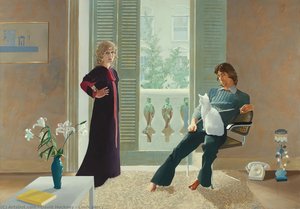
A Symphony of Light and Texture: Reimagining the Pine Forest
In the vast landscape of twentieth-century British art, few works capture the essence of sensory perception as vibrantly as David Hockney’s "Yosemite i (2)." Often associated with his profound exploration of nature through the lens of his "Pine Forest" series, this piece serves as a breathtaking meditation on light, color, and the very act of seeing. To encounter this work is to step into a dense, rhythmic woodland where the boundaries between reality and abstraction begin to dissolve. Hockney does not merely depict a forest; he orchestrates a visual symphony, using dappled sunlight and deep, verdant shadows to create a space that feels both intimately enclosed and infinitely expansive.
The composition is a masterclass in verticality and movement. The eye is immediately drawn upward by the rhythmic repetition of tree trunks, which act as structural pillars within a cathedral of greenery. Through a brilliant use of aerial perspective, Hockney guides the viewer through layers of foliage, where vibrant yellow accents dance against deep blue-purple backgrounds. This interplay of light and dark creates a palpable sense of depth, inviting the observer to wander through the thicket. For the collector or interior designer, this piece offers a unique architectural quality, providing a focal point that brings the restorative energy of the natural world into any sophisticated living space.
Technique and the Revolution of Color
What sets this work apart is Hockney’s revolutionary departure from traditional academic methods. Moving away from the subtle, blended transitions of classical landscapes, he embraced a bold, impasto-inspired approach. By layering pigments thickly onto the canvas, he achieved a textured surface that celebrates the materiality of the paint itself. Each brushstroke feels deliberate and expressive, contributing to an organic texture that mimics the rough bark of pines and the soft, fluttering needles of the forest canopy.
< p>The use of acrylic paints allowed Hockney to maintain an extraordinary level of color intensity, ensuring that the greens remain lush and the highlights remain piercingly bright. This technique, heavily influenced by the structural innovations of Cézanne, allows the artwork to vibrate with life. The result is a surface that changes character depending on the light in the room where it is displayed—a quality that makes a high-quality reproduction an essential acquisition for those who appreciate art that breathes and evolves alongside its environment.
Historical Resonance and Emotional Depth
Emerging from the creative ferment of the late 1960s, this work stands as a defiant assertion of optimism. Created during the tension of the Cold War era, Hockney’s focus on renewal and vitality offered a much-needed counter-narrative to the prevailing gloom of the period. His style, which bridges the gap between the bold simplicity of Pop Art and the emotive power of Expressionism, reflects a broader movement toward liberating color from purely representational constraints.
Beyond its historical significance, the emotional impact of "Yosemite i (2)" is profoundly tranquil. There is a sense of sanctuary within these painted woods—a quietude found in the density of the trees and the soft, diffuse light that permeates the scene. It evokes feelings of enclosure and peace, making it an ideal selection for spaces designed for reflection and repose. Whether viewed as a piece of historical importance or a modern decorative masterpiece, Hockney’s vision remains a timeless testament to the beauty of the natural world and the limitless possibilities of human perception.
Questions et réponses
Quelle palette de couleurs est utilisée dans «Yosemite i (2)» de David Hockney ?
La palette de «Yosemite i (2)» de David Hockney est décrite comme étant Nature. Il s'agit d'une description concise des couleurs de l'œuvre.
Quelle est la technique utilisée pour «Yosemite i (2)» de David Hockney ?
«Yosemite i (2)» de David Hockney est réalisé en Acrylic. Les reproductions visent à restituer l'aspect de cette technique.
Quel est le format de « Yosemite i (2) » ?
L'œuvre « Yosemite i (2) » est au format Landscape. Cette information est utile pour prévoir l'emplacement de sa reproduction.



 Aperçu en situation
 Commander la reproduction peinte à la main
 Envoyer
 Partager
 Détails de l'œuvre
 Guide
Guide

 Télécharger l'image
 Articles similaires
 Radiographie
 Diaporama
 Statistiques

 Lire la suite






































 L'option verre n'est disponible que pour les dimensions inférieures à 110 cm.