Premières années et formation
David Hockney, peintre, dessinateur, graveur, décorateur de théâtre et photographe anglais renommé, est né le 9 juillet 1937 à Bradford, en Angleterre. Il était le quatrième des cinq enfants de Laura et Kenneth Hockney, ce dernier étant un objecteur de conscience pendant la Seconde Guerre mondiale. Ses premières études ont eu lieu à l'école primaire Wellington, suivies par la Bradford Grammar School, puis il a fréquenté le Bradford College of Art.
Carrière et contributions artistiques
La carrière artistique de Hockney s'est épanouie dans les années 1960 en tant que figure marquante du mouvement Pop Art. Son travail se caractérise souvent par des couleurs vibrantes, des lignes audacieuses et une imagerie reconnaissable, ce qui en fait l'un des artistes britanniques les plus influents du XXe siècle.
- A Bigger Splash (1966), une peinture qui met en valeur son style unique, est un exemple emblématique de l'art Pop.
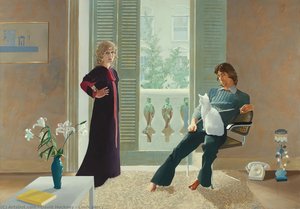
- Ses doubles portraits, tels que American Collectors (Fred and Marcia Weisman), démontrent sa capacité à capturer l'essence de ses sujets.
- L'exploration de l'amour homosexuel dans ses portraits, comme on le voit dans We Two Boys Together Clinging (1961), témoigne de son ouverture d'esprit et de sa volonté de remettre en question les normes sociétales.
Évolution stylistique et influences
L’œuvre de Hockney a connu plusieurs évolutions stylistiques au fil des ans. Initialement influencé par le Pop Art, il s'est ensuite tourné vers la figuration et l'exploration de thèmes tels que les piscines californiennes, les paysages et les portraits. Son intérêt pour la perspective et la représentation du mouvement est évident dans ses œuvres, souvent caractérisées par des compositions dynamiques et une utilisation audacieuse de la couleur. Hockney a été influencé par des artistes comme Henri Matisse et David Bomberg, ainsi que par l'art japonais, notamment en ce qui concerne l'utilisation de perspectives multiples.
Réalisations majeures et reconnaissance
Tout au long de sa carrière illustre, Hockney a reçu de nombreux prix et distinctions, notamment :
- Nommé Order of the Companion of Honour (CH) en 2018
- Élu Fellow of the Royal Society (FRS) en 2003
- A reçu le Praemium Imperiale pour la peinture en 2000
Ses œuvres sont exposées dans les plus grands musées du monde et ont contribué à façonner l'histoire de l'art contemporain.
Héritage artistique et présence en ligne
WahooArt.com, un site web international d’impression d’art raffiné, présente les œuvres de Hockney, les rendant facilement accessibles aux amateurs d'art du monde entier. Ses peintures peuvent être trouvées dans diverses galeries en ligne, notamment :
L'impact profond de David Hockney sur le monde de l'art, en particulier dans le domaine du Pop Art, est indéniable. Son style innovant et sa volonté d’explorer des thèmes variés ont consolidé sa position comme l'un des artistes britanniques les plus influents du XXe siècle.



 Aperçu en situation
 Acheter la peinture faite à la main
 Partager
 Partager
 Détails
 Guide
Guide

 Télécharger
 Articles similaires
 Radiographie
 Voir le diaporama
 Statistiques

 Afficher la suite






































 L'option verre n'est disponible que pour les dimensions inférieures à 110 cm.