CONSEIL EN ART GRATUIT

x
Commander l'impression Commander l'impressionAcheter l'image haute résolution Acheter l'image haute résolution PartagerPartager
DétailsDétails Ajouter aux favoris Ajouter aux favoris TéléchargerTélécharger Articles similairesArticles similaires RadiographieRadiographie DiaporamaDiaporama

Circus (Abstract Composition)

Discover 'Circus' by David Bomberg (1921), an abstract masterpiece blending cubism & futurism with vibrant colors and dynamic figures. Explore the work of this pioneering British artist.

David Bomberg (1890-1957) : Des débuts cubistes aux paysages expressifs, explorez le parcours de ce peintre britannique influent & 'Whitechapel Boy'.

Reproduction à l'huile faite à la main

Huile sur toile peinte à la main, avec cadre et dimensions personnalisés, réalisée sur commande par nos artistes.

P118B $10
P118H $10
P118W $10
P438Z $10
P508JH $12
P508YH $12
P805H $10
P805Z $10
P919BZ $10
P919G $10
P919XJ $10
P959ZH $10
P968JZ $12
W106C $8
W218G $10
W218JH $8
W218Y $10
W307PJ $10
W316G $10
W316PJ $8
W316Y $10
W398PJ $8
W4111J $10
W500HY $15
W500JH $15
W692G $12
W849H $8
W940BG $15
W953PJ $8

Standard
custom
CM
INCH

Choisissez parmi nos formats prédéfinis qui respectent les proportions originales de l’œuvre.

largeur
hauteur

Vous pouvez saisir vos propres dimensions pour l'adapter à un cadre ou à un espace spécifique. Si la taille sélectionnée ne correspond pas aux proportions de l'image d'origine, nous recadrerons l'œuvre ou prolongerons la peinture avec des éléments peints à la main supplémentaires. Une maquette numérique vous sera envoyée pour approbation avant le début de la production.
Veuillez noter que l'aperçu à l'écran ne reflète pas le recadrage ou l'extension réels. Seule la maquette montrera fidèlement la composition finale.
Bien que des tailles personnalisées soient disponibles, nous vous recommandons de sélectionner une dimension dans la liste prédéfinie afin de préserver les proportions d'origine.

Exemples de personnalisation : remplacer un visage par la photo du client ; ajouter un animal de compagnie (par exemple, remplacer un chat par un chien) ; inclure un message caché en arrière-plan ; modifier le paysage ou les éléments de l'arrière-plan.
Après la commande, l’équipe WahooArt.com contactera le client par e-mail pour obtenir ses instructions et lui fournira une maquette d’aperçu.

Livraison dans le monde entier () en 3 à 4 semaines au lieu des 5 semaines habituelles. (2 juillet). Aucune concession sur la qualité.

why_choose_icon
Livraison express gratuite dans le monde entier

why_choose_icon
Toile de lin de haute qualité
why_choose_icon
Assurance transport complète
why_choose_icon
Garantie de remboursement des frais de douane
why_choose_icon
Garantie de fidélité des couleurs
why_choose_icon
Politique de retour de 60 jours (uniquement en cas de défaut)
why_choose_icon
Garantie de remboursement à 100%
why_choose_icon
Réduction sur les achats groupés

Prix total

-

reproduction

Circus (Abstract Composition)

Technique de reproduction

Format de reproduction

-

Prix total final

-

En bref

  • Artist: David Bomberg
  • Movement: Cubism, Futurism
  • Location: Ashmolean Museum
  • Influences:
    • Cézanne
    • Sickert
  • Title: Circus (Abstract Composition)
  • Artistic style: Expressionist
  • Notable elements: Angular figures, color

Quiz d'art

Chaque question ne comporte qu'une seule bonne réponse.

Question 1:
What is the primary subject matter depicted in David Bomberg’s ‘Circus (Abstract Composition)’?
Question 2:
In what year was ‘Circus (Abstract Composition)’ painted?
Question 3:
Which artistic movement heavily influenced David Bomberg’s style during the creation of ‘Circus (Abstract Composition)’?
Question 4:
What is the approximate size of the painting ‘Circus (Abstract Composition)’?
Question 5:
David Bomberg was part of a group known as the ‘Whitechapel Boys’. What is significant about this group?

Description de l'œuvre

A Whirlwind of Color and Form: David Bomberg’s “Circus”

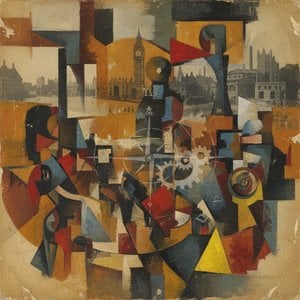
David Bomberg's "Circus (Abstract Composition)," painted in 1921, isn’t merely a depiction of a traveling show; it’s an explosion of energy, emotion, and the restless spirit of early modernism. This vibrant canvas, now housed at the Ashmolean Museum in Oxford, captures a fleeting moment within a chaotic yet strangely ordered spectacle – a testament to Bomberg's unique ability to distill complex experience into powerful visual form. The painting immediately assaults the senses with its bold palette: assertive blues and reds clash dynamically against yellows and whites, creating an atmosphere of both excitement and underlying tension.

Bomberg’s style during this period was deeply influenced by the avant-garde movements sweeping through Europe. He absorbed the geometric abstraction of Cubism – evident in the fragmented forms suggesting figures and structures – while simultaneously embracing the dynamism and expressive power of Futurism, particularly its fascination with movement and speed. The painting's composition isn’t static; it feels like a captured rush, a snapshot of a scene perpetually in motion. Notice how the figures are reduced to angular shapes, almost dissolving into the swirling colors, mirroring the fragmented reality presented by Cubist principles.

The Artist and His Time

Born in Birmingham in 1890, David Bomberg’s early life was shaped by his Polish-Jewish heritage and a challenging upbringing. He initially trained as a lithographer but quickly gravitated towards painting, finding himself drawn to the radical artistic currents of the time. He became part of the “Whitechapel Boys,” a group of East End artists who pushed against established conventions and experimented with new forms of expression. This group, including Mark Gertler and Stanley Spencer, formed a vital network of support and influence during a period of significant social and political upheaval in Britain.

Bomberg’s artistic journey was marked by experimentation and controversy. His early work, particularly his engagement with Cubism and Futurism, drew criticism from some quarters who viewed these movements as overly abstract or even decadent. However, Bomberg remained steadfast in his pursuit of a new visual language, reflecting the anxieties and aspirations of a rapidly changing world. His expulsion from the Slade School of Art in 1913, due to his perceived disregard for traditional artistic methods, further solidified his position as an outsider artist challenging established norms.

Decoding the Composition: Symbolism and Emotion

While seemingly abstract, “Circus” is rich with symbolic potential. The figures themselves – a jumble of shapes suggesting people and animals – represent not individual portraits but rather archetypal elements of the circus experience: performers, spectators, and the spectacle itself. The swirling colors aren’t simply decorative; they convey a sense of disorientation, excitement, and perhaps even underlying unease. The dominant blues could symbolize both the vastness of the sky and the melancholy associated with transient experiences.

Consider the elephant in the center of the composition. It's not rendered realistically but rather as a powerful, simplified form – a symbol of strength, memory, and perhaps even the weight of tradition. The overall effect is one of controlled chaos, inviting the viewer to contemplate the complexities of human experience within a world of illusion and spectacle. Bomberg masterfully uses color and form to evoke a visceral response, capturing not just what he saw but also how he *felt* about it.

A Legacy of Innovation

“Circus (Abstract Composition)” stands as a pivotal work in David Bomberg’s oeuvre and a significant example of early British abstraction. It demonstrates his willingness to embrace radical experimentation, blending influences from Cubism, Futurism, and his own unique artistic vision. His exploration of form, color, and emotion paved the way for subsequent generations of artists, solidifying his place as a key figure in the development of modern art in Britain. Reproductions of this dynamic painting continue to resonate with viewers today, offering a glimpse into the turbulent yet exhilarating world of early 20th-century artistic innovation.

Œuvres apparentées


Biographie de l'artiste

Jeunesse et Formation Artistique

  • Né : Birmingham, Royaume-Uni (5 décembre 1890)
  • Décédé : Londres, Royaume-Uni (19 août 1957)
  • L'un des 'Whitechapel Boys' – un groupe d'artistes de l'East End qui ont émergé au début du XXe siècle.

Né dans une famille immigrante polonaise-juive, Abraham et Rebecca Bomberg, à Birmingham. La famille a déménagé à Whitechapel, Londres, en 1895.

A étudié initialement à la City and Guilds Technical Art School avant de se former comme lithographe à Birmingham.

A étudié sous Walter Sickert à Westminster School of Art (1908-1910), où il a été influencé par l'accent mis par Sickert sur la forme et la vie urbaine.

Exposition significative à Paul Cézanne grâce à l'exposition de 1910 de Roger Fry "Manet et les post-impressionnistes".

A fréquenté la Slade School of Art (1911), remportant le prix Tonks pour son dessin du camarade étudiant Isaac Rosenberg.

Les Années d'Avant-Garde : Cubisme, Futurisme et Controverse

  • À la Slade, Bomberg faisait partie d'une génération remarquable comprenant Mark Gertler, Stanley Spencer, C.R.W. Nevinson et Dora Carrington.
  • Influencé par les expositions londoniennes de 1912 des Futurs italiens et la deuxième exposition post-impressionniste de Fry (Picasso, Matisse, Fauves, Wyndham Lewis).
  • A développé un style distinctif combinant le Cubisme et le Futurisme – caractérisé par des compositions géométriques, des palettes de couleurs limitées, des figures angulaires et des structures en forme de grille.
  • Son approche radicale a conduit à son expulsion de la Slade School of Art en 1913, jugé trop audacieux pour les méthodes conventionnelles de l'institution.
  • A été brièvement associé à l'Omega Workshops du Bloomsbury Group et a exposé avec le Camden Town Group.
  • A montré une affinité avec le mouvement Vorticiste de Wyndham Lewis mais est resté indépendant, refusant toute implication complète.

De la Guerre au Paysage : Un Changement de Style

Les expériences en tant que soldat pendant la Première mondiale ont profondément influencé sa vision artistique, conduisant à un éloignement de l'abstraction.

Dans les années 1920, Bomberg a adopté un style plus figuratif, se concentrant sur des portraits et des paysages tirés directement de la nature.

A développé une technique expressionniste de plus en plus marquée, caractérisée par un impasto texturé et une intensité émotionnelle.

De nombreux voyages à travers le Moyen-Orient (en particulier la Palestine) et l'Europe ont considérablement influencé son œuvre ultérieure. Ses représentations de Jérusalem sont particulièrement notables.

Les Dernières Années et Héritage

  • De 1945 à 1953, a enseigné à Borough Polytechnic (aujourd'hui London South Bank University), influençant une génération d'artistes dont Frank Auerbach, Leon Kossoff, Philip Holmes, Cliff Holden, Edna Mann, Dorothy Mead, Gustav Metzger, Dennis Creffield, Cecil Bailey et Miles Richmond.
  • A épousé la peintre de paysages Lilian Holt.
  • Malgré des périodes d'obscurité relative pendant sa vie, l'œuvre de Bomberg a acquis une reconnaissance croissante ces dernières décennies en tant que contribution significative à l'art britannique moderne.
  • La David Bomberg House se trouve à London South Bank University en son honneur.
  • Son héritage réside dans sa synthèse unique des mouvements d'avant-garde européens et son développement ultérieur d'un style de paysage puissant et expressif qui capturait l'essence du lieu et de l'expérience humaine.
David Bomberg

David Bomberg

1890 - 1957 , Royaume-Uni

En bref

  • Artistes Influencés:
    • Frank Auerbach
    • Leon Kossoff
  • Artistes Influents:
    • Paul Cézanne
    • Walter Sickert
  • Date De Décès: 19 août 1957
  • Date De Naissance: 5 décembre 1890
  • Lieu De Naissance: Birmingham, Royaume-Uni
  • Mouvement Artistique:
    • Cubisme
    • Futurisme
    • Expressionnisme
  • Nationalité: Britannique
  • Nom Complet: David Garshen Bomberg
  • Oeuvres Notables:
    • Self Portrait (1937)
    • Jerusalem
    • Kitty...
Explorez des œuvres d'art classées par thèmes, styles et caractéristiques.