CONSEIL EN ART GRATUIT

x
Commander l'impression Commander l'impressionCommander la reproduction Commander la reproduction PartagerPartager
Détails de l'œuvreDétails de l'œuvre Ajouter aux favoris Ajouter aux favoris TéléchargerTélécharger Articles similairesArticles similaires RadiographieRadiographie DiaporamaDiaporama

Vase

  • Dimensions51.0 x 81.0 cm

Discover Clément Massier, a French Art Nouveau ceramicist known for luster glazes. Explore his decorative artworks & innovative techniques.

Acquérez une image numérique haute résolution et améliorée, bien supérieure à l'aperçu en ligne.

Chaque fichier est méticuleusement préparé par nos spécialistes internes à l'aide d'outils avancés et d'une retouche manuelle experte. Nous garantissons que chaque image possède une clarté exceptionnelle, une précision des couleurs irréprochable et un niveau de détail fin.

Le fichier final est livré par e-mail sous 72 heures, optimisé pour une utilisation immédiate dans des contextes professionnels, éditoriaux et d'impression. Il offre la même qualité de confiance que celle utilisée par les plus grands studios de création, éditeurs et galeries.

Image numérique

Téléchargez un fichier haute résolution pour un usage personnel, l'impression et vos projets créatifs.

Prix total

$9.99

Inclus avec chaque achat d'image numérique

Livraison numérique experte, garantie.

En choisissant WahooArt.com, vous n'obtenez pas seulement une simple image : vous recevez une œuvre numérique sublimée avec professionnalisme, conçue avec précision et accompagnée d'une garantie de satisfaction. Voici tout ce qui accompagne automatiquement votre commande :

shipping_icon
Livraison rapide par e-mail

Votre fichier d'image numérique haute résolution vous sera envoyé par e-mail sous 72 heures après votre commande — prêt à un usage immédiat.

canvas_icon
Fichier numérique optimisé par l'IA

Votre œuvre d'art bénéficie d'une optimisation professionnelle grâce à des outils d'IA avancés et une retouche manuelle, garantissant un niveau maximal de détail, de clarté et de fidélité chromatique.

insurance_icon
Réexpédition gratuite à vie

Vous avez accidentellement supprimé ou perdu votre fichier ? Pas de panique — nous vous le renverrons gratuitement, quand vous le souhaitez.

tax_icon
Aucun frais de douane - À jamais

Profitez de votre œuvre d'art instantanément sans frais de douane ni de livraison — les téléchargements numériques sont toujours exonérés de taxes.

color_icon
Garantie de fidélité des couleurs

Nous garantissons que votre image numérique reproduit les couleurs de l'original aussi fidèlement que possible grâce à des outils professionnels et une gestion rigoureuse des couleurs.

return_icon
Garantie de satisfaction de 60 jours

Si vous n'êtes pas satisfait de votre image numérique, nous la réviserons ou vous rembourserons 100% sous 60 jours - sans poser de questions.

guarantee_icon
Garantie de remboursement à 100%

Pas satisfait ? Obtenez un remboursement intégral dans les 60 jours suivant la réception de votre fichier numérique — sans aucune question posée.

discount_icon
Réductions sur les commandes groupées

Achetez 3 images, économisez 10% - Achetez 5, économisez 15% - Achetez 10+, économisez 20%. Idéal pour les projets créatifs, les galeries et les agences.

Description du collectible

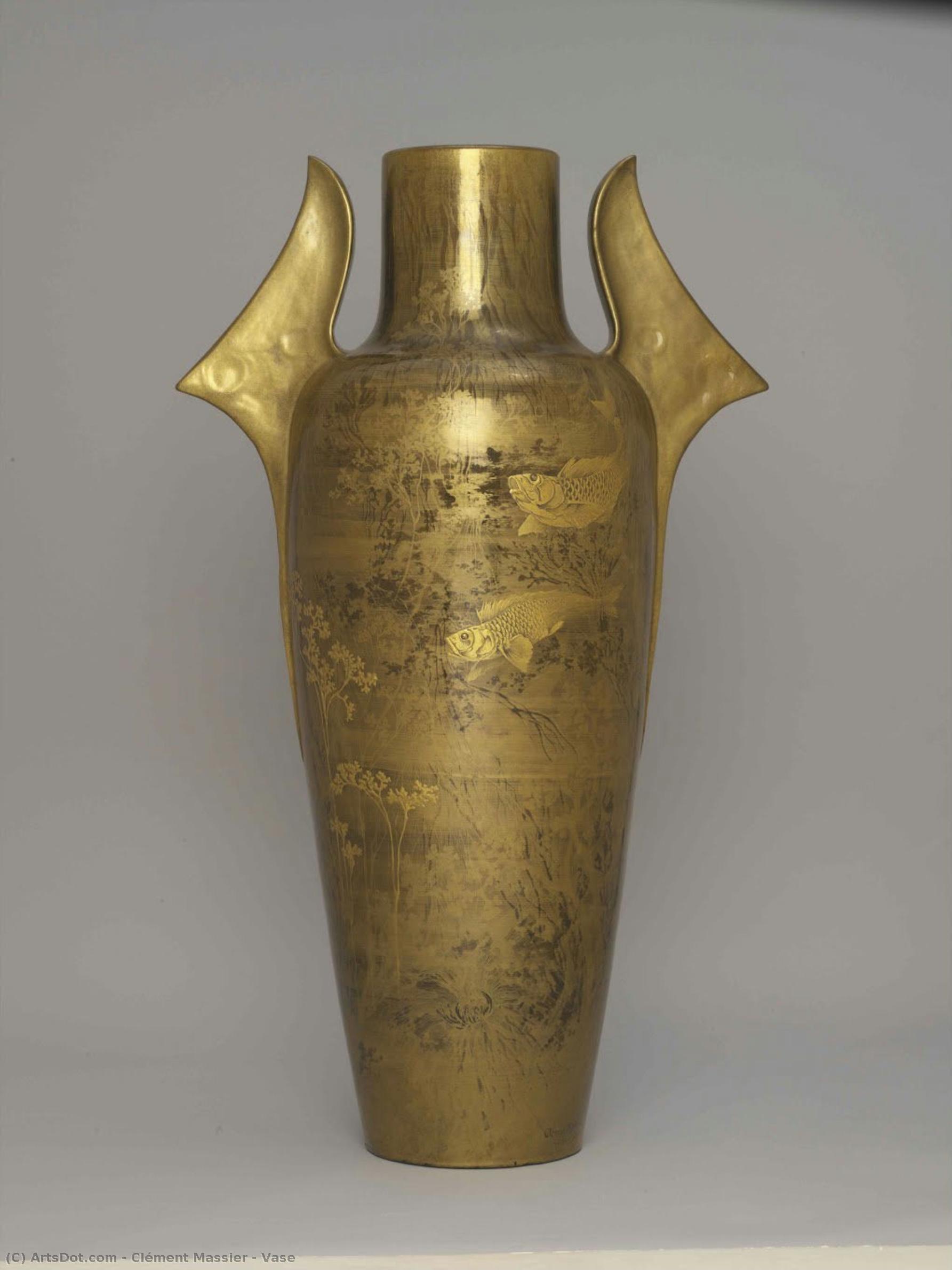
Clément Massier established an important ceramic atelier the south of France. The forms of his works were often inspired by those of Oriental ceramics and his use of iridescent glazes was influenced by Hispano-Moresque ceramics. The form of the vase was inspired by Chinese ceramics. However the visual effect of its decorative iridescent glaze, depicting fish and aquatic plants, was inspired by the appearance of Japanese sprinkled or makie lacquered artifacts that were fashionable with collectors of this period. France was an important centre for the development of Art Nouveau. There the art of the Symbolist movement, with its appeal to the emotions, influenced the subject matter of many French Art Nouveau artifacts. In Paris, important practitioners included the architect Hector Guimard (1867-1942), critic and dealer Julius Meier-Graefe (1867-1935), (whose shop La Maison Moderne was designed by Henry van de Velde), and the art dealer Siegfried Bing (1838-1905). Since the late 1870s, Bing, one of the first dealers to present ancient Chinese artifacts in the West, had helped sensitized Europeans to the aesthetics of Japanese art. In 1895, Bing opened his shop called La Maison de l’Art Nouveau, from which he sold works by major designers including Eugène Gaillard, Emile Gallé, René Lalique, Louis Comfort Tiffany, and Edward Colonna. Nancy, France, was another centre of production, where glass-artist Emile Gallé (1846-1904) and furnituremaker Louis Majorelle (1859-1926), ran large, successful, ateliers.

Biographie de l'artiste

The Pioneering Luster of Clément Massier

Clément Massier, born in Vallauris, France, in 1844 and passing away in Golfe-Juan in 1917, stands as a pivotal figure in the transition from traditional French pottery to the innovative spirit of Art Nouveau. He wasn’t merely a potter; he was an alchemist of clay, transforming humble earth into objects of shimmering beauty that captured the burgeoning aesthetic sensibilities of his time. Coming from a long lineage of potters—his family had been working with ceramics in Vallauris for generations—Massier initially followed in their footsteps, producing utilitarian wares. However, he possessed a restless artistic drive that pushed him beyond functionality and towards pure creative expression. This ambition led him to establish his own factory in Golfe-Juan in 1883, a move that would prove instrumental in shaping the future of French ceramics.

A Family Legacy & The Rise of Artistic Innovation

The Massier family’s history was deeply intertwined with the clay of Vallauris. Jacques Massier, Clément's father, had established a respected pottery workshop, but it was Clément who truly revolutionized their approach. He recognized the potential for ceramics to be more than just vessels; they could be canvases for artistic exploration, imbued with color, texture, and symbolic meaning. Early influences included Italian master ceramist Gaetano Gandolfi, hired by Jacques Massier, who introduced techniques like glazed earthenware that would become foundational to the family’s success. However, Clément quickly surpassed these initial methods, driven by a desire to create something entirely new. He wasn't content with simply replicating existing styles; he sought to forge his own path, experimenting relentlessly with glazes and forms.

The Allure of Luster & The Paris Exposition Universelle

Massier’s most significant contribution—and the element that cemented his reputation—was his mastery of luster glazes. These weren't simply surface coatings; they were iridescent, metallic sheens that seemed to capture and reflect light from within the ceramic itself. He achieved this effect through a complex process involving multiple firings and the careful application of metallic oxides, creating surfaces that shimmered with an ethereal quality. The breakthrough came in 1887 when he hired Lucien Lévy-Dhurmer as his artistic director. This collaboration proved transformative. In 1900, Massier’s iridescent pottery was awarded a gold medal at the Paris Exposition Universelle, catapulting him to international fame. The exhibition showcased not only the technical brilliance of his glazes but also the Art Nouveau designs that adorned his pieces—flowing floral motifs, sinuous curves, and organic forms that embodied the movement's embrace of nature.

Beyond Decoration: Symbolism & Artistic Collaboration

While celebrated for their decorative appeal, Massier’s ceramics were often imbued with subtle symbolism. The naturalistic designs weren’t merely aesthetic choices; they reflected a broader fascination with the mysteries of life and the beauty of the natural world. The factory became a hub for artistic collaboration, attracting talented painters and sculptors who contributed to the design process. This collaborative spirit ensured that Massier's work wasn't solely defined by technical innovation but also by artistic vision. He produced a wide range of objects—vases, bowls, plaques, and even architectural elements—all characterized by his signature luster glazes and Art Nouveau aesthetic. His pieces quickly became sought after by the elite, adorning the homes of collectors in France, England, and beyond.

A Lasting Legacy & The Enduring Appeal of Art Nouveau Ceramics

Clément Massier’s impact on French ceramics is undeniable. He elevated pottery from a craft to an art form, paving the way for future generations of ceramic artists. His factory in Golfe-Juan became a model for other workshops, and his luster glazes continue to inspire contemporary ceramists today. He was also a dedicated teacher, mentoring numerous artists and sharing his knowledge and techniques. Though he passed away in 1917, his legacy lives on through the exquisite pieces that bear his name—objects of shimmering beauty that capture the spirit of Art Nouveau and the enduring allure of handcrafted artistry. His work represents not just a technical achievement but a philosophical shift, embracing decoration as a form of artistic expression and celebrating the transformative power of clay.

Clément Massier

Clément Massier

1844 - 1917