rompre le style italo-byzantin
Cimabue, né vers 1240 et décédé en 1302, était un peintre et concepteur de mosaïques italien influent originaire de Florence, également connu sous le nom de
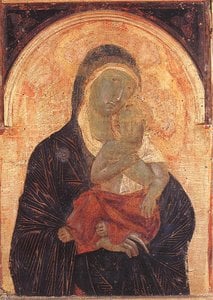
Cenni di Pepo. Pionnier dans la rupture avec le style italo-byzantin, Cimabue est célébré pour avoir introduit des proportions et des ombrages plus réalistes dans son œuvre, marquant un passage significatif vers le réalisme dans l’art médiéval.
Jeunesse et formation
Peu d'informations sont connues sur la jeunesse de Cimabue. Une source qui relate sa carrière est la
Vie des plus excellents peintres, sculpteurs et architectes de Giorgio Vasari, mais sa précision est incertaine. Il est né à Florence et décédé à Pise. Selon l’historien d'art Pietro Tosca, le premier œuvre attribuée à Cimabue, la crucifixion dans l'église
San Domenico à Arezzo, date d’environ 1270 et présente une rupture avec le style byzantin.
Œuvres notables
* Maïeutique (initialement exposée dans l'église
San Francesco à Pise, maintenant au Louvre) : Cette œuvre a établi un style suivi par de nombreux artistes ultérieurement, dont
Duccio di Buoninsegna dans sa
Rucellai Madonna (mal attribuée par le passé à Cimabue). * Flagellation (Collection Frick) : Une peinture d'atelier qui pourrait être datée d’une période légèrement ultérieure. * Mosaïques pour le
baptistère de Florence (maintenant largement restauré) : Dans un état de dégradation en raison de l'oxydation des couleurs les plus vives.
Influence et héritage
L’art de Cimabue a joué un rôle crucial dans la transition du byzantin vers des représentations plus réalistes dans la peinture italienne, et son influence sur les artistes ultérieurs a été profonde. Ses œuvres, caractérisées par un mélange de techniques traditionnelles et innovantes, marquent un chapitre important dans l'histoire de l'art, reliant le style médiéval à celui de la Renaissance.
**Découvrez le monde de l’art avec WahooArt.com, où vous trouverez une vaste collection d’œuvres d'art, y compris celles de Cimabue et d'autres artistes renommés.**



 Aperçu en situation
 Commander la reproduction peinte à la main
 Envoyer
 Partager
 Détails de l'œuvre

 Télécharger
 Articles similaires
 Radiographie
 Diaporama
 Stats
Stats

 Lire la suite






































 L'option verre n'est disponible que pour les dimensions inférieures à 110 cm.