Aperçu en situation Aperçu en RA Passer au format impression Passer au format image numérique Partager
Détails Guide Ajouter aux favoris Télécharger Articles similaires Radiographie Voir le diaporama Statistiques

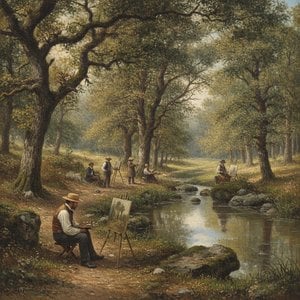
On the River Oise

Experience Charles-François Daubigny's 'On the River Oise,' a serene landscape capturing the beauty of the French countryside. A masterpiece of atmospheric impressionism, perfect for art lovers.

Découvrez Charles-François Daubigny (1817-1878), précurseur clé de l'École de Barbizon et de l'Impressionnisme ! Paysages évocateurs, scènes rurales & reproductions d'œuvres majeures sur WahooArt.

Reproduction à l'huile faite à la main

Huile sur toile peinte à la main, avec cadre et dimensions personnalisés, réalisée sur commande par nos artistes. ( Passer au format impression Passer au format image numérique)

P118B $10
P118H $10
P118W $10
P438Z $10
P508JH $12
P508YH $12
P805H $10
P805Z $10
P919BZ $10
P919G $10
P919XJ $10
P959ZH $10
P968JZ $12
W106C $8
W218G $10
W218JH $8
W218Y $10
W307PJ $10
W316G $10
W316PJ $8
W316Y $10
W398PJ $8
W4111J $10
W500HY $15
W500JH $15
W692G $12
W849H $8
W940BG $15
W953PJ $8

Format standard
personnalisé
CM
INCH

Choisissez parmi nos formats prédéfinis qui respectent les proportions originales de l’œuvre.

largeur
hauteur

Vous pouvez saisir vos propres dimensions pour l'adapter à un cadre ou à un espace spécifique. Si la taille sélectionnée ne correspond pas aux proportions de l'image d'origine, nous recadrerons l'œuvre ou prolongerons la peinture avec des éléments peints à la main supplémentaires. Une maquette numérique vous sera envoyée pour approbation avant le début de la production.
Veuillez noter que l'aperçu à l'écran ne reflète pas le recadrage ou l'extension réels. Seule la maquette montrera fidèlement la composition finale.
Bien que des tailles personnalisées soient disponibles, nous vous recommandons de sélectionner une dimension dans la liste prédéfinie afin de préserver les proportions d'origine.

Exemples de personnalisation possibles : remplacer un visage par la photo du client ; ajouter un animal de compagnie (par exemple, remplacer un chat par un chien) ; inclure un message caché en arrière-plan ; modifier le paysage ou les éléments de l'arrière-plan.
Après la commande, l’équipe WahooArt.com contactera le client par e-mail pour recueillir ses instructions et lui fournira une maquette d’aperçu

Livraison dans le monde entier () en 3 à 4 semaines au lieu des 5 semaines habituelles. (21 septembre). Aucun compromis sur la qualité.

why_choose_icon
Livraison express gratuite dans le monde entier
why_choose_icon
Toile de lin de haute qualité
why_choose_icon
Assurance transport complète
why_choose_icon
Garantie de remboursement des droits de douane
why_choose_icon
Garantie de fidélité des couleurs
why_choose_icon
Garantie de retour de 100 jours (uniquement en cas de défaut)
why_choose_icon
Garantie de remboursement à 100%
why_choose_icon
Tarifs dégressifs sur quantité

Prix total

$ 272

reproduction

On the River Oise

Technique de reproduction

Format de la reproduction

-

Prix total final

$ 272

L'essentiel de l'œuvre

  • Influences:
    • Corot
    • Delaroche
  • Title: On the River Oise
  • Location: Reading Public Museum
  • Medium: Oil on wood
  • Subject or theme: River scenery
  • Movement: Barbizon School, Impressionism
  • Dimensions: 37.5 x 67 cm

Quiz d'art

Chaque question ne comporte qu'une seule bonne réponse.

Question 1:
What artistic movement is Charles-François Daubigny most closely associated with?
Question 2:
The painting 'On the River Oise' primarily depicts:
Question 3:
What technique did Daubigny frequently employ in his paintings, as evidenced by the 'On the River Oise'?
Question 4:
In which museum can you currently view a copy of 'On the River Oise'?
Question 5:
What is a key characteristic of Daubigny’s approach to landscape painting, as reflected in 'On the River Oise'?

Charles-François Daubigny’s “On the River Oise”: A Symphony of Light and Tranquility

Charles-François Daubigny's "On the River Oise," painted in 1863, isn’t merely a landscape; it’s an immersion into a fleeting moment of serene beauty. This captivating work, now residing within the Reading Public Museum, offers a glimpse into the heart of the Barbizon school and the burgeoning Impressionist movement—a testament to Daubigny's pioneering approach to capturing the essence of nature through light and atmosphere. The painting immediately draws the viewer in with its soft, diffused light, reminiscent of a hazy summer afternoon, and invites contemplation of the river’s gentle flow.

Daubigny, born in Paris in 1817, was a pivotal figure bridging the gap between academic tradition and the revolutionary techniques of his contemporaries. Initially trained under Paul Delaroche, he quickly rejected the rigid formality of classical painting, embarking on a journey to paint directly from nature—a radical shift at the time. His decision to relocate to Auvers-sur-Oise in 1860 marked a turning point, allowing him to spend countless hours observing and documenting the river’s ever-changing moods. This intimate connection with his subject matter is palpable in “On the River Oise,” where every brushstroke seems imbued with a deep understanding of the landscape.

A Masterclass in Atmospheric Impressionism

The painting's style exemplifies atmospheric impressionism, a technique championed by Daubigny and others who sought to capture not just the appearance of a scene but its very feeling. He employed loose, visible brushstrokes—a hallmark of the Barbizon school—to render the water’s surface with shimmering reflections and subtle gradations of color. Notice how he avoids sharp outlines, instead blending hues seamlessly to create an illusion of depth and movement. The distant mountains are rendered in muted blues and purples, while the foreground is bathed in a warmer, golden light, drawing the eye into the heart of the composition.

Daubigny’s masterful use of color is particularly noteworthy. He doesn't rely on precise representation but rather on capturing the *impression* of color—the way it shifts and changes with the interplay of light and shadow. The dominant palette consists of greens, blues, and browns, creating a harmonious and calming effect. The subtle variations in tone – from the vibrant greens of the riverbank to the hazy blues of the distant hills – contribute significantly to the painting’s overall sense of tranquility.

Symbolism and Emotional Resonance

Beyond its technical brilliance, “On the River Oise” is rich in symbolic meaning. The washerwoman kneeling by the water's edge—a recurring motif in Daubigny’s work—represents a connection to everyday life and the rhythms of nature. Her presence adds a touch of human warmth to the otherwise serene landscape, reminding us of our own place within the natural world. The river itself symbolizes fluidity, change, and the passage of time – themes that resonate deeply with the Impressionist sensibility.

Furthermore, the painting evokes a profound sense of peace and contemplation. The stillness of the water, the muted colors, and the absence of any dramatic elements create an atmosphere of quiet beauty—a refuge from the hustle and bustle of modern life. It’s a scene that invites us to slow down, breathe deeply, and appreciate the simple pleasures of nature. “On the River Oise” is more than just a painting; it's an invitation to experience a moment of profound serenity.

A Legacy of Light and Observation

Charles-François Daubigny’s "On the River Oise" stands as a pivotal work in the transition from academic art to the Impressionist movement. His dedication to painting *en plein air*, his innovative use of color, and his ability to capture the fleeting effects of light have left an enduring legacy on generations of artists. Reproductions of this stunning piece offer a remarkable opportunity to bring its tranquil beauty into any interior space, fostering a sense of calm and connection with the natural world—a timeless reminder of Daubigny’s profound understanding of light, color, and the human spirit.


Biographie de l'artiste

Premières années et formation

Charles-François Daubigny, né le 15 février 1817 à Paris, est issu d'une famille d'artistes. Il reçoit sa formation artistique de son père, Edmond François Daubigny, et de son oncle, le miniaturiste Pierre Daubigny. Cette exposition précoce à l’art jette les bases du succès futur de Daubigny.

L'École de Barbizon et l'Impressionnisme

Daubigny est un des peintres de l'École de Barbizon, un groupe d'artistes qui travaillaient dans et autour du hameau de Barbizon, dans la forêt de Fontainebleau, au sud-est de Paris. Ils cherchaient à créer des représentations précises et non idéalisées de la vie rurale et du paysage, peignant souvent en plein air. Le travail de Daubigny est considéré comme un précurseur important de l'impressionnisme, un style qui met l’accent sur la capture de la réalité fugitive de la nature.

Œuvres Notables

Parmi les œuvres les plus notables de Daubigny figurent :
  • La Récolte (1857), aujourd'hui au Musée d'Orsay (Paris, France), qui met en valeur sa capacité à capturer l’essence de la vie rurale.
  • Les Étangs de Gylieu (1864) démontre son habileté dans la peinture de paysage, et est conservée au Cincinnati Art Museum (Cincinnati, États-Unis).
  • Clair de Lune (1865) et Auvers-sur-Oise (1868) consolident davantage sa position de maître des paysages impressionnistes.

Évolution Artistique et Influences

Daubigny a commencé par peindre dans un style plus traditionnel, mais cela a changé après 1843 lorsqu'il s'est installé à Barbizon pour travailler en plein air. Une rencontre importante avec Camille Corot en 1852 à Optevoz (Isère) a marqué un tournant dans son œuvre. Daubigny utilisait fréquemment son bateau, le *Botin*, transformé en atelier flottant, pour peindre le long des rivières et des canaux. Son style s'est progressivement affiné, intégrant une analyse plus précise de la lumière naturelle et l’utilisation de couleurs vives. Il a influencé les jeunes artistes Claude Monet et Alfred Sisley, devenant un pont entre le naturalisme organisé de Corot et la réceptivité visuelle moins formelle des impressionnistes.

Héritage et Postérité

Charles-François Daubigny est décédé le 19 février 1878 à Paris. Il repose au cimetière du Père-Lachaise (division 24). Son œuvre continue d'être appréciée pour sa représentation authentique de la nature et son influence sur le développement de l’impressionnisme. Ses disciples et ses élèves sont reconnus pour leurs contributions au monde de l'art.
Charles-François Daubigny

Charles-François Daubigny

1817 - 1878 , France

En bref

  • Artistes Influents: ['Camille Corot']
  • Date De Décès: 19 février 1878
  • Date De Naissance: 15 février 1817
  • Influence Sur Les Artistes:
    • Claude Monet
    • Alfred Sisley
  • Lieu De Naissance: Paris, France
  • Mouvement Artistique: Barbizon et Pré-impressionnisme
  • Nationalité: Française
  • Nom Complet: Charles-François Daubigny
  • Oeuvres Notables:
    • Récolte (1857)
    • Les Étangs de Gylieu (1864)
    • Clair de lune (1865)
    • Auvers-sur-Oise (1868)
Explorez des œuvres d'art classées par thèmes, styles et caractéristiques.