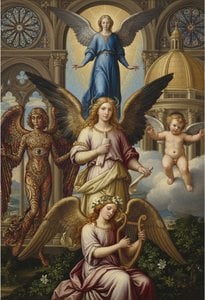
Angels Pity (1470) par Carlo Crivelli, reproduction de peinture à l'huile réalisée à la main par un maître artiste
Aperçu en situation Visualiser en RA Passer au format impression Passer au format numérique Envoyer
Détails de l'œuvre Guide Ajouter aux favoris Télécharger l'image Articles similaires Radiographie Diaporama Questions et réponses Présentation Statistiques

Angels Pity Reproduction de peinture à l'huile faite à la main

Dimensions
72.0 x 55.0 cm

Discover Carlo Crivelli’s ‘Angels Pity’ (1470), a stunning Early Renaissance oil painting. Admire its devotional beauty, intricate details & serene composition – a timeless masterpiece.

Découvrez Carlo Crivelli (1435-1495), peintre de la Renaissance vénitienne, maître du style gothique tardif et des détails saisissants. Explorez son art unique !

Reproduction à l'huile faite à la main

Huile sur toile peinte à la main, avec cadre et dimensions personnalisés, réalisée sur commande par nos artistes. ( Passer au format impression Passer au format numérique)

Corner sample of the P118B picture frame: polystyrène moulé, 5 cm wide and 3 cm thick
P118B €10
Corner sample of the P118H picture frame: polystyrène moulé, 5 cm wide and 3 cm thick
P118H €10
Corner sample of the P118W picture frame: polystyrène moulé, 5 cm wide and 3 cm thick
P118W €10
Corner sample of the P438Z picture frame: polystyrène moulé, 5.5 cm wide and 3.5 cm thick
P438Z €10
Corner sample of the P508JH picture frame: polystyrène moulé, 7 cm wide and 3.5 cm thick
P508JH €12
Corner sample of the P508YH picture frame: polystyrène moulé, 7 cm wide and 3.5 cm thick
P508YH €12
Corner sample of the P805H picture frame: polystyrène moulé, 5 cm wide and 3.5 cm thick
P805H €10
Corner sample of the P805Z picture frame: polystyrène moulé, 5 cm wide and 3.5 cm thick
P805Z €10
Corner sample of the P919BZ picture frame: polystyrène moulé, 7 cm wide and 3.5 cm thick
P919BZ €10
Corner sample of the P919G picture frame: polystyrène moulé, 7 cm wide and 3.5 cm thick
P919G €10
Corner sample of the P919XJ picture frame: polystyrène moulé, 7 cm wide and 3.5 cm thick
P919XJ €10
Corner sample of the P959ZH picture frame: polystyrène moulé, 5 cm wide and 3 cm thick
P959ZH €10
Corner sample of the P968JZ picture frame: polystyrène moulé, 6 cm wide and 4 cm thick
P968JZ €12
Corner sample of the W106C picture frame: bois massif, 5 cm wide and 3 cm thick
W106C €8
Corner sample of the W218G picture frame: bois massif, 5 cm wide and 3 cm thick
W218G €10
Corner sample of the W218JH picture frame: bois massif, 5 cm wide and 3 cm thick
W218JH €8
Corner sample of the W218Y picture frame: bois massif, 5 cm wide and 3 cm thick
W218Y €10
Corner sample of the W307PJ picture frame: bois massif, 6 cm wide and 3 cm thick
W307PJ €10
Corner sample of the W316G picture frame: bois massif, 6 cm wide and 3 cm thick
W316G €10
Corner sample of the W316PJ picture frame: bois massif, 6 cm wide and 3 cm thick
W316PJ €8
Corner sample of the W316Y picture frame: bois massif, 6 cm wide and 3 cm thick
W316Y €10
Corner sample of the W398PJ picture frame: bois massif, 5 cm wide and 3 cm thick
W398PJ €8
Corner sample of the W4111J picture frame: bois massif, 6.5 cm wide and 3.5 cm thick
W4111J €10
Corner sample of the W500HY picture frame: bois massif, 7 cm wide and 5 cm thick
W500HY €15
Corner sample of the W500JH picture frame: bois massif, 7 cm wide and 5 cm thick
W500JH €15
Corner sample of the W692G picture frame: bois massif, 8 cm wide and 4 cm thick
W692G €12
Corner sample of the W849H picture frame: bois massif, 5 cm wide and 3 cm thick
W849H €8
Corner sample of the W940BG picture frame: bois massif, 7.5 cm wide and 4.5 cm thick
W940BG €15
Corner sample of the W953PJ picture frame: bois massif, 6 cm wide and 3.5 cm thick
W953PJ €8

Format standard
sur mesure
CM
INCH

Choisissez parmi nos formats prédéfinis qui respectent les proportions originales de l’œuvre.

largeur
hauteur

Saisissez la largeur et la hauteur souhaitées, pour s'adapter à votre cadre ou à votre mur. Cette œuvre est peinte à la main ; ainsi, pour un format de forme différente, l'artiste peut peindre un peu plus autour du tableau ou réduire légèrement les bords — c'est vous qui choisissez. Nous vous envoyons une maquette numérique pour approbation avant que la peinture ne commence. L'image présentée sur cette page ne reflète pas le résultat réel — seule la maquette le fait.

Exemples de personnalisation possibles : remplacer un visage par la photo du client ; ajouter un animal de compagnie (par exemple, remplacer un chat par un chien) ; inclure un message caché en arrière-plan ; modifier le paysage ou les éléments de l'arrière-plan.
Après la commande, l’équipe WahooArt.com contactera le client par e-mail pour recueillir ses instructions et lui fournira une maquette d’aperçu

Livraison dans le monde entier () en 3 à 4 semaines au lieu des 5 semaines habituelles. (8 novembre). Aucun compromis sur la qualité.

Livraison express gratuite dans le monde entier
Toile de lin de qualité supérieure
Assurance transport complète
Garantie de remboursement des droits de douane
Garantie de fidélité des couleurs
Politique de retour de 100 jours (uniquement en cas de défaut)
Garantie de remboursement à 100%
Offre de tarifs dégressifs

Prix total

€ 265

Angels Pity

Technique de reproduction

Format de la reproduction

-

Prix total

€ 265

Informations clés

  • Subject or theme: Jesus with children, angels, and piety
  • Medium: Oil on wood panel
  • Notable elements or techniques: Glazing, trompe l'oeil, linear quality
  • Movement: Early Renaissance
  • Artistic style: Late Gothic decorative sensibility

A Vision of Divine Compassion

In the quiet, hallowed atmosphere of the Early Renaissance, few works capture the intersection of human sorrow and divine grace as poignantly as Carlo Crivelli’s "Angels Pity." Painted in 1470, this masterpiece serves as a profound meditation on tenderness and spiritual devotion. The scene unfolds with an intimate warmth, presenting Jesus cradling two children within his arms—a gesture that transcends mere historical depiction to become a universal symbol of protection and innocence. Surrounded by a celestial assembly of angels and watchful figures, the composition draws the viewer into a sacred circle of empathy. Even the subtle presence of a solitary bird in the upper corner acts as a silent witness, lending an air of tranquility to a moment heavy with emotional significance.

The artistry of Crivelli is on full display through his masterful command of color and light. Utilizing soft, luminous hues and delicate brushstrokes, the artist creates a sense of palpable intimacy that makes the divine feel reachable. The painting is a triumph of the Early Renaissance style, where every detail is rendered with an almost obsessive realism. Crivelli’s technique involves the meticulous application of oil glazes on wood panel, building layers of color to achieve a radiant depth. This method allows light to appear as if it is emanating from within the figures themselves, highlighting the soft textures of skin and the intricate folds of drapery, thereby inviting the observer to linger on the subtle nuances of the composition.

Symbolism and the Language of Devotion

Beyond its visual splendor, "Angels Pity" is a rich tapestry of Christian iconography designed to provoke deep reflection. The arrangement of the figures within an arched niche creates a sense of sacred enclosure, separating the holy event from the mundane world. Every element serves a symbolic purpose: the tender way Jesus holds the children reflects the theological concept of divine mercy, while the surrounding angels represent the bridge between heaven and earth. Crivelli’s use of trompe l'oeil—a technique intended to trick the eye into perceiving three-dimensional reality—adds a layer of tactile presence to the work, making the spiritual themes feel grounded in a tangible, physical reality.

For the discerning collector or interior designer, this painting offers more than mere decoration; it provides an emotional anchor for any space. The somber yet serene mood makes it an ideal centerpiece for rooms dedicated to contemplation, study, or quiet luxury. Whether one is drawn to its historical significance as a product of the Venetian-influenced March of Ancona or moved by its profound expression of compassion, "Angels Pity" remains a timeless testament to the power of art to evoke the sublime. Owning a high-quality reproduction of this work allows for the preservation of this Renaissance spirit, bringing a sense of historical weight and aesthetic harmony into the modern home.

Questions et réponses

Puis-je voir «Angels Pity» de Carlo Crivelli sur mon propre mur avant de l'acheter ?

Visualisez «Angels Pity» de Carlo Crivelli sur votre propre mur grâce à la page Aperçu en RA de l'œuvre, en utilisant la réalité augmentée sur un appareil compatible.

Comment puis-je découvrir des œuvres d'art similaires à «Angels Pity» de Carlo Crivelli ?

Les œuvres similaires à « Angels Pity » sont répertoriées sur la page Œuvres similaires de l'œuvre.

À quelle période historique appartient «Angels Pity» de Carlo Crivelli ?

«Angels Pity» de Carlo Crivelli date de la période Renaissance. Cette époque apporte le contexte historique de l'œuvre.


Biographie de l'artiste

Premières années et formation

Carlo Crivelli, peintre de la Renaissance italienne, est né à Venise vers 1430-35. Issu d'une famille de peintres, il a reçu sa formation artistique à Venise et Padoue. La formation précoce de Crivelli aurait été dispensée par Jacobello del Fiore, encore actif en 1436. Il a également étudié à l'école de Vivarini à Venise.

Carrière et style

Crivelli a passé ses premières années dans le Vénétien, s'imprégnant des influences de Vivarini, Squarcione et Mantegna. En 1458, il quitta le Vénétien et passa la majeure partie de sa carrière dans les Marches d’Ancône, développant un style personnel distinctif qui contraste avec celui de son contemporain vénitien Giovanni Bellini. Le travail de Crivelli se caractérise par une sensibilité décorative gothique tardive et conservatrice, marquée par une qualité linéaire, une attention aux détails et l'utilisation de techniques de "trompe-l'oeil".

Œuvres notables et collaborations

Musées et collections

  • La Pinacothèque de Brera à Milan, en Italie, présente plusieurs œuvres de Crivelli, dont la "Piéta" (128 x 241 cm).
  • Le Musée San Giovanni in Bragora à Venise, en Italie, possède une collection d'œuvres d'art de différentes périodes et styles, dont certaines sont attribuées à Crivelli.
L'héritage de Crivelli continue d'inspirer les passionnés d'art et les érudits, son œuvre témoignant du pouvoir durable d'une sensibilité décorative gothique tardive et conservatrice.
Carlo Crivelli

Carlo Crivelli

1435 - 1495 , Italie

L'essentiel de l'artiste

  • Artistic Movement Or Style: Gothique tardif/Renaissance
  • Artists Who Influenced This Artist:
    • Vivarini
    • Squarcione
    • Mantegna
  • Date Of Birth: vers 1430-35
  • Date Of Death: 1495
  • Full Name: Carlo Crivelli
  • Nationality: Italienne
  • Notable Artworks:
    • Madone et Enfant Enthronés
    • Pieta
  • Place Of Birth (City And Country): Venise, Italie
Explorez des œuvres d'art classées par thèmes, styles et caractéristiques.