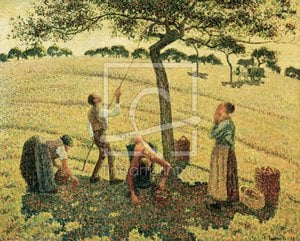
Camille Pissarro : Une Vie dans l'Art
Jeunesse et Formation
Jacob Abraham Camille Pissarro est né le 10 juillet 1830 à Charlotte Amalie, sur Saint-Thomas (alors les Indes occidentales danoises, aujourd’hui les îles Vierges américaines). Son père, Frederick Abraham Gabriel Pissarro, était d'ascendance juive portugaise de nationalité française, et sa mère, Rachel Manzano-Pomié, venait d'une famille juive française. Son éducation fut quelque peu atypique en raison du mélange de ses origines et des circonstances de sa famille. Il reçut sa formation artistique précoce à l’Académie Savary à Passy près de Paris, où il développa une appréciation pour les maîtres de l'art français et fut encouragé à dessiner de la nature.
À 17 ans, Pissarro revint à Saint-Thomas et continua à dessiner pendant ses pauses tout en travaillant comme employé de chargement. Cette période lui a inculqué une observation attentive de la vie quotidienne et du monde naturel – des thèmes qui deviendront centraux dans son art.
Développement Artistique et Influences
En 1855, Pissarro s'installa à nouveau à Paris, où il travailla comme assistant du peintre danois Anton Melbye. Il étudia les œuvres de Gustave Courbet, Jean-Baptiste-Camille Corot, Honoré Daumier, et Charles-François Daubigny, dont les styles ont profondément influencé son travail précoce. Il trouva l'enseignement artistique formel dans des institutions comme l’École des Beaux-Arts étouffant et rechercha une instruction alternative auprès de Corot.
Initialement, les peintures de Pissarro adhéraient aux normes traditionnelles et étaient exposées au Salon de Paris. Sa première peinture fut acceptée en 1859. Cependant, il commença rapidement à expérimenter avec des coups de pinceau plus libres et un accent sur la capture des effets fugaces de la lumière – des caractéristiques propres à l'impressionnisme.
Contribution à l’Impressionnisme et Au-delà
Camille Pissarro est considéré comme une figure clé tant de l’Impressionnisme que du Post-Impressionnisme. Il est le seul artiste à avoir exposé à toutes les huit expositions impressionistes de Paris (1874-1886), agissant comme une force stabilisatrice au sein du groupe. Il n'était pas seulement un exposant ; il encourageait et soutenait activement ses camarades, ce qui lui a valu le surnom de « figure paternelle » du mouvement.
Plus tard dans sa carrière, Pissarro a exploré le néo-impressionnisme, influencé par Georges Seurat et Paul Signac, en employant une technique pointilliste pendant un certain temps avant de revenir à un style plus personnel.
Réalisations Majeures et Thèmes
- Paysages : Pissarro est renommé pour ses représentations de paysages ruraux et urbains, se concentrant souvent sur des scènes de la vie quotidienne.
- Scènes de Vie Parisienne : Il a capturé l'atmosphère animée et les rues bondées de Paris pendant une période de changements rapides.
- Vie Paysanne : Ses peintures dépeignent fréquemment la vie et le travail des paysans, reflétant sa conscience sociale.
- Influence sur les Jeunes Artistes : Pissarro a encadré et influencé profondément Paul Cézanne, Vincent van Gogh, et Paul Gauguin, façonnant leur développement artistique.
Signification Historique et Héritage
L'héritage de Camille Pissarro s’étend au-delà de ses magnifiques peintures. Il a été un champion de la liberté artistique et de l'innovation, jouant un rôle crucial dans le développement de l'art moderne. Son engagement à peindre *en plein air* (à l'extérieur) et à capturer l'expérience immédiate a révolutionné la peinture de paysages. Sa volonté d’expérimenter différents styles et techniques témoigne de sa curiosité intellectuelle et de son courage artistique.
Aujourd'hui, les œuvres de Pissarro sont conservées dans de nombreux musées du monde entier, notamment le Museum Kunstsalon Franke Schenk et le Museum Frieder Burda, inspirant toujours les artistes et les amateurs d’art. Il reste une figure célèbre dont les contributions sont continuellement étudiées et appréciées.



 Aperçu en situation
 Acheter la peinture faite à la main
 Partager
 Partager
 Détails
 Guide
Guide

 Télécharger
 Articles similaires
 Radiographie
 Voir le diaporama
 Statistiques

 Afficher la suite






































 L'option verre n'est disponible que pour les dimensions inférieures à 110 cm.