Aperçu en situation Aperçu en RA Passer au format impression Passer au format image numérique Partager
Détails Guide imprimable Ajouter aux favoris Télécharger Articles similaires Radiographie Voir le diaporama Statistiques

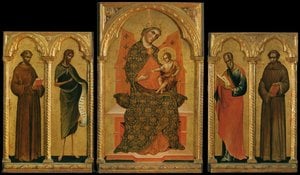
Conversano Polyptych

Explore Bartolomeo Vivarini’s Conversano Polyptych – a stunning 1475 Renaissance altarpiece! Admire its intricate details, gold leaf & religious symbolism at the Gallerie dell'Accademia.

Maître de la Renaissance vénitienne célèbre pour ses œuvres lumineuses à la détrempe comme la Madone à l'Enfant, Bartolomeo Vivarini a mêlé tradition byzantine et nouvelles techniques à l'huile pour laisser un héritage unique.

Reproduction à l'huile faite à la main

Huile sur toile peinte à la main, avec cadre et dimensions personnalisés, réalisée sur commande par nos artistes. ( Passer au format impression Passer au format image numérique)

Corner sample of the P118B picture frame: polystyrène moulé, 5 cm wide and 3 cm thick
P118B €10
Corner sample of the P118H picture frame: polystyrène moulé, 5 cm wide and 3 cm thick
P118H €10
Corner sample of the P118W picture frame: polystyrène moulé, 5 cm wide and 3 cm thick
P118W €10
Corner sample of the P438Z picture frame: polystyrène moulé, 5.5 cm wide and 3.5 cm thick
P438Z €10
Corner sample of the P508JH picture frame: polystyrène moulé, 7 cm wide and 3.5 cm thick
P508JH €12
Corner sample of the P508YH picture frame: polystyrène moulé, 7 cm wide and 3.5 cm thick
P508YH €12
Corner sample of the P805H picture frame: polystyrène moulé, 5 cm wide and 3.5 cm thick
P805H €10
Corner sample of the P805Z picture frame: polystyrène moulé, 5 cm wide and 3.5 cm thick
P805Z €10
Corner sample of the P919BZ picture frame: polystyrène moulé, 7 cm wide and 3.5 cm thick
P919BZ €10
Corner sample of the P919G picture frame: polystyrène moulé, 7 cm wide and 3.5 cm thick
P919G €10
Corner sample of the P919XJ picture frame: polystyrène moulé, 7 cm wide and 3.5 cm thick
P919XJ €10
Corner sample of the P959ZH picture frame: polystyrène moulé, 5 cm wide and 3 cm thick
P959ZH €10
Corner sample of the P968JZ picture frame: polystyrène moulé, 6 cm wide and 4 cm thick
P968JZ €12
Corner sample of the W106C picture frame: bois massif, 5 cm wide and 3 cm thick
W106C €8
Corner sample of the W218G picture frame: bois massif, 5 cm wide and 3 cm thick
W218G €10
Corner sample of the W218JH picture frame: bois massif, 5 cm wide and 3 cm thick
W218JH €8
Corner sample of the W218Y picture frame: bois massif, 5 cm wide and 3 cm thick
W218Y €10
Corner sample of the W307PJ picture frame: bois massif, 6 cm wide and 3 cm thick
W307PJ €10
Corner sample of the W316G picture frame: bois massif, 6 cm wide and 3 cm thick
W316G €10
Corner sample of the W316PJ picture frame: bois massif, 6 cm wide and 3 cm thick
W316PJ €8
Corner sample of the W316Y picture frame: bois massif, 6 cm wide and 3 cm thick
W316Y €10
Corner sample of the W398PJ picture frame: bois massif, 5 cm wide and 3 cm thick
W398PJ €8
Corner sample of the W4111J picture frame: bois massif, 6.5 cm wide and 3.5 cm thick
W4111J €10
Corner sample of the W500HY picture frame: bois massif, 7 cm wide and 5 cm thick
W500HY €15
Corner sample of the W500JH picture frame: bois massif, 7 cm wide and 5 cm thick
W500JH €15
Corner sample of the W692G picture frame: bois massif, 8 cm wide and 4 cm thick
W692G €12
Corner sample of the W849H picture frame: bois massif, 5 cm wide and 3 cm thick
W849H €8
Corner sample of the W940BG picture frame: bois massif, 7.5 cm wide and 4.5 cm thick
W940BG €15
Corner sample of the W953PJ picture frame: bois massif, 6 cm wide and 3.5 cm thick
W953PJ €8

Format standard
personnalisé
CM
INCH

Choisissez parmi nos formats prédéfinis qui respectent les proportions originales de l’œuvre.

largeur
hauteur

Saisissez la largeur et la hauteur souhaitées, pour s'adapter à votre cadre ou à votre mur. Cette œuvre est peinte à la main ; ainsi, pour un format de forme différente, l'artiste peut peindre un peu plus autour du tableau ou réduire légèrement les bords — c'est vous qui choisissez. Nous vous envoyons une maquette numérique pour approbation avant que la peinture ne commence. L'image présentée sur cette page ne reflète pas le résultat réel — seule la maquette le fait.

Exemples de personnalisation possibles : remplacer un visage par la photo du client ; ajouter un animal de compagnie (par exemple, remplacer un chat par un chien) ; inclure un message caché en arrière-plan ; modifier le paysage ou les éléments de l'arrière-plan.
Après la commande, l’équipe WahooArt.com contactera le client par e-mail pour recueillir ses instructions et lui fournira une maquette d’aperçu

Livraison dans le monde entier () en 3 à 4 semaines au lieu des 5 semaines habituelles. (24 octobre). Aucun compromis sur la qualité.

Livraison express gratuite dans le monde entier
Toile de lin de haute qualité
Assurance transport complète
Garantie de remboursement des droits de douane
Garantie de fidélité des couleurs
Garantie de retour de 100 jours (uniquement en cas de défaut)
Garantie de remboursement à 100%
Tarifs dégressifs sur quantité

Prix total

€ 414

Conversano Polyptych

Technique de reproduction

Format de la reproduction

-

Prix total final

€ 414

L'essentiel de l'œuvre

  • Title: Conversano Polyptych
  • Dimensions: 157 x 271 cm
  • Subject or theme: Religious scenes and biblical figures
  • Year: 1475
  • Movement: Renaissance

A Divine Vision in Gold: The Majesty of the Conversano Polyptych

In the heart of the Venetian Renaissance, where the light of the lagoons meets the profound devotion of the era, Bartolomeo Vivarini crafted a masterpiece that transcends time. The Conversano Polyptych, completed in 1475, is not merely an altarpiece but a celestial window into the late Gothic and early Renaissance spirit. As one gazes upon this monumental work, housed within the prestigious Gallerie dell'Accademia, there is an immediate sense of being transported to a sacred realm. The composition, a complex arrangement of multiple panels, orchestrates a narrative of profound religious significance, centered around the Nativity and the presence of holy figures that seem to emerge from a gilded eternity.

The artistry of Vivarini is revealed through his masterful use of tempera on wood panels, a technique that demands absolute precision and foresight. This method allows for an extraordinary level of detail and a saturation of color that remains vibrant centuries later. The central panel serves as the emotional anchor, drawing the viewer into a gathering of figures surrounding a sacred relic, their faces etched with piety and reverence. The use of gold leaf in the background is particularly breathtaking; it does not merely decorate but creates an atmospheric opulence, suggesting a divine light that radiates from within the painting itself, casting a glow upon the intricate headdresses and heavy, embroidered robes of the saints.

Symbolism and the Language of Devotion

Every element within this polyptych is imbued with deep symbolic meaning, designed to guide the faithful through a visual liturgy. The architecture of the piece—divided into distinct sections that separate the heavenly from the earthly—mirrors the hierarchical structure of the universe as understood in the 15th century. Within these frames, the soft curves of halos and the rhythmic placement of figures create a sense of divine order. The Nativity scenes are rich with iconography: the humble manger, the swaddling clothes, and the watchful eyes of Mary and Joseph all serve to ground the miraculous event in a tangible, human reality.

For the discerning collector or interior designer, the Conversano Polyptych offers more than just historical value; it offers an unparalleled aesthetic experience. The interplay of chiaroscuro—the dramatic contrast between light and shadow—adds a sculptural depth to the figures, making them appear almost lifelike within their gilded niches. This tension between the flat, decorative tradition of the Gothic period and the emerging realism of the Renaissance creates a visual complexity that is both intellectually stimulating and emotionally resonant. It is a work that commands attention, bringing a sense of historical weight and spiritual serenity to any space it inhabits.

A Legacy for the Modern Collector

To possess a high-quality reproduction of such a significant work is to invite a piece of Venetian history into one's personal sanctuary. The warmth of the color palette, dominated by rich ochres, deep blues, and radiant golds, provides a sophisticated foundation for luxurious interior design. Whether placed in a grand gallery or a quiet study, the polyptych acts as a focal point of contemplation, echoing the craftsmanship of Bartolomeo Vivarini and the enduring legacy of the Italian masters. It remains a testament to an era where art was the ultimate bridge between the human soul and the divine.

Questions et réponses

Quel emplacement convient au format de «Conversano Polyptych» de Bartolomeo Vivarini ?

Avec sa forme Panoramic, une reproduction de « Conversano Polyptych » est idéale pour un(e) Hotel Lobby.

Quelle est la date de création et le style de «Conversano Polyptych» de Bartolomeo Vivarini ?

«Conversano Polyptych» de Bartolomeo Vivarini date de 1475 et appartient au mouvement Renaissance.

Comment puis-je prévisualiser une reproduction de «Conversano Polyptych» de Bartolomeo Vivarini ?

Pour prévisualiser une reproduction de «Conversano Polyptych» de Bartolomeo Vivarini, ouvrez la page Aperçu de l'œuvre.


Biographie de l'artiste

Un héritage de lumière et de dévotion vénitienne

Dans l'atmosphère vibrante et scintillante du Quattrocento, Bartolomeo Vivarini s'est imposé comme une figure charnière de l'évolution de la peinture vénitienne. Né au cœur du célèbre centre verrier de Murano, en Italie, il faisait partie d'une dynastie d'artistes influents qui ont contribué à façonner l'identité visuelle de la République de Venise. En tant que membre de la famille Vivarini, sa vie et son œuvre étaient profondément liées au pouls artistique de sa patrie, orchestrant la transition entre les traditions dorées et ornées de la fin de la période gothique et l'humanisme naissant de la première Renaissance.

L'art de Vivarini se caractérise par un profond sentiment de profondeur spirituelle et une précision technique remarquable. Bien qu'il fût un maître de la tempera, utilisant souvent la feuille d'or pour imprégner ses compositions d'un luxe céleste, il fut également un innovateur dans l'usage de nouveaux médiums. On note qu'il apprit l'art de la peinture à l'huile auprès d'Antonello da Messina, et on lui attribue la production de ce qui est considéré comme la première peinture à l'huile à Venise vers 1473. Cette maîtrise lui permit de manipuler la lumière et la texture d'une manière qui insuffla une nouvelle dimension d'intimité et de sérénité à ses sujets religieux.

Maîtrise de la forme et symbolisme

L'œuvre de Vivarini présente souvent un équilibre frappant entre des contours nets et définis et une palette de couleurs riche et émotive. Ses figures possèdent fréquemment une expression digne et dévote, capturant la solennité requise pour les retables qui ornaient les basiliques vénitiennes. Cette capacité à transmettre l'émotion humaine à travers des formes structurées fit de lui un peintre très sollicité pour d'importantes commandes religieuses. Un exemple notable de son talent se trouve dans sa Madone à l'Enfant, où il utilise la lumière pénétrant par les fenêtres et des draperies rouge profond pour créer un sentiment d'espace sacré.

Au-delà des figures elles-mêmes, les peintures de Vivarini sont souvent imprégnées de significations symboliques :

  • L'usage de l'or : Son application fréquente de la feuille d'or ne sert pas seulement de décoration, mais agit comme un médium pour représenter la lumière divine.
  • Motifs naturels : Dans un clin d'œil charmant à son nom — puisque vivarino se traduit par chardonneret en italien — il incluait occasionnellement ce petit oiseau comme une signature subtile au sein de ses œuvres.
  • Profondeur architecturale : Ses compositions, telles que le Polyptyque de Conversano, démontrent une compréhension sophistiquée de la perspective et l'intégration de figures sacrées dans des structures complexes à plusieurs panneaux.

Importance historique et influence artistique

L'importance historique de Bartolomeo Vivarini réside dans son rôle de pont entre les époques. Il se trouvait au carrefour des traditions d'influence byzantine de ses prédécesseurs et des styles révolutionnaires de la Renaissance apportés par des artistes tels que Fra Angelico et Giovanni Bellini. En fusionnant ces diverses influences, il a aidé à établir un langage visuel vénitien unique, privilégiant la couleur lumineuse et la résonance émotionnelle.

Son influence s'est étendue à travers sa lignée familiale, impactant notamment le travail de son neveu, Alvise Vivarini, qui deviendra un artiste de premier plan à Venise avant l'ascension de Bellini. Par la minutie de ses détails et son adoption pionnière des techniques à l'huile, Bartolomeo Vivarini a laissé une marque indélébile dans l'histoire de l'art italien, garantissant que la grandeur spirituelle et esthétique de Murano et de Venise soit préservée pour les générations à venir.

Bartolomeo Vivarini

Bartolomeo Vivarini

1440 - 1499 , Italie

En bref

  • Artistic Movement Or Style: Renaissance vénitienne
  • Artists Or Movements Influenced By This Artist: ['Alvise Vivarini']
  • Artists Who Influenced This Artist:
    • Antonello da Messina
    • Fra Angelico
  • Date Of Birth: 1440
  • Date Of Death: 1499
  • Full Name: Bartolomeo Vivarini
  • Nationality: Italien
  • Notable Artworks:
    • Madone et l'Enfant
    • Polyptyque de Conversano
    • Triptyque (détail)
  • Place Of Birth: Murano, Italie
Explorez des œuvres d'art classées par thèmes, styles et caractéristiques.