Aperçu en situationAperçu en situation Aperçu en RAAperçu en RA Passer au format impression Passer au format impressionPasser au format image numérique Passer au format image numérique PartagerPartager
DétailsDétails Ajouter aux favoris Ajouter aux favoris TéléchargerTélécharger Articles similairesArticles similaires RadiographieRadiographie Voir le diaporamaVoir le diaporama StatistiquesStatistiques

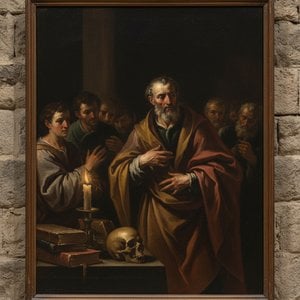
Saint Jerome reading

Bartolomé Esteban Murillo’s serene Saint Jerome reading embodies the contemplative spirit of Seville’s Baroque era, capturing a moment of profound devotion amidst a warmly lit interior adorned with books—a timeless masterpiece to admire or collect.

Découvrez Murillo (1618-1682), maître baroque espagnol ! Ses œuvres religieuses lumineuses & ses scènes de genre captivantes en font un artiste incontournable.

Reproduction à l'huile faite à la main

Huile sur toile peinte à la main, avec cadre et dimensions personnalisés, réalisée sur commande par nos artistes. (Passer au format impression Passer au format impressionPasser au format image numérique Passer au format image numérique)

P118B $10
P118H $10
P118W $10
P438Z $10
P508JH $12
P508YH $12
P805H $10
P805Z $10
P919BZ $10
P919G $10
P919XJ $10
P959ZH $10
P968JZ $12
W106C $8
W218G $10
W218JH $8
W218Y $10
W307PJ $10
W316G $10
W316PJ $8
W316Y $10
W398PJ $8
W4111J $10
W500HY $15
W500JH $15
W692G $12
W849H $8
W940BG $15
W953PJ $8

Format standard
personnalisé
CM
INCH

Choisissez parmi nos formats prédéfinis qui respectent les proportions originales de l’œuvre.

largeur
hauteur

Vous pouvez saisir vos propres dimensions pour l'adapter à un cadre ou à un espace spécifique. Si la taille sélectionnée ne correspond pas aux proportions de l'image d'origine, nous recadrerons l'œuvre ou prolongerons la peinture avec des éléments peints à la main supplémentaires. Une maquette numérique vous sera envoyée pour approbation avant le début de la production.
Veuillez noter que l'aperçu à l'écran ne reflète pas le recadrage ou l'extension réels. Seule la maquette montrera fidèlement la composition finale.
Bien que des tailles personnalisées soient disponibles, nous vous recommandons de sélectionner une dimension dans la liste prédéfinie afin de préserver les proportions d'origine.

Exemples de personnalisation possibles : remplacer un visage par la photo du client ; ajouter un animal de compagnie (par exemple, remplacer un chat par un chien) ; inclure un message caché en arrière-plan ; modifier le paysage ou les éléments de l'arrière-plan.
Après la commande, l’équipe WahooArt.com contactera le client par e-mail pour recueillir ses instructions et lui fournira une maquette d’aperçu

Livraison dans le monde entier () en 3 à 4 semaines au lieu des 5 semaines habituelles. (12 septembre). Aucun compromis sur la qualité.

why_choose_icon
Livraison express gratuite dans le monde entier
why_choose_icon
Toile de lin de haute qualité
why_choose_icon
Assurance transport complète
why_choose_icon
Garantie de remboursement des droits de douane
why_choose_icon
Garantie de fidélité des couleurs
why_choose_icon
Garantie de retour de 100 jours (uniquement en cas de défaut)
why_choose_icon
Garantie de remboursement à 100%
why_choose_icon
Tarifs dégressifs sur quantité

Prix total

$ 272

reproduction

Saint Jerome reading

Technique de reproduction

Format de la reproduction

-

Prix total final

$ 272

L'essentiel de l'œuvre

  • Year: 1652
  • Subject or theme: Religious contemplation
  • Artistic style: Realistic
  • Artist: Bartolomé Esteban Murillo
  • Title: Saint Jerome reading
  • Movement: Baroque
  • Notable elements or techniques: Warm lighting

A Sanctuary of Silence: The Soul of Murillo’s Saint Jerome

In the quiet corners of art history, few images capture the essence of spiritual devotion as tenderly as Bartolomé Esteban Murillo’s Saint Jerome Reading. Painted in 1652, this masterpiece serves as a profound window into the contemplative heart of the Spanish Baroque. Rather than presenting a saint in a moment of grand, miraculous intervention, Murillo invites us into a private, humble sanctuary. Here, the formidable scholar and Doctor of the Church is stripped of ecclesiastical pomp, depicted instead as a man lost in the rhythmic dance of intellect and faith. As he pores over his texts amidst a dimly lit interior, the painting transcends mere religious iconography to become a universal portrait of solitude, focus, and the pursuit of truth.

The emotional resonance of the work lies in its ability to transform a simple room into a sacred space. The presence of a flickering fireplace casts a gentle, amber glow across the scene, weaving a sense of warmth and domesticity that softens the ascetic nature of Saint Jerome’s life. This subtle interplay of light and shadow—a hallmark of Murillo’s mature style—creates an atmosphere of profound stillness. For the modern collector or interior designer, this piece offers more than just visual beauty; it provides an emotional anchor, a sense of "quietude" that can transform a bustling room into a place of reflection and peace.

Mastery of Light and the Andalusian Glow

To observe Murillo’s technique is to witness the mastery of luminosity. Moving away from the harsh, theatrical shadows of Caravaggio, Murillo pioneered a more delicate, diffused approach to light. In Saint Jerome Reading, he employs a sophisticated use of glazing—applying thin, translucent layers of oil paint to build a depth that seems to radiate from within the canvas itself. This technique allows the light from the fireplace to bleed softly into the textures of the weathered book pages and the rugged skin of the saint, creating a tactile richness that invites the eye to linger.

The palette is intentionally muted, dominated by earthy tones, deep browns, and warm ochres, which ensures that the viewer's focus remains fixed on the subject's intense concentration. The way the light catches the edges of the scattered books and the folds of Jerome’s garments creates a rhythmic movement throughout the composition. This soft-focus brilliance is what defines the "Sevillian" style, making the artwork feel less like a static image and more like a living, breathing moment captured in time. For those seeking to adorn a space with art that feels both substantial and ethereal, Murillo’s ability to balance weight and light is unparalleled.

Historical Echoes and Timeless Symbolism

The creation of this work in 1652 places it at the height of the Spanish Golden Age, a period when Seville was a pulsating nexus of global trade and religious fervor. Under the reign of the Habsburgs, art served as a vital tool for reinforcing Catholic piety. Murillo, however, manages to navigate this era of intense dogma by focusing on the human element of the divine. The symbolism within the painting is subtle yet deeply layered: the books represent the intellectual rigor of the scholar, while the humble setting and the solitary figure embody the asceticism of the hermit.

Every element in the room—from the scattered manuscripts to the simple chair in the background—contributes to a narrative of dedication. There is no distraction here, only the singular pursuit of wisdom. This theme of "devotion to a craft" or "dedication to knowledge" remains incredibly relevant in our contemporary, fragmented world. Owning a high-quality reproduction of this work allows one to bring this spirit of focused intention into the home, serving as a constant reminder of the beauty found in deep thought and the quiet strength of a life lived with purpose.


Biographie de l'artiste

Premières années et formation

Bartolomé Esteban Murillo, un peintre baroque espagnol de premier plan, est né à Séville, en Espagne, fin décembre 1617 et a été baptisé le 1er janvier 1618. Il était le plus jeune des quatorze enfants de Gaspar Esteban et María Pérez. Après la mort de ses parents en 1627 et 1628, Murillo devint l'ami de son beau-frère, Juan Agustín Lagares. Murillo commença ses études artistiques à Séville sous la direction de Juan del Castillo, un parent de sa mère qui était également artiste. Ses premières œuvres furent influencées par l’approche réaliste et forte de Zurbarán, Jusepe de Ribera et Alonzo Cano.

Évolution artistique et style

Le style artistique de Murillo évolua au fil du temps, initialement influencé par la peinture flamande et le « traité sur les images sacrées » de Molanus. À mesure qu'il mûrit, son travail développa un style raffiné qui convenait aux goûts bourgeois et aristocratiques de l’époque, en particulier dans ses œuvres religieuses catholiques romaines.
  • Jeune homme avec un panier de fruits ou Personification de l'été (c. 1640-50), illustrant son approche réaliste précoce.
  • Le Jeune Mendiant (c. 1645, Musée du Louvre, Paris, France), démontrant l’influence de Velázquez.
  • Saint Jérôme (c. 1650-52), exemplifiant son style mature, doucement lumineux.

Œuvres majeures et thèmes

Murillo est particulièrement connu pour ses représentations touchantes de l'Enfant Jésus, souvent dépeint comme un enfant jouant ou distribuant de la nourriture aux pauvres. Ces œuvres, empreintes d’une tendresse particulière, captivent par leur réalisme et leur émotion. Il a également peint des scènes de la Vierge Marie avec l'Enfant Jésus, ainsi que des saints et des figures religieuses, toujours caractérisées par une lumière douce et une composition harmonieuse. Ses tableaux de genre, comme Le Jeune Mendiant, témoignent de son intérêt pour les sujets contemporains et de sa capacité à capturer la vie quotidienne avec réalisme et compassion.

Collections et héritage

Les peintures de Murillo se trouvent dans divers musées du monde entier, notamment :
  • Le Museo del Prado (Madrid, Espagne)
  • L’Ermitage (Saint-Pétersbourg, Russie)
  • La Wallace Collection (Londres)
  • Le Timken Museum of Art (San Diego, présentant le Christ sur la croix)
  • Le Krannert Art Museum (Champaign, Illinois, présentant le Christ après la flagellation)
Murillo eut de nombreux élèves et disciples, assurant sa réputation en Espagne et sa renommée dans toute l'Europe. Des artistes tels que Gainsborough et Greuze furent influencés par son style. Son œuvre continue d’être admirée pour sa beauté, sa tendresse et sa capacité à toucher le cœur des spectateurs.
Bartolomé Esteban Murillo

Bartolomé Esteban Murillo

1618 - 1682 , Espagne

En bref

  • Artistic Movement Or Style: Baroque espagnol
  • Artists Or Movements Influenced By This Artist:
    • Gainsborough
    • Greuze
  • Artists Who Influenced This Artist:
    • Zurbarán
    • Jusepe de Ribera
    • Alonzo Cano
    • Velázquez
  • Date Of Birth: 1618
  • Date Of Death: 1682
  • Full Name: Bartolomé Esteban Murillo
  • Nationality: Espagnol
  • Notable Artworks:
    • Jeune homme avec un panier de fruits
    • Le Jeune Mendiant
    • Saint Jérôme
    • L'Adoration des bergers
  • Place Of Birth (City And Country): Séville, Espagne
Explorez des œuvres d'art classées par thèmes, styles et caractéristiques.