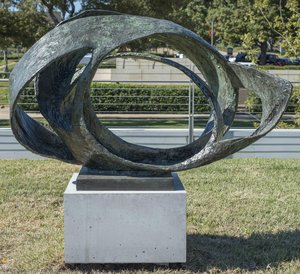
The Essence of Vitality: Reimagining Hepworth’s Spring
In the quiet dialogue between form and space, few works resonate with the rhythmic pulse of life quite like Barbara Hepworth’s Spring. A masterpiece of British Modernism, this sculpture serves as a profound meditation on the cyclical nature of existence. At first glance, the viewer is met with an evocative, egg-like silhouette—a shape that inherently suggests the potentiality of new beginnings. Yet, this organic smoothness is masterfully disrupted by horizontal strings that radiate from a central hollow, creating a tension between the enclosed interior and the expansive exterior world. It is a piece that does not merely sit in a room; it breathes within it, inviting the observer to contemplate the delicate balance between protection and release.
The technical brilliance of Spring lies in its origins and execution. While the version held within the Arts Council Collection captures the monumental presence of Hepworth’s vision, the work finds its soul in the meticulous technique of dry carving. Originally conceived from an elmwood carving titled Oval Form with Strings and Colour in 1965, the sculpture showcases a sophisticated interplay of light and shadow. The way the light catches the textured surfaces and traverses the hollowed center evokes the sensation of sunlight filtering through a forest canopy. For the discerning collector or interior designer, this piece offers a sculptural depth that transforms any space, providing a focal point that is both intellectually stimulating and visually soothing.
A Symphony of Abstraction and Symbolism
To understand Spring is to delve into the heart of the abstraction-création movement. Influenced by her formative years in Paris and the surrealist currents of the interwar period, Hepworth sought to move beyond mere representation. She did not wish to sculpt a literal egg, but rather the feeling of fertility, resilience, and rebirth. The strings, stretched across the void, act as umbilical connections to the environment, symbolizing how all living things are tethered to the cosmos. This sense of connectivity makes the artwork particularly poignant for modern living spaces, where the desire to bring organic, soulful elements indoors is at its peak.
The emotional impact of the work is found in its duality: it is simultaneously heavy and weightless, solid yet permeable. The dark, commanding tones of the sculpture provide a grounding presence, while the rhythmic lines suggest movement and growth. For those seeking to curate an environment of sophistication and tranquility, a high-quality reproduction of Spring offers more than just decoration; it provides a window into the sublime. It is an invitation to pause, to breathe, and to reconnect with the primordial rhythms of the natural world through the lens of one of the twentieth century's greatest artistic visionaries.



 Passer au format impression
 Partager
 Partager
 Détails
 Guide
Guide

 Télécharger
 Articles similaires
 Voir le diaporama
 Statistiques


 Afficher la suite






































 L'option verre n'est disponible que pour les dimensions inférieures à 110 cm.