Passer au format impression Passer au format image numérique Partager
Détails Ajouter aux favoris Télécharger Articles similaires Voir le diaporama Statistiques

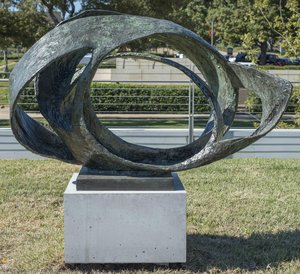
Pierced Hemisphere I

Explore 'Pierced Hemisphere I' by Dame Barbara Hepworth – a striking 1937 marble sculpture embodying modernism & abstract form. Discover its texture, symbolism & artistic significance.

Découvrez Barbara Hepworth (1903-1975), pionnière de la sculpture britannique moderne ! Explorez ses œuvres abstraites, dont 'Oval Form' et 'Two Forms', au Hepworth Wakefield.

Reproduction à l'huile faite à la main

Huile sur toile peinte à la main, avec cadre et dimensions personnalisés, réalisée sur commande par nos artistes. ( Passer au format impression Passer au format image numérique)

Format standard
personnalisé
CM
INCH

Choisissez parmi nos formats prédéfinis qui respectent les proportions originales de l’œuvre.

largeur
hauteur

Vous pouvez saisir vos propres dimensions pour l'adapter à un cadre ou à un espace spécifique. Si la taille sélectionnée ne correspond pas aux proportions de l'image d'origine, nous recadrerons l'œuvre ou prolongerons la peinture avec des éléments peints à la main supplémentaires. Une maquette numérique vous sera envoyée pour approbation avant le début de la production.
Veuillez noter que l'aperçu à l'écran ne reflète pas le recadrage ou l'extension réels. Seule la maquette montrera fidèlement la composition finale.
Bien que des tailles personnalisées soient disponibles, nous vous recommandons de sélectionner une dimension dans la liste prédéfinie afin de préserver les proportions d'origine.

Exemples de personnalisation possibles : remplacer un visage par la photo du client ; ajouter un animal de compagnie (par exemple, remplacer un chat par un chien) ; inclure un message caché en arrière-plan ; modifier le paysage ou les éléments de l'arrière-plan.
Après la commande, l’équipe WahooArt.com contactera le client par e-mail pour recueillir ses instructions et lui fournira une maquette d’aperçu

Livraison dans le monde entier () en 3 à 4 semaines au lieu des 5 semaines habituelles. (20 septembre). Aucun compromis sur la qualité.

why_choose_icon
Livraison express gratuite dans le monde entier
why_choose_icon
Toile de lin de haute qualité
why_choose_icon
Assurance transport complète
why_choose_icon
Garantie de remboursement des droits de douane
why_choose_icon
Garantie de fidélité des couleurs
why_choose_icon
Garantie de retour de 100 jours (uniquement en cas de défaut)
why_choose_icon
Garantie de remboursement à 100%
why_choose_icon
Tarifs dégressifs sur quantité

Prix total

$ 272

reproduction

Pierced Hemisphere I

Technique de reproduction

Format de la reproduction

-

Prix total final

$ 272

L'essentiel de l'œuvre

  • Notable elements: Fragmented sphere, curved lines
  • Dimensions: 35 x 38 cm
  • Artistic style: Abstract Sculpture
  • Subject or theme: Geometric Form
  • Year: 1937
  • Artist: Barbara Hepworth
  • Title: Pierced Hemisphere I

A Fragmented Sphere: Barbara Hepworth’s Pierced Hemisphere I

Barbara Hepworth's "Pierced Hemisphere I," crafted in 1937 from pristine white marble, isn’t merely a sculpture; it’s an invitation to contemplate the delicate balance between wholeness and disruption. This arresting piece, currently housed at The Hepworth Wakefield, embodies the core tenets of Hepworth’s modernist approach – a profound exploration of form, texture, and the inherent dynamism within static materials. It speaks to a world grappling with change, mirroring both the beauty of natural processes and the unsettling implications of fragmentation.

The sculpture itself presents as a subtly distorted hemisphere, its surface punctuated by a decisive, almost violent, incision. This ‘piercing’ isn't destructive in the traditional sense; rather, it reveals an inner structure, suggesting a hidden geometry beneath the apparent solidity of the stone. The curve is not perfectly smooth – instead, it possesses a gentle undulation, hinting at movement and echoing the rhythms found in nature. The choice of white marble is crucial, lending an ethereal quality to the work. Marble’s inherent translucence allows light to penetrate and play across its surface, creating a shifting interplay of shadows that further emphasize the sculpture's three-dimensional form.

The Context of Modernism and Abstraction

To fully appreciate "Pierced Hemisphere I," it’s essential to situate it within the broader context of early 20th-century art. Hepworth, along with figures like Ben Nicholson and Paul Nash, was a pivotal member of the Unit One group – an avant-garde collective dedicated to forging a distinctly British approach to modernism. Unit One sought to move beyond representational art, embracing abstraction and exploring new ways of expressing form and space. This period witnessed a significant shift away from traditional sculptural techniques, with artists experimenting with materials like wood, metal, and, crucially for Hepworth, stone.

Hepworth’s work during this time was deeply influenced by the principles of Cubism and Constructivism – movements that emphasized geometric forms and explored the relationship between two-dimensional and three-dimensional space. However, she resisted rigid adherence to these styles, developing a uniquely personal language characterized by flowing lines, subtle curves, and an intuitive understanding of material properties. The influence of Surrealism is also evident in her exploration of subconscious imagery and the evocative power of abstract forms.

Symbolic Resonance: Wholeness and Disruption

The symbolism embedded within "Pierced Hemisphere I" is layered and open to interpretation. The hemisphere itself represents wholeness, a complete form – a symbol often associated with the cosmos or the human psyche. Yet, the incision disrupts this perfect unity, suggesting a loss of innocence, a confrontation with reality, or perhaps even an acknowledgement of inherent imperfection. It’s not simply a break; it's a revelation, exposing a new dimension within the original shape.

Some art historians have linked the pierced form to Hepworth’s personal experiences – her divorce and subsequent move to St Ives, where she found inspiration in the rugged Cornish coastline. The sculpture can be seen as a metaphor for navigating life's challenges, embracing both beauty and sorrow, and finding strength in resilience. The subtle variations in tone within the marble further contribute to this sense of complexity, mirroring the nuances of human emotion.

Craftsmanship and Technique

Hepworth’s mastery of her chosen medium – white marble – is undeniable. The sculpture demonstrates a remarkable sensitivity to material properties; she skillfully exploited the stone's natural veining and grain to create a surface that is both smooth and tactile. The precision of the incision itself speaks volumes about Hepworth’s technical skill, requiring immense control and an intimate understanding of how marble responds to tools.

The piece was created using traditional carving techniques, yet with a distinctly modern sensibility. The artist's hand is evident in the subtle imperfections and irregularities that add character and depth to the work. "Pierced Hemisphere I" stands as a testament to Hepworth’s ability to transform raw material into a powerful and enduring statement of artistic vision. It remains a compelling example of how sculpture can engage with fundamental questions about form, space, and the human condition.


Biographie de l'artiste

Premières années et formation

Dame Barbara Hepworth, une artiste et sculptrice anglaise de renom, est née le 10 janvier 1903 à Wakefield, dans le Yorkshire. Elle a fréquenté la Leeds School of Art à partir de 1920 puis a remporté une bourse du comté pour étudier à la Royal College of Art (RCA) à Londres de 1921 jusqu'à ce qu'elle obtienne le diplôme en 1924.

Carrière artistique

  • L’œuvre de Dame Barbara Hepworth exemplifie le modernisme, en particulier la sculpture moderne. Elle était l'une des rares artistes féminines à atteindre une reconnaissance internationale.
  • En 1933, elle a cofondé le mouvement artistique Unit One avec Ben Nicholson, Paul Nash et d'autres, cherchant à unir le surréalisme et l'abstraction dans l'art britannique.
  • Le travail précoce de Hepworth était caractérisé par l'abstraction et son implication avec le mouvement artistique parisien, Abstraction-Création.

Œuvres notables et expositions

Évolution artistique et influences

L'œuvre de Hepworth a évolué au fil des ans, passant d'abstractions influencées par le cubisme et le surréalisme à des formes plus organiques et abstraites. Son séjour en France dans les années 1930, où elle a rencontré des artistes comme Brancusi et Arp, a été déterminant pour son développement artistique. Elle s’est intéressée aux formes naturelles, notamment celles trouvées dans la mer et le paysage de Cornouailles, où elle a vécu pendant une grande partie de sa carrière.

Héritage et collections muséales

L'œuvre de Barbara Hepworth est largement reconnue, ses sculptures et peintures faisant partie de diverses collections de musées dans le monde. Le Hepworth Wakefield, du nom de l'artiste, abrite de nombreux chefs-d'œuvre d'artistes renommés, dont les propres œuvres de Hepworth. (découvrez davantage sur le Hepworth Wakefield sur WahooArt)

Conclusion

Dame Barbara Hepworth’s pioneering work in modern British sculpture has left an indelible mark on the art world. Her legacy continues to inspire artists and art enthusiasts alike, with her works remaining a testament to her innovative spirit and artistic genius. more about barbara hepworth on wikipedia
Barbara Hepworth

Barbara Hepworth

1903 - 1975 , Royaume-Uni

En bref

  • Artistes Influents:
    • Brancusi
    • Henry Moore
    • Ben Nicholson
  • Date De Naissance: 10 janvier 1903
  • Lieu De Naissance: Wakefield, Royaume-Uni
  • Mouvement Artistique: Modernisme, Sculpture abstraite
  • Nationalité: Britannique
  • Nom Complet: Barbara Hepworth
  • Oeuvres Notables:
    • Oval Form (Trezion)
    • Two Forms
    • Totem
Explorez des œuvres d'art classées par thèmes, styles et caractéristiques.