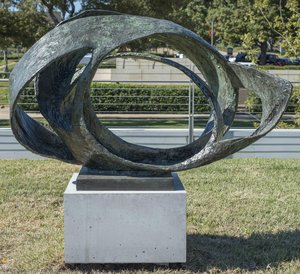
Barbara Hepworth: Mask – A Meditation on Form and Silence
Barbara Hepworth (1903–1975), considered one of Britain’s foremost sculptors, produced monumental works that explored the relationship between geometric abstraction and organic form. Her oeuvre is characterized by a profound sensitivity to material—particularly stone—and an unwavering commitment to distilling visual experience into its purest essence.
“Mask,” created in 1928, exemplifies Hepworth’s distinctive approach. Executed from alabaster, the sculpture presents a deceptively simple geometric shape – a roughly oval form – yet it possesses an arresting presence due to its subtly textured surface and carefully considered positioning within its wooden frame.
Hepworth's artistic journey began at Leeds School of Art in 1920, where she honed her skills before securing a prestigious scholarship to the Royal College of Art. Influenced by Surrealist ideas and championed by Ben Nicholson, Paul Nash, and others, Hepworth established Unit One Art Movement, aiming for a fusion between abstraction and surrealism.
The sculpture’s material—alabaster—was chosen deliberately. Its milky translucence allows light to penetrate through the stone, creating an ethereal glow that enhances its sculptural qualities. The surface is treated with meticulous attention to detail, employing techniques such as polishing and grinding to achieve a smooth, polished finish while retaining subtle irregularities that contribute to the piece’s tactile character.
“Mask” transcends mere visual representation; it invites contemplation on themes of concealment and revelation. Its form echoes ancient ceremonial masks—symbols of ritual and transformation—suggesting an exploration of psychological states and primal instincts. Hepworth's masterful manipulation of space and material underscores the sculpture’s enduring power to provoke emotion and stimulate intellectual curiosity.
The artwork is housed in The Hepworth Wakefield, United Kingdom, where it continues to captivate visitors with its understated elegance and profound artistic vision. Its inclusion in the Piasecka-Johnson Collection further cements Hepworth's legacy as a pivotal figure in modern sculpture.



 Passer au format impression
 Partager
 Partager
 Détails

 Télécharger
 Articles similaires
 Voir le diaporama
 Statistiques


 Afficher la suite






































 L'option verre n'est disponible que pour les dimensions inférieures à 110 cm.