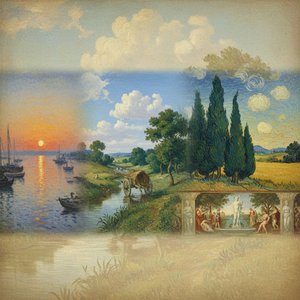
A Portuguese Painter’s Journey Through Time
Artur José de Sousa Loureiro, a prominent figure in the vibrant tapestry of Portuguese art, left an indelible mark on the canvas of history. Born on February 11, 1853, in Porto, and passing away on July 7, 1932, his life was a testament to artistic evolution, embracing diverse influences and culminating in a significant contribution to both the national and international art scenes. His journey spanned continents, reflecting a restless spirit and an unwavering dedication to his craft.
Early Beginnings and Formative Years
Loureiro’s initial steps into the world of art were guided by the mentorship of his close friend, António José da Costa. Under Da Costa's tutelage, he honed the fundamental skills of drawing and painting, laying a solid foundation for his future endeavors. This early training led him to the Escola Superior de Belas-Artes do Porto, where he studied under the esteemed guidance of João António Correia. It was during this period that Loureiro began to develop his unique artistic voice, absorbing the principles of academic art while simultaneously seeking inspiration from the burgeoning movements of the time. The influence of Correia, a respected figure in Portuguese art education, undoubtedly shaped Loureiro’s approach to composition and technique.
A Journey Across Continents
Loureiro's artistic trajectory took an exciting turn with the support of his patron, Delfim Deodato Guedes. In 1875, he embarked on a transformative journey to Rome, immersing himself in the rich artistic heritage of the Eternal City. This experience broadened his horizons considerably, exposing him to classical art and architectural grandeur. Subsequently, in 1879, he moved to Paris, securing a scholarship to study at the École des Beaux-Arts. Life in the Latin Quarter proved stimulating, allowing him to engage with the vibrant artistic community and refine his skills under the tutelage of renowned instructors. He became part of the Parisian art scene, exhibiting at the Salon de 1880 through 1882 alongside fellow Portuguese artists like João Marques de Oliveira and António Silva Porto. His time in Paris was marked by a growing awareness of contemporary artistic trends and a desire to push the boundaries of his own style.
A pivotal moment in Loureiro’s career arrived with his emigration to Australia in 1884, accompanied by his wife, Marie Huybers. This move represented a significant shift, as he settled in Melbourne and began contributing to the burgeoning Australian art community. The decision was driven partly by personal circumstances – Marie's origins – but also by an opportunity to experience a new environment and explore different artistic landscapes. He quickly established himself within the local scene, participating in exhibitions organized by the Australian Art Association and eventually becoming a professor of design at the Presbyterian Ladies’ Academy.
Notable Works and Achievements
Loureiro’s artistic output spanned various genres, including landscape paintings, portraits, and depictions of animals. His work often reflected his experiences and observations across different cultures. A particularly poignant piece is *The Death of Burke* (1892), a powerful portrayal capturing the tragic fate of explorer Robert Burke and his party in the Australian outback. The painting, based on sketches provided by Alfred Howitt, demonstrates Loureiro’s ability to convey emotion and narrative through visual imagery. His involvement with the Australian Art Association and his role as an educator further solidified his position within the country's artistic landscape. In 1899, he received the gold medal at the International Exhibition in London, a prestigious recognition of his talent and dedication.
Legacy and Remembrance
Loureiro’s return to Porto in 1904 marked a new phase in his life. He established a studio at the “Crystal Palace,” a purpose-built exhibition hall that became a hub for artists and art enthusiasts. His second marriage in 1918 to Elisa Fernanda de Sousa Pires brought further stability and personal fulfillment. Despite passing away in 1932, Loureiro’s legacy endures through numerous exhibitions and the lasting impact he had on the Portuguese art world. His work continues to be appreciated for its technical skill, evocative imagery, and insightful portrayal of human experience and the natural world.
Key Links: -
artur josé de sousa loureiro | WahooArt.com -
artur loureiro - wikipedia -
palavras cruzadas vii | WahooArt.com



 Aperçu en situation
 Acheter la peinture faite à la main
 Partager
 Partager
 Détails
 Guide
Guide

 Télécharger
 Articles similaires
 Radiographie
 Voir le diaporama
 Statistiques


 Afficher la suite






































 L'option verre n'est disponible que pour les dimensions inférieures à 110 cm.