Impressions giclées ou sur toile de qualité musée, avec une production rapide et des finitions au choix. ( Commander la reproduction peinte à la main Passer au format numérique)





























Choisissez parmi nos formats prédéfinis qui respectent les proportions originales de l’œuvre.

Saisissez la largeur et la hauteur souhaitées pour qu'elles s'adaptent à votre cadre ou à votre mur. Une impression peut être recadrée, mais jamais agrandie au-delà de l'image originale ; ainsi, un format de forme différente entraînera la perte d'une partie de l'image. Nous vous envoyons une maquette numérique pour approbation avant toute impression. L'image présentée sur cette page ne montre pas le recadrage réel — seule la maquette le permet.
Livraison dans le monde entier () en 2 semaines au lieu des 4/5 semaines habituelles. (10 novembre)
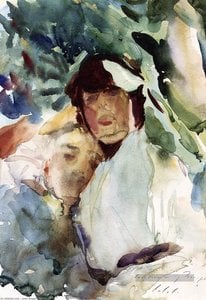
The Peacock Feather
Format de la reproduction
To gaze upon this depiction of a musician lost in his art is to witness time itself slowing down. The scene captures a young man utterly absorbed by the resonance of his violin, an act so deeply personal it seems to exist outside the clamor of the surrounding world. It is not merely a portrait; it is an immersion into the very spirit of creation. The artist has masterfully rendered this fleeting moment, allowing the viewer to feel the vibration of the bow against the strings and the profound solitude that accompanies true artistic passion. This piece speaks directly to the universal human experience of finding solace and expression through melody.
The technical brilliance of this work lies in its commitment to capturing an atmosphere rather than merely recording a likeness. The style leans heavily into late 19th-century Impressionism, evident in the visible, expressive brushstrokes that give life to every patch of color. Observe how the background dissolves into a dense, swirling tapestry of foliage—a vibrant, almost palpable curtain of greens and shadows. This is not a sharply defined backdrop; rather, it is an emotional echo chamber created through layered washes of paint. The artist prioritizes the interplay of light and shadow, using soft, diffused illumination to gently sculpt the contours of the musician’s face and the rich texture of his attire. It is this masterful handling of *sfumato* effect within a looser framework that gives the painting its dynamic, breathing quality.
Created in 1875, this work situates itself within a vibrant period of artistic transition, echoing the observational spirit championed by masters like Monet and Renoir. While the subject matter evokes the romanticism often associated with Parisian Impressionism, the underlying dedication to capturing human drama connects it to the profound realism found in Italian art traditions. The artist’s ability to blend vigorous technique with an almost lyrical sensitivity suggests a deep understanding of both formal structure and emotional spontaneity. It is a testament to the power of observation filtered through a highly skilled hand.
The symbolism woven into this canvas is rich and multilayered. The solitary musician represents introspection—the necessary withdrawal required for profound self-discovery or artistic breakthrough. His focus suggests a dialogue between man and art, a communion that requires shutting out the external world. Juxtaposed against this intense inner life is the enveloping natural setting. The foliage acts as both a beautiful enclosure and a visual metaphor for the subconscious mind—lush, complex, and sometimes overwhelming. It invites contemplation on themes of passion, melancholy, and the enduring power of art to connect us to something deeper than ourselves.
For collectors or designers seeking an artwork that transcends mere decoration, this piece offers narrative depth. Its vibrant color palette and palpable sense of movement make it a captivating focal point for any room. Owning a reproduction allows one to bring home not just paint on canvas, but a carefully preserved moment of pure artistic feeling—a whisper of late 19th-century passion rendered with modern appreciation for its evocative power.
Dans « The Peacock Feather », des couleurs Earthy accompagnent une sensation Passionate.
«The Peacock Feather» date de 1875. Cette date inscrit l'œuvre dans la carrière de Antonio Mancini ainsi que dans son époque.
L'émotion Passionate de « The Peacock Feather » accompagne son style Impressionism.

Antonio Mancini (1852-1930) était un peintre italien célébré, renommé pour ses représentations poignantes de la vie quotidienne, se concentrant particulièrement sur les communautés marginalisées de Naples. Né à Rome, en Italie, Mancini a manifesté un talent artistique remarquable dès son plus jeune âge. À seulement douze ans, il a été admis à l'Institut des Beaux-Arts de Naples, où il a étudié sous la direction d'éminents artistes tels que Domenico Morelli et Filippo Palizzi. Ces expériences formatrices ont profondément façonné sa trajectoire artistique, jetant les bases de son style distinctif enraciné dans le Vériisme.
Le début de carrière de Mancini a été marqué par un développement rapide sous la tutelle de Morelli, qui mettait l'accent sur des clair-obscurs dramatiques et une touche vigoureuse. Palizzi a encore affiné les compétences de Mancini, encourageant une attention particulière à l’observation réaliste. Dès 1872, il avait déjà exposé son travail au Salon de Paris, démontrant un talent émergent reconnu au-delà de l'Italie. Ses sensibilités artistiques ont été considérablement influencées par ses rencontres avec les peintres impressionnistes Edgar Degas et Édouard Manet lors de son séjour à Paris. L’amitié avec John Singer Sargent, qui a déclaré Mancini être « le plus grand peintre vivant », a encore renforcé sa réputation au sein de la scène artistique européenne.
Mancini est devenu une figure de proue du mouvement vériiste, une réponse italienne à l'esthétique réaliste du XIXe siècle. Cette philosophie artistique privilégiait la représentation de la vie telle qu’elle était, sans idéalisation ni romantisme. Les sujets de Mancini étaient souvent tirés des rues de Naples : enfants pauvres, artistes de cirque juvéniles et musiciens. Ses œuvres les plus célèbres, telles que *Il Saltimbanco* (1877-78), capturent un sentiment de fragilité et de vulnérabilité dans ses portraits d'individus marginalisés. Il employait une technique d’empâtement saisissante sur la toile, créant des surfaces texturées qui ajoutaient de la profondeur et du réalisme à ses peintures. Son utilisation des pastels était tout aussi magistrale, démontrant une maîtrise audacieuse de la couleur et de la forme.
La vie de Mancini a pris un tournant difficile en 1881 lorsqu'il a souffert d’une maladie mentale débilitante. Il déménagea à Rome en 1883 puis à Frascati, où il vécut jusqu'en 1918, faisant souvent face à des périodes de dénuement et dépendant du soutien d'amis et de mécènes d'art. Malgré ces difficultés, Mancini a continué à peindre. Après la Première Guerre mondiale, sa situation s’est stabilisée, conduisant à une période de sérénité artistique renouvelée qui se reflète dans ses œuvres ultérieures. Il est décédé à Rome en 1930 et a été enterré dans la basilique Santi Bonifacio e Alessio sur l'Aventin.
La contribution d’Antonio Mancini à l’art italien réside dans son engagement indéfectible envers le Vériisme et sa capacité à capturer l’essence de la vie quotidienne avec une sensibilité et une compétence remarquables. Ses peintures, dont *Le Petit Écolier Pauvre* (exposée au Salon de 1876 et aujourd'hui conservée au Musée d'Orsay), offrent un aperçu puissant des réalités sociales de l'Italie du XIXe siècle. Son œuvre est représentée dans des collections prestigieuses telles que la Galleria Nazionale d’Arte Moderna e Contemporanea à Rome et le Museo Civico-Galleria d’Arte Moderna à Turin. La première exposition aux États-Unis consacrée exclusivement à son œuvre au Philadelphia Museum of Art (2007-2008) a encore consolidé sa place dans l'histoire de l'art, introduisant sa vision poignante à un public plus large.

1852 - 1930 , Italie

Sublimez votre intérieur avec une reproduction à l'huile de prestige. WahooArt transforme vos souvenirs en chefs-d'œuvre impressionnistes grâce à une technique d'impasto authentique et un savoir-faire académique. Commandez votre héritage artistique personnalisé dès aujourd'hui.

Explore the ethereal beauty of Impressionist landscapes. Discover how masters like Monet captured fleeting light through color and texture, and learn to curate these timeless, luminous masterpieces for your home collection.

Discover the profound allure of oil on canvas. Explore the mastery of impasto textures, the science of pigment longevity, and expert guides to selecting museum-quality reproductions that elevate your collection with timeless elegance and tactile depth.

Maîtrisez l'équilibre entre lumière et texture du réalisme impressionniste. Découvrez l'essence de ce mouvement avec notre expertise.

Sublimez votre intérieur avec WahooArt. Transformez vos photos en véritables chefs-d'œuvre impressionnistes. Nos maîtres peintres créent des reproductions à l'huile sur toile d'une qualité muséale. Un héritage intemporel, fait main, livré avec excellence partout dans le monde.
 Aperçu en situation
 Envoyer
 Partager
 Détails de l'œuvre
 Guide
Guide

 Télécharger l'image
 Articles similaires
 Radiographie
 Diaporama
 Questions et réponses
 Statistiques


 Lire la suite









 L'option verre n'est disponible que pour les dimensions inférieures à 110 cm.