


 Oil On CanvasWallArtNeoclassicism
 1757Early Modern
 61.0 x 47.0 cm
 Musée Ashmolean d’Art et d’Archéologie
Huile sur toile peinte à la main, avec cadre et dimensions personnalisés, réalisée sur commande par nos artistes. ( Commander l'impression Acheter l'image haute résolution)





























Choisissez parmi nos formats prédéfinis qui respectent les proportions originales de l’œuvre.

Vous pouvez saisir vos propres dimensions pour l'adapter à un cadre ou à un espace spécifique. Si la taille sélectionnée ne correspond pas aux proportions de l'image d'origine, nous recadrerons l'œuvre ou prolongerons la peinture avec des éléments peints à la main supplémentaires. Une maquette numérique vous sera envoyée pour approbation avant le début de la production.
Veuillez noter que l'aperçu à l'écran ne reflète pas le recadrage ou l'extension réels. Seule la maquette montrera fidèlement la composition finale.
Bien que des tailles personnalisées soient disponibles, nous vous recommandons de sélectionner une dimension dans la liste prédéfinie afin de préserver les proportions d'origine.
Livraison dans le monde entier () en 3 à 4 semaines au lieu des 5 semaines habituelles. (6 septembre). Aucun compromis sur la qualité.


William Fermor
Format de la reproduction
In the delicate transition between the exuberant flourishes of the Rococo and the disciplined clarity of Neoclassicism, Anton Raphael Mengs’s 1757 masterpiece, “William Fermor,” emerges as a profound testament to artistic evolution. This striking oil on canvas does more than merely capture the likeness of a Scottish-born officer in the Imperial Russian Army; it serves as a window into an era where the intellectual rigor of the Enlightenment began to reshape the visual language of Europe. As one gazes upon the portrait, there is an immediate sense of dignified resolve, a quality that transcends the sitter's individual identity to touch upon universal ideals of nobility and strength.
The technical execution of the piece reveals Mengs’s unparalleled mastery over light and form. Utilizing a sophisticated application of chiaroscuro, the artist orchestrates a dramatic interplay between shadow and illumination to sculpt Fermor’s features with sculptural precision. The subtle textures of the background wall act as a quiet stage, ensuring that the viewer's focus remains anchored on the subject's commanding presence. Every brushstroke contributes to a sense of tactile reality, from the crispness of the white cravat to the heavy, luxurious weight of the crimson coat, inviting the observer to appreciate the meticulous craftsmanship that defines this pivotal work of the mid-18th century.
Beyond its surface beauty, “William Fermor” is rich with symbolic layers that would have been deeply legible to a contemporary audience. The sitter’s attire—a vibrant crimson coat embellished with gleaming gold buttons—is far from a mere fashion statement; it is a deliberate reference to royal heraldry, signaling prestige, authority, and a high social standing. This sartorial grandeur is balanced by the refined elegance of his powdered wig and cravat, elements that evoke the idealized dignity of Roman antiquity. Through these details, Mengs aligns Fermor with the classical virtues of gravitas and decorum, echoing the influential aesthetic theories of Johann Joachim Winckelmann.
The composition itself functions as a visual anchor for the Neoclassical movement. By placing Fermor against a restrained, subtly textured backdrop, Mengs avoids the distracting ornamentation typical of the preceding Rococo style, opting instead for a clarity that mirrors the stability and order sought during the Seven Years’ War era. This deliberate simplicity allows the emotional weight of the portrait to resonate more deeply, making it an ideal centerpiece for those who appreciate art that communicates power through restraint rather than excess.
For the discerning collector or interior designer, a high-quality reproduction of “William Fermor” offers much more than a decorative element; it provides a profound connection to art history. The painting’s palette of deep reds, brilliant golds, and soft neutrals possesses a timeless versatility, capable of anchoring a room with a sense of historical weight and intellectual sophistication. Whether placed in a formal study, a grand library, or a contemporary living space, the portrait introduces an atmosphere of stately composure and refined taste.
Owning a piece that embodies the bridge between two great eras allows for a continuous dialogue with the past. The artwork’s ability to evoke both the warmth of human character and the cold precision of classical ideals makes it a captivating subject for contemplation. It remains an evocative choice for those seeking to surround themselves with art that inspires respect, commands attention, and celebrates the enduring beauty of the human spirit captured through the lens of classical perfection.

Anton Raphael Mengs était un peintre germano-bohème qui a considérablement influencé la transition de la peinture rococo à la peinture néoclassique. Actif principalement à Rome, Madrid et en Saxe, son œuvre incarne un mélange de grandeur baroque avec des idéaux classiques émergents, ce qui en fait une figure cruciale dans l'art du XVIIIe siècle.
Le parcours artistique de Mengs a commencé sous la tutelle de son père, Ismael Mengs, un peintre danois qui s'était installé à Dresde. Ismael reconnut tôt le talent de son fils et l'emmena à Rome en 1741. Cette expérience formatrice impliqua la copie d’œuvres de Raphaël pour l'Électeur de Saxe, façonnant profondément les sensibilités esthétiques d'Anton Raphael. L'exposition à la maîtrise de Raphaël lui a insufflé une profonde appréciation des formes et compositions classiques, qui deviendront les marques de son propre style.
La carrière de Mengs s’est épanouie à travers plusieurs cours européens. En 1749, il fut nommé premier peintre auprès de Frédéric Auguste, Électeur de Saxe, un poste qui lui a procuré un considérable patronage tout en lui permettant de maintenir sa base romaine. Son œuvre la plus célèbre est sans doute la fresque du Parnasse à Villa Albani à Rome, qui a suscité une large reconnaissance et a consolidé sa réputation d'artiste de premier plan. D’autres commandes importantes comprenaient une superbe fresque sur le dôme de l'église Sant'Eusebio à Rome, démontrant ses compétences en décoration monumentale, et le plafond de la salle de banquet du Palais Royal de Madrid, considéré comme l'une de ses réalisations les plus abouties.
Bien qu'influencé par la tradition baroque romaine, Mengs a de plus en plus embrassé les idéaux de l’Antiquité classique. Ce changement a été considérablement stimulé par sa collaboration étroite avec Johann Joachim Winckelmann, un éminent historien de l'art et théoricien qui a défendu le renouveau des esthétiques grecques et romaines. Ensemble, ils ont plaidé pour un retour à la simplicité, à la clarté et aux formes idéalisées dans l’art, jetant les bases du mouvement néoclassique.
Anton Raphael Mengs est décédé à Rome en 1779, laissant derrière lui un corpus important d'œuvres qui comblaient le fossé entre les styles baroque et néoclassiques. Son insistance sur les idéaux classiques, combinée à ses compétences techniques, a fait de lui une figure essentielle dans le développement du néoclassicisme. Il est rappelé non seulement pour ses impressionnantes fresques et portraits, mais aussi pour ses contributions intellectuelles à la théorie de l'art grâce à sa collaboration avec Winckelmann. Son influence peut être observée chez les générations d’artistes suivantes qui ont embrassé la clarté, l’ordre et les formes idéalisées qui caractérisaient la peinture néoclassique.

1728 - 1779 , République tchèque

Explore the profound elegance of Neoclassical art. Discover the principles of order, symmetry, and virtue through the works of masters like David and Mengs. Immerse yourself in a journey of classical grace and timeless aesthetic perfection.
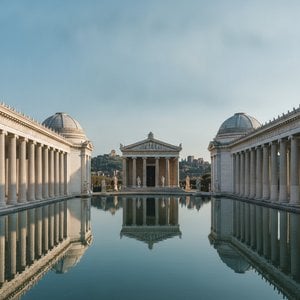
Discover the profound elegance of Neoclassicism. Explore how the pursuit of order, symmetry, and Greco-Roman ideals created a timeless aesthetic for collectors seeking grandeur and intellectual depth in fine art and architecture.

 Aperçu en situation
 Envoyer
 Partager
 Détails de l'œuvre

 Télécharger
 Articles similaires
 Radiographie
 Diaporama
 Lire la suite







 L'option verre n'est disponible que pour les dimensions inférieures à 110 cm.


