


Huile sur toile peinte à la main, avec cadre et dimensions personnalisés, réalisée sur commande par nos artistes. ( Commander l'impression Acheter l'image haute résolution)
Choisissez parmi nos formats prédéfinis qui respectent les proportions originales de l’œuvre.

Vous pouvez saisir vos propres dimensions pour l'adapter à un cadre ou à un espace spécifique. Si la taille sélectionnée ne correspond pas aux proportions de l'image d'origine, nous recadrerons l'œuvre ou prolongerons la peinture avec des éléments peints à la main supplémentaires. Une maquette numérique vous sera envoyée pour approbation avant le début de la production.
Veuillez noter que l'aperçu à l'écran ne reflète pas le recadrage ou l'extension réels. Seule la maquette montrera fidèlement la composition finale.
Bien que des tailles personnalisées soient disponibles, nous vous recommandons de sélectionner une dimension dans la liste prédéfinie afin de préserver les proportions d'origine.
Livraison dans le monde entier () en 3 à 4 semaines au lieu des 5 semaines habituelles. (7 septembre). Aucun compromis sur la qualité.


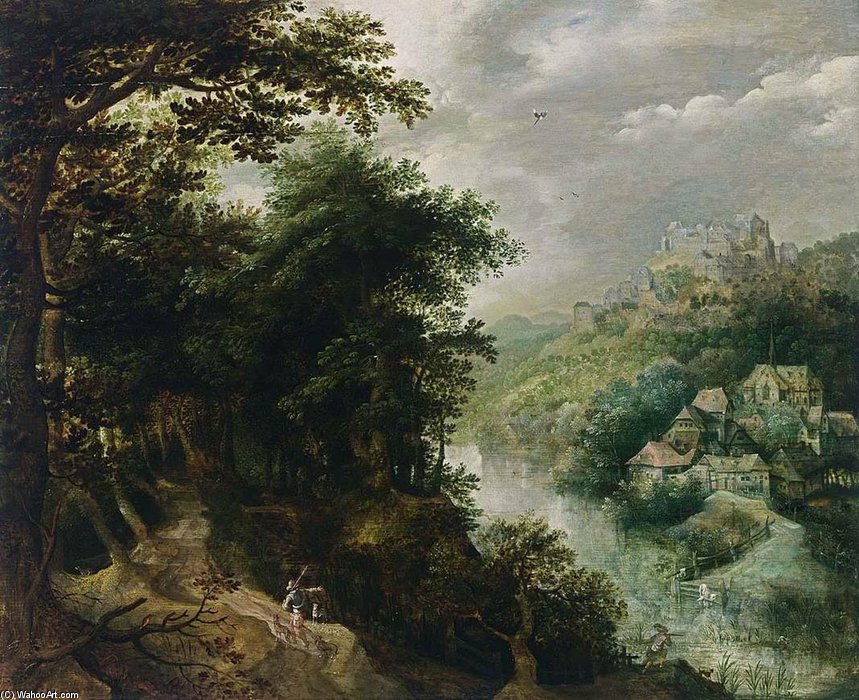
Wooded River Landscape
Format de la reproduction

The world of 16th-century Flemish art is rich with talent, yet Anthonie Mirou (c. 1578 – c. 1621/1627) remains a quietly compelling figure, a master of atmospheric landscapes and evocative genre scenes that offer intimate glimpses into the lives of rural communities. Born in Antwerp, a city then at the heart of the Habsburg Netherlands, Mirou’s artistic journey was shaped by both familial circumstances – his father an apothecary – and the turbulent political climate of the era, leading to a relocation to Frankenthal, a region within present-day Germany that served as a crucial hub for Flemish artists seeking refuge from religious persecution. His life, though tragically brief, produced a body of work characterized by a remarkable sensitivity to light, texture, and the subtle drama of the natural world.
Mirou’s early training is believed to have been profoundly influenced by Gillis van Coninxloo, a prominent landscape painter who resided in Frankenthal during the late 1580s. This connection established a foundational understanding of composition, color theory, and the depiction of atmospheric perspective – techniques that would become hallmarks of Mirou’s distinctive style. Furthermore, his time in Frankenthal coincided with the activity of Hendrik van der Borcht the elder and his son, Hendrik van der Borch II, both members of the burgeoning Frankenthal school, further enriching his artistic vocabulary. This exposure to a diverse group of artists fostered a dynamic exchange of ideas and contributed to Mirou’s development as a skilled and independent artist.
Mirou's landscapes are immediately recognizable for their richly detailed depictions of wooded areas, rocky outcrops, and meandering streams. Unlike some of his contemporaries who favored grand, sweeping vistas, Mirou consistently focused on smaller, more intimate scenes – often featuring a single figure or a small group engaged in everyday activities. This deliberate choice created a sense of immediacy and allowed the viewer to connect with the subjects on a deeply personal level. His use of color is particularly noteworthy; he employed subtle gradations of tone and hue to create a remarkable illusion of depth and atmosphere, capturing the shifting light and shadow that define the natural world.
A key element of Mirou’s technique was his masterful rendering of texture. He meticulously depicted the rough bark of trees, the dampness of moss-covered rocks, and the flowing movement of water – all with a remarkable level of detail. He frequently utilized oil paint to achieve this effect, layering thin glazes over dry underpaintings to build up complex surfaces that shimmered with light. His landscapes are not merely representations of nature; they are carefully constructed compositions designed to evoke a specific mood or feeling.
While Mirou is primarily known for his landscape paintings, he also produced a significant number of genre scenes – depictions of everyday life in rural communities. These works offer valuable insights into the social customs, beliefs, and occupations of the people who inhabited the region. Notable among these are scenes depicting peasants working in fields, families gathering around firesides, and religious figures engaged in biblical narratives. The inclusion of human figures within his landscapes is not arbitrary; they serve to anchor the scene, providing a sense of scale and context.
One particularly striking example is “River Landscape with Elegant Figures on a Path” (c. 1598-1603), where a young couple strolls along a winding path amidst a dense forest. The figures are dressed in elaborate attire, suggesting a degree of wealth and social status that contrasts sharply with the rustic setting. This juxtaposition creates a subtle tension, inviting the viewer to contemplate the relationship between human ambition and the natural world. Similarly, his “Extensive Landscape With The Rest On The Flight Into Egypt” (c. 1605-1610) masterfully blends religious narrative with topographical detail, showcasing a dramatic mountain landscape punctuated by figures fleeing into the wilderness.
Despite his relatively short career, Anthonie Mirou left behind a substantial body of work that continues to be admired for its technical skill, atmospheric quality, and intimate portrayal of rural life. He is considered a key figure in the Frankenthal school of landscape painting, alongside artists such as Gillis van Coninxloo and Hendrik van der Borcht. His influence can be seen in the works of later generations of Flemish painters who followed in his footsteps.
Mirou’s landscapes offer a valuable window into the social and cultural history of 16th-century Flanders. They provide insights into the lives of ordinary people, their relationship to the natural world, and their religious beliefs. His work stands as a testament to the enduring power of landscape painting to evoke emotion, stimulate contemplation, and connect us with the past.

1578 - 1621 , France

 Aperçu en situation
 Envoyer
 Partager
 Détails de l'œuvre

 Télécharger
 Articles similaires
 Radiographie
 Diaporama
 Lire la suite




































 L'option verre n'est disponible que pour les dimensions inférieures à 110 cm.


