Acquérez une image numérique haute résolution et optimisée, d'une qualité bien supérieure à l'aperçu en ligne.
Chaque fichier est méticuleusement préparé par nos spécialistes internes à l'aide d'outils avancés et d'une retouche manuelle experte. Nous garantissons que chaque image possède une clarté exceptionnelle, une précision des couleurs irréprochable et un niveau de détail fin.
Le fichier final est livré par e-mail sous 72 heures, optimisé pour une utilisation immédiate dans des contextes professionnels, éditoriaux et d'impression. Il offre la même qualité de confiance que celle utilisée par les plus grands studios de création, éditeurs et galeries.
Téléchargez un fichier haute résolution pour votre usage personnel, l'impression et vos projets créatifs. ( Passer au format impression
Acheter la peinture faite à la main)
En choisissant WahooArt.com, vous n'obtenez pas seulement une simple image : vous recevez une œuvre numérique sublimée avec professionnalisme, conçue avec précision et accompagnée d'une garantie de satisfaction. Voici tout ce qui accompagne automatiquement votre commande :
Votre fichier d'image numérique haute résolution vous sera envoyé par e-mail sous 72 heures après votre commande — prêt à un usage immédiat.
Votre œuvre d'art bénéficie d'une optimisation professionnelle grâce à des outils d'IA avancés et une retouche manuelle, garantissant un niveau maximal de détail, de clarté et de fidélité chromatique.
Vous avez accidentellement supprimé ou perdu votre fichier ? Pas d'inquiétude — nous vous le renverrons gratuitement, quand vous le souhaitez.
Profitez de votre œuvre d'art instantanément sans frais de douane ni de livraison — les téléchargements numériques sont toujours exonérés de taxes.
Nous garantissons que votre image numérique reproduit les couleurs de l'original aussi fidèlement que possible grâce à des outils professionnels et une gestion rigoureuse des couleurs.
Si vous n'êtes pas satisfait de votre image numérique, nous la retoucherons ou vous rembourserons 100% sous 100 jours — sans poser de questions.
Pas satisfait ? Obtenez un remboursement intégral dans les 100 jours suivant la réception de votre fichier numérique — sans aucune question posée.
Achetez 3 images, économisez 10% - Achetez 5, économisez 15% - Achetez 10+, économisez 20%. Idéal pour les projets créatifs, les galeries et les agences.
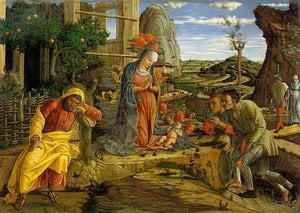
Andrea Mantegna's Calvaria, a profoundly moving depiction of the crucifixion, isn't merely a religious image; it is a testament to a revolutionary artistic spirit. Born in 1431 near Padua, Mantegna forged his own path through the early Renaissance, rejecting the prevailing trends and instead immersing himself in the tangible remnants of Rome’s glorious past. This dedication to archaeological accuracy – fueled by his formative years under Francesco Squarcione, a man who treated his workshop as an academy for Roman studies – resulted in a work that feels less like a painting and more like a meticulously reconstructed fragment of antiquity brought vividly to life. The sheer physicality of the figures, their sculpted forms echoing the statues Mantegna would have studied, immediately establishes a powerful connection with classical art, yet this isn’t a simple imitation; it's an intensely personal interpretation.
Calvaria is dominated by its unflinching portrayal of Christ’s crucifixion. The scene unfolds with a stark realism, focusing on the central figure suspended from the cross – Jesus himself – surrounded by a carefully rendered group of onlookers. Mantegna's mastery of perspective is immediately apparent; he employs a dramatic foreshortening that draws the viewer into the heart of the event, creating an almost overwhelming sense of immediacy. The inclusion of at least thirteen figures, including disciples and mourners, adds to the scene’s emotional weight and underscores the scale of this pivotal moment in Christian history. The artist's deliberate arrangement isn't simply a depiction of a biblical event; it’s a carefully constructed narrative designed to evoke profound contemplation.
Beyond its religious subject matter, Calvaria is rich with symbolic meaning deeply rooted in the artistic and intellectual currents of Mantegna's time. The mountainous landscape behind the scene isn’t a naturalistic backdrop but a deliberate reference to the Roman world – specifically, the Appian Way, a major thoroughfare that served as a stage for countless processions and public spectacles. This association elevates the crucifixion to a grand, almost theatrical event, reminiscent of Roman triumphal processions. The figures themselves are rendered with a classical dignity, reflecting Mantegna’s belief in the enduring relevance of ancient virtues and ideals. The use of muted colors – predominantly earth tones – further reinforces this connection to antiquity, creating a sense of timelessness and solemnity.
Mantegna's technique is characterized by its meticulous attention to detail and his ability to convey both physical realism and profound emotional intensity. The artist’s use of *terrazzo* – a technique involving the layering of colored plaster – creates a remarkable sense of depth and texture, further enhancing the sculptural quality of the figures. The faces of the mourners are particularly expressive, conveying a range of emotions from grief to concern. Calvaria remains a powerful testament to Mantegna’s artistic genius and his unwavering commitment to reviving the spirit of antiquity. Its enduring impact lies not only in its technical brilliance but also in its ability to evoke a deeply felt sense of human tragedy and spiritual reflection.
1431 - 1506 , Italie