Impressions giclées ou sur toile de qualité musée, avec une production rapide et des finitions au choix. ( Commander la reproduction peinte à la main Passer au format numérique)





























Choisissez parmi nos formats prédéfinis qui respectent les proportions originales de l’œuvre.

Saisissez la largeur et la hauteur souhaitées pour qu'elles s'adaptent à votre cadre ou à votre mur. Une impression peut être recadrée, mais jamais agrandie au-delà de l'image originale ; ainsi, un format de forme différente entraînera la perte d'une partie de l'image. Nous vous envoyons une maquette numérique pour approbation avant toute impression. L'image présentée sur cette page ne montre pas le recadrage réel — seule la maquette le permet.
Livraison dans le monde entier () en 2 semaines au lieu des 4/5 semaines habituelles. (8 novembre)
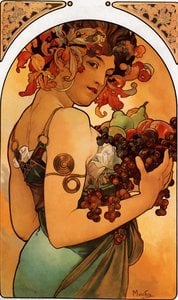
Litho de fleurs
Format de la reproduction
This exquisite 1897 lithograph, titled simply “Flower Litho,” offers a captivating glimpse into the world of Alphonse Maria Mucha, one of the most celebrated figures of the Art Nouveau movement. Measuring 44 x 66 cm, this piece isn’t merely a depiction of a woman holding flowers; it's an embodiment of a particular aesthetic – a harmonious blend of natural beauty and stylized elegance that defined Mucha’s distinctive vision. The vibrant palette, dominated by rich reds, yellows, greens, blues, and purples, immediately draws the eye, creating a sense of opulent warmth and inviting contemplation.
Born in Brno, Czech Republic, in 1860, Alphonse Maria Mucha’s artistic journey began with formal training at the Academy of Fine Arts in Prague. However, he quickly recognized the limitations of traditional academic approaches, seeking instead a more fluid and expressive style. His relocation to Paris in 1887 proved pivotal, allowing him to fully immerse himself in the burgeoning Art Nouveau movement. Mucha’s work is instantly recognizable for its flowing lines, organic forms, and an almost palpable sense of movement – qualities he consciously adopted from influences like Pierre-Auguste Renoir and Gustave Moreau. This “Flower Litho” exemplifies this style perfectly, showcasing a woman draped in a delicate lace dress, crowned with symbolic ornamentation, and presented amidst a profusion of blossoms.
The central figure, a beautifully idealized woman, is a recurring motif in Mucha’s oeuvre. Her pose, holding bouquets of flowers, speaks to themes of beauty, fertility, and perhaps even remembrance – common subjects within Art Nouveau's romantic sensibility. The two bouquets themselves are not simply decorative; they likely represent carefully chosen floral symbols with specific meanings, though the precise interpretation would have been understood within the context of late 19th-century symbolism. The potted plant in the background adds depth and a subtle connection to nature, reinforcing the artwork’s core themes. The overall composition evokes a sense of serenity and quiet contemplation, inviting the viewer to lose themselves in its delicate beauty.
This “Flower Litho” is a lithograph, a printmaking technique that allowed Mucha to reproduce his designs with remarkable precision and detail. The process involved transferring ink from a stone onto paper, resulting in rich, velvety tones – particularly evident in the vibrant hues of the flowers. Created in 1897, this piece reflects the peak of Mucha’s fame, following his success at the Salon des Cent in 1898. It's a testament to his ability to capture and translate the spirit of Art Nouveau into a commercially viable format, influencing countless artists and designers during that era. This reproduction offers an authentic connection to a pivotal moment in art history, allowing you to experience Mucha’s genius firsthand.
La luminosité perçue de «Litho de fleurs» de Alphonse Maria Mucha est lumineux. Elle peut être harmonisée avec la lumière de l'espace prévu.
«Litho de fleurs» de Alphonse Maria Mucha est une œuvre réalisée en Lithographie, mesurant 44 x 66 cm.
Dans « Litho de fleurs », un Contrasté contraste s'allie à une Palette unifiée harmonie.


1860 - 1939 , République tchèque

Maîtrisez les secrets de la lithographie et apprenez à authentifier vos œuvres. Devenez un expert du trait et de la pierre dès maintenant.

Discover the enchanting world of Art Nouveau. Explore the flowing lines of Alphonse Mucha and learn how to integrate these timeless, organic masterpieces into your collection with expert guidance on fine art appreciation and preservation.

Explorez l'essence de l'Art Nouveau et sa révolution organique. Plongez dans l'histoire du design avec notre expertise.
 Aperçu en situation
 Envoyer
 Partager
 Détails de l'œuvre
 Guide
Guide

 Télécharger l'image
 Articles similaires
 Radiographie
 Diaporama
 Questions et réponses
 Statistiques

 Lire la suite









 L'option verre n'est disponible que pour les dimensions inférieures à 110 cm.