Impressions giclées ou sur toile de qualité musée, avec une production rapide et des finitions au choix. ( Commander la reproduction peinte à la main Passer au format numérique)





























Choisissez parmi nos formats prédéfinis qui respectent les proportions originales de l’œuvre.

Saisissez la largeur et la hauteur souhaitées pour qu'elles s'adaptent à votre cadre ou à votre mur. Une impression peut être recadrée, mais jamais agrandie au-delà de l'image originale ; ainsi, un format de forme différente entraînera la perte d'une partie de l'image. Nous vous envoyons une maquette numérique pour approbation avant toute impression. L'image présentée sur cette page ne montre pas le recadrage réel — seule la maquette le permet.
Livraison dans le monde entier () en 2 semaines au lieu des 4/5 semaines habituelles. (10 novembre)
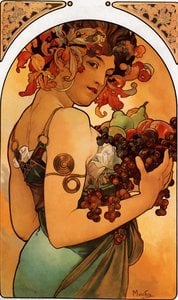
Study for Poetry
Format de la reproduction
Alphonse Maria Mucha's "Study for Poetry," a captivating work from his early Parisian period, offers a profound glimpse into the artist’s burgeoning mastery of Art Nouveau. This seemingly simple depiction – a woman seated in quiet reflection – is far more than just a portrait; it’s an embodiment of the movement’s core tenets: a celebration of natural forms, a yearning for beauty, and a deeply romantic sensibility. The painting immediately draws the eye to the central figure, a young woman with cascading auburn hair that seems to flow almost independently of her pose. Her expression is one of serene contemplation, inviting the viewer into her private world. The subtle details – the delicate crown adorning her head, the folds of her garment – speak volumes about Mucha’s meticulous attention to detail and his desire to elevate everyday subjects to the realm of art.
Mucha's style in this piece is immediately recognizable as a cornerstone of Art Nouveau. Notice the absence of harsh angles or rigid lines; instead, everything curves and flows – from the woman’s hair to the decorative elements within the room. This organic approach was heavily influenced by Mucha’s studies of Japanese prints and his admiration for artists like Pierre-Auguste Renoir. The use of rich, saturated colors—deep reds, greens, and golds—further enhances the painting's luxurious feel, a hallmark of the style intended to evoke a sense of opulence and refinement. The composition itself is carefully balanced, creating a harmonious visual experience that reflects Mucha’s belief in art as a means of elevating the spirit.
Beyond its aesthetic qualities, “Study for Poetry” is rich with symbolic elements. The clock on the wall serves not just as a functional object but also represents the passage of time and the fleeting nature of beauty – themes frequently explored in Art Nouveau. The vase and potted plants introduce an element of natural serenity, reinforcing the painting’s overall mood of tranquility. These additions are characteristic of Mucha's approach: he didn't simply depict reality; he imbued it with meaning and emotion. The woman’s posture, lost in thought, suggests a connection to Romantic ideals – a focus on individual experience and the power of imagination.
Created during a pivotal moment in Mucha’s artistic development, “Study for Poetry” demonstrates his early experimentation with the techniques that would define his career. It's a testament to his ability to synthesize classical influences – evident in the idealized form of the woman – with the innovative spirit of Art Nouveau. This work foreshadows his later success with poster design and decorative panels, solidifying his place as one of the most influential artists of the late 19th and early 20th centuries. A reproduction of “Study for Poetry” offers a beautiful addition to any interior space, bringing a touch of Mucha’s timeless elegance and contemplative spirit into your home.
«Study for Poetry» de Alphonse Maria Mucha s'inscrit dans le mouvement Art Nouveau, au sein de l'époque XIXe siècle de son créateur.
Driftwood (#b1a24b) est la couleur dominante de «Study for Poetry» de Alphonse Maria Mucha.
« Study for Poetry » a été créé par Alphonse Maria Mucha dans le style Art Nouveau. L'artiste et le mouvement définissent la tradition de l'œuvre.


1860 - 1939 , République tchèque
 Aperçu en situation
 Envoyer
 Partager
 Détails de l'œuvre
 Guide
Guide

 Télécharger l'image
 Articles similaires
 Radiographie
 Diaporama
 Questions et réponses
 Statistiques
 Lire la suite









 L'option verre n'est disponible que pour les dimensions inférieures à 110 cm.