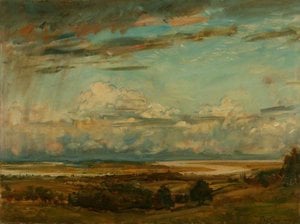
A Pioneer of Lyrical Landscape: The Life and Art of Alexei Savrasov
Alexei Kondratyevich Savrasov, born in Moscow on May 24, 1830, stands as a monumental figure within the annals of Russian painting. He wasn’t merely an observer of nature; he was its ardent poet, crafting what would become known as the “lyrical landscape”—a genre distinguished by its profound emotional depth and rejection of academic conventions. Savrasov's artistic journey commenced with rigorous training at the Moscow School of Painting, Sculpture and Architecture in 1844, where he honed his skills under the tutelage of Karl Rabus, graduating in 1850 and immediately dedicating himself to capturing the essence of Russian scenery—a pursuit that mirrored the burgeoning interest in realism during this transformative period.
Early Travels and Artistic Awakening
Savrasov’s formative years were marked by expeditions to Ukraine, immersing him in its expansive vistas and fostering an appreciation for untamed beauty. These experiences profoundly influenced his artistic sensibilities, shaping his vision of the Russian landscape as a realm imbued with spiritual significance. Simultaneously, he absorbed inspiration from Western European masters—particularly John Constable and Alexandre Calame—whose ability to convey atmospheric conditions and evoke emotion resonated deeply within him. Unlike many artists of his time who adhered strictly to academic ideals, Savrasov actively sought to transcend formalism, prioritizing feeling over precise representation.
The Influence of Constable and Calame
Savrasov’s admiration for Constable and Calame extended beyond mere stylistic imitation; it encompassed a fundamental philosophical shift. These painters championed the notion that art should strive to capture not just what is seen but what is felt—a principle that Savrasov embraced wholeheartedly. He meticulously studied their techniques, analyzing how they achieved luminous effects and conveyed mood through subtle brushstrokes. This intellectual engagement fueled his artistic experimentation and propelled him toward a uniquely expressive style.
The Formation of the Wanderers’ Movement
Savrasov's relocation to St. Petersburg in 1854—at the invitation of Grand Duchess Maria Nikolayevna—marked a pivotal moment in his career, placing him at the epicenter of Russia’s artistic milieu and fostering connections with fellow artists who championed realism and social commentary. He joined forces with Vasily Perov and Pavel Tretyakov, establishing the “Peredvizhniki” (Wanderers) group—a collective dedicated to challenging the dominance of academic art and advocating for a more truthful depiction of Russian life. This alliance proved invaluable, providing Savrasov with intellectual stimulation and collaborative opportunities that enriched his artistic output.
The Triumph of ‘The Rooks Have Returned’
Savrasov's magnum opus—*The Rooks Have Returned* (1871)—stands as an emblem of Russian lyrical landscape painting and a testament to his artistic genius. This deceptively simple depiction of spring’s arrival—rooks returning to their nests amidst birch trees against the backdrop of melting snow—captured the collective spirit of Russia, embodying hope, renewal, and nostalgia with unparalleled eloquence. Critics lauded it as the genesis of “mood painting,” a style characterized by prioritizing atmosphere and emotion over meticulous topographical accuracy. The painting's enduring popularity solidified Savrasov’s reputation as a visionary artist who had achieved an extraordinary feat—transforming ordinary scenery into profound expressions of human experience.
Later Years and Legacy
Despite achieving considerable acclaim during his lifetime, Savrasov endured personal hardships that cast a shadow over his final years. The devastating loss of his daughter in 1871 triggered a period of intense grief and psychological turmoil—a crisis that profoundly impacted both his artistic endeavors and his overall well-being. He wrestled with alcoholism, culminating in dismissal from his teaching position at the Moscow School of Painting, Sculpture and Architecture in 1882. Yet, even amidst adversity, Savrasov persevered, continuing to paint until his death in October 8, 1897—a poignant reminder that artistic brilliance can coexist with human vulnerability.
Selected Works
- View of the Kremlin from the Krymsky Bridge in Inclement Weather (1851)
- View in the Neighborhood of Oranienbaum (1854)
- Landscape with River and Angler (1859)
- Rustic View (1867)
- Winter Night (1869)
- Winter (1870)
- The Rooks Have Returned (1871)
- Monastery of Caves near Nizhny Novgorod (1871)
- Sukharev Tower (1872)
- Rainbow (1873)
- Spring Day (1873)
- Rafts (1873)
- Monastery Gates (1875)
- Early Spring. Thaw. (1880s)
- Spring. Kitchen Gardens (1893)
- Rasputitsa (Sea of Mud, 1894)



 Aperçu en situation
 Passer au format impression
 Partager
 Partager
 Détails
 Guide imprimable

 Télécharger
 Articles similaires
 Radiographie
 Voir le diaporama
 Statistiques

 Afficher la suite