


Impressions giclées ou sur toile de qualité musée, avec une production rapide et des finitions au choix. ( Commander la reproduction peinte à la main Acheter l'image haute résolution)
Choisissez parmi nos formats prédéfinis qui respectent les proportions originales de l’œuvre.

Vous pouvez saisir vos propres dimensions pour vous adapter à un cadre ou à un espace spécifique. Si la taille sélectionnée ne correspond pas aux proportions de l'image originale, nous recadrerons l'œuvre ou étendrons l'image avec une bordure en miroir ou une couleur unie. Une maquette numérique vous sera envoyée pour approbation avant le début de la production.
Veuillez noter que l'aperçu à l'écran ne reflète pas le recadrage ou l'extension réelle. Seule la maquette montrera avec précision la composition finale.
Bien que des tailles personnalisées soient disponibles, nous vous recommandons de choisir une dimension dans la liste prédéfinie afin de préserver les proportions originales.
Livraison dans le monde entier () en 2 semaines au lieu des 4/5 semaines habituelles. (7 septembre)


Annunciation
Format de la reproduction
In the quiet, meticulously rendered world of Albrecht Dürer’s Annunciation, time seems to suspend itself within a single, breathless moment of revelation. This exquisite pen and ink drawing serves as a profound window into the Northern Renaissance, capturing the exact instant when the Archangel Gabriel descends to deliver a celestial message to the Virgin Mary. The composition is a masterclass in architectural depth, where every line and shadow works in harmony to create a sacred space that feels both physically tangible and spiritually transcendent. As the viewer’s eye wanders through the intricate layers of the chamber, one is struck by the profound stillness that permeates the scene—a silence heavy with the weight of divine destiny.
The artistry on display is nothing short of breathtaking, showcasing Dürer’s unparalleled ability to manipulate light and line. Utilizing a sophisticated technique of hatching and cross-hatching, the artist breathes life into stone, fabric, and flesh. The architectural elements—the soaring arches, the sturdy columns, and the complex geometric patterns of the ceiling—are rendered with a precision that rivals the finest engravings of the era. These structural forms do more than merely frame the figures; they create a sense of monumental stability that contrasts beautifully with the ethereal, fleeting nature of the angelic visitation. The play of light, seemingly emanating from a singular, divine source, casts deep, dramatic shadows that define the volume of the room and imbue the entire scene with a palpable sense of three-dimensional reality.
Beyond its technical brilliance, the Annunciation is a tapestry of rich symbolism designed to guide the faithful through a journey of contemplation. Every detail within this richly decorated chamber serves a higher purpose. The architectural grandeur reflects the majesty of the divine presence, while the meticulous textures of the drapery and surfaces evoke the tactile reality of the earthly realm being touched by the heavenly. Dürer’s mastery of Mannerist spatial illusion allows the viewer to step into this sacred dialogue, making the theological themes of faith, humility, and revelation feel intimately accessible. The way the angel is positioned upon the staircase suggests a bridge between the celestial heights and the terrestrial world, a visual metaphor for the Incarnation itself.
For the discerning collector or interior designer, this piece offers much more than mere decoration; it provides a focal point of intellectual and emotional depth. A high-quality reproduction of this work brings with it the prestige of the German Renaissance, offering a sophisticated aesthetic that complements both classical and contemporary settings. The monochromatic elegance of the ink work allows it to integrate seamlessly into diverse color palettes, while its intricate detail rewards prolonged study, making it a conversation piece that inspires awe. To possess such a work is to invite a sense of historical continuity and spiritual serenity into one's personal sanctuary, celebrating the enduring power of Dürer’s visionary genius.

Albrecht Dürer, figure marquante de la Renaissance allemande, est né le 21 mai 1471 à Nuremberg, en Allemagne. Son père, Albrecht Dürer l'Ancien, était un orfèvre prospère, et c’est dans cet environnement artistique que l’inclinaison d’Albrecht pour l’art a commencé à s’épanouir. À l’âge de treize ans, il a commencé son apprentissage auprès de Michael Wolgemut, un artiste renommé à Nuremberg, acquérant des compétences fondamentales en peinture, dessin et techniques de gravure sur bois. Un autoportrait créé en 1484, conservé à l’Albertina de Vienne, fournit des preuves remarquables de son talent précoce.
Au début de ses vingt ans, Dürer s'était établi comme maître graveur, obtenant une reconnaissance dans toute l’Europe. Il a entrepris des voyages en Italie, où il a rencontré les œuvres des maîtres de la Renaissance tels que Raphaël, Giovanni Bellini et Leonardo da Vinci. Ces interactions ont profondément influencé son style artistique, l'amenant à intégrer des motifs et techniques classiques dans son esthétique nordique.
L’œuvre d’Albrecht Dürer englobe une grande variété de supports, notamment la peinture, les gravures, les estampes sur bois et les écrits théoriques. Certaines de ses œuvres les plus célèbres comprennent :
Le style de Dürer se caractérise par un réalisme méticuleux, une précision du dessin et une compréhension profonde de l'anatomie et de la perspective. Il a également été pionnier dans l’utilisation de l’aquarelle comme médium indépendant.
Au-delà de sa pratique artistique, Dürer a apporté des contributions significatives à la théorie de l'art. Il a écrit plusieurs traités sur la géométrie, la proportion et l'anatomie humaine, dont Quatre livres sur la proportion humaine (1528). Ces écrits témoignent de sa conviction dans les fondements mathématiques de l’art et de son engagement à établir une approche scientifique de la création artistique.
L'impact d’Albrecht Dürer sur le monde de l'art est indéniable. Il a comblé le fossé entre les traditions nordiques et les idéaux de la Renaissance italienne, introduisant des motifs classiques dans l'art du Nord tout en conservant son caractère distinctif. Ses traités théoriques ont contribué à élever le statut des artistes et à établir un nouveau cadre intellectuel pour la pratique artistique. Il reste une figure centrale dans l'histoire de l'art, inspirant les générations d’artistes par sa maîtrise technique, son esprit novateur et sa vision profonde.

1471 - 1528 , Italy
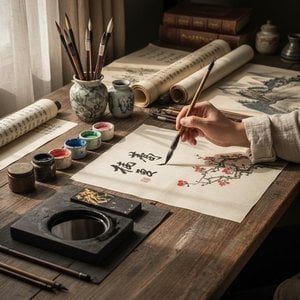
Embark on a sophisticated exploration of ink wash painting and Sumi-e. Uncover the profound historical lineages, Zen philosophies, and technical mastery behind this timeless medium in our authoritative guide for fine art enthusiasts.

Explore the profound mastery of engraving and intaglio printmaking. Delve into the rich history, technical precision of the burin, and the enduring legacy of fine art techniques that shaped the world's most iconic masterpieces.

Elevate your artistic practice with this expert guide to mastering the line. Discover advanced techniques in graphite, charcoal, and contour drawing designed for art students seeking technical precision and expressive depth in their fine art studies.

Explore the profound artistry of graphite drawing. Discover professional techniques for mastering depth, texture, and detail through a lens of art history, from classical sketches to modern masterpieces. Elevate your understanding of the pencil medium with our expert guide.

 Aperçu en situation
 Envoyer
 Partager
 Détails de l'œuvre

 Télécharger
 Articles similaires
 Radiographie
 Diaporama

 Lire la suite




































 L'option verre n'est disponible que pour les dimensions inférieures à 110 cm.


