x
Aperçu en situationAperçu en situation Visualiser en RAVisualiser en RA Commander l'impression Commander l'impressionAcheter l'image haute résolution Acheter l'image haute résolution EnvoyerEnvoyer
Détails de l'œuvreDétails de l'œuvre Ajouter aux favoris Ajouter aux favoris TéléchargerTélécharger Articles similairesArticles similaires RadiographieRadiographie DiaporamaDiaporama

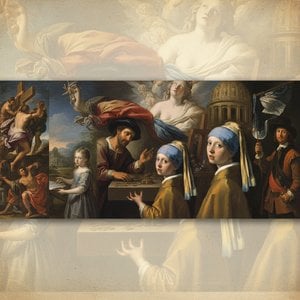
The Flight into Egypt

Adam Elsheimer's 'Flight into Egypt' (1609) is a stunning cabinet painting showcasing the Holy Family amidst a dramatic, star-filled night sky – a masterpiece of Baroque artistry and innovative landscape depiction.

Adam Elsheimer (1578-1610) : Peintre baroque allemand pionnier des paysages innovants et des scènes nocturnes lumineuses. Influence majeure sur Rembrandt & Rubens !

Reproduction à l'huile faite à la main

Huile sur toile peinte à la main, avec cadre et dimensions personnalisés, réalisée sur commande par nos artistes. (Commander l'impression Commander l'impressionAcheter l'image haute résolution Acheter l'image haute résolution)

P118B $10
P118H $10
P118W $10
P438Z $10
P508JH $12
P508YH $12
P805H $10
P805Z $10
P919BZ $10
P919G $10
P919XJ $10
P959ZH $10
P968JZ $12
W106C $8
W218G $10
W218JH $8
W218Y $10
W307PJ $10
W316G $10
W316PJ $8
W316Y $10
W398PJ $8
W4111J $10
W500HY $15
W500JH $15
W692G $12
W849H $8
W940BG $15
W953PJ $8

Format standard
sur mesure
CM
INCH

Choisissez parmi nos formats prédéfinis qui respectent les proportions originales de l’œuvre.

largeur
hauteur

Vous pouvez saisir vos propres dimensions pour l'adapter à un cadre ou à un espace spécifique. Si la taille sélectionnée ne correspond pas aux proportions de l'image d'origine, nous recadrerons l'œuvre ou prolongerons la peinture avec des éléments peints à la main supplémentaires. Une maquette numérique vous sera envoyée pour approbation avant le début de la production.
Veuillez noter que l'aperçu à l'écran ne reflète pas le recadrage ou l'extension réels. Seule la maquette montrera fidèlement la composition finale.
Bien que des tailles personnalisées soient disponibles, nous vous recommandons de sélectionner une dimension dans la liste prédéfinie afin de préserver les proportions d'origine.

Exemples de personnalisation possibles : remplacer un visage par la photo du client ; ajouter un animal de compagnie (par exemple, remplacer un chat par un chien) ; inclure un message caché en arrière-plan ; modifier le paysage ou les éléments de l'arrière-plan.
Après la commande, l’équipe WahooArt.com contactera le client par e-mail pour recueillir ses instructions et lui fournira une maquette d’aperçu

Livraison dans le monde entier () en 3 à 4 semaines au lieu des 5 semaines habituelles. (29 août). Aucun compromis sur la qualité.

why_choose_icon
Livraison express gratuite dans le monde entier
why_choose_icon
Toile de lin de qualité supérieure
why_choose_icon
Assurance transport complète
why_choose_icon
Garantie de remboursement des droits de douane
why_choose_icon
Garantie de fidélité des couleurs
why_choose_icon
Politique de retour de 60 jours (uniquement en cas de défaut)
why_choose_icon
Garantie de remboursement à 100%
why_choose_icon
Offre de tarifs dégressifs

Prix total

$ 272

reproduction

The Flight into Egypt

Technique de reproduction

Format de la reproduction

-

Prix total

$ 272

Informations clés

  • Year: 1609
  • Medium: Oil on copper
  • Influences:
    • Rembrandt
    • Rubens
  • Dimensions: 9 x 7 cm
  • Artist: Adam Elsheimer
  • Notable elements: Night sky, constellations
  • Location: Alte Pinakothek, Munich

Quiz d'art

Chaque question ne comporte qu'une seule bonne réponse.

Question 1:
What is the primary subject of Adam Elsheimer’s ‘The Flight into Egypt’?
Question 2:
According to the description, what is unique about Elsheimer's depiction of the night sky in ‘The Flight into Egypt’?
Question 3:
What medium did Elsheimer predominantly use for his cabinet paintings like ‘The Flight into Egypt’?
Question 4:
In the description, what does the ‘broad-brimmed hats’ symbolize in relation to the figures depicted?
Question 5:
The description mentions that Elsheimer was part of a circle of artists in Rome. Which of the following artists was also associated with this group?

A Nocturnal Pilgrimage: Adam Elsheimer’s “The Flight into Egypt”

Adam Elsheimer's "The Flight into Egypt," painted around 1609 during his brief but brilliant Roman period, isn’t merely a biblical depiction; it’s an immersive experience of light, shadow, and profound spiritual contemplation. Far removed from the grand scale of many Baroque masterpieces, this small oil-on-copper panel—a mere 9 x 7 centimeters—holds within its diminutive frame a universe of artistic innovation and emotional resonance. It's a testament to Elsheimer’s singular vision: a master of capturing fleeting moments of intense feeling with remarkable technical precision.

The scene unfolds against a dramatically rendered night sky, an audacious choice for the time. Elsheimer wasn’t simply illustrating a biblical narrative; he was wrestling with the mysteries of darkness and light, mirroring the human condition's inherent struggle between fear and hope. The composition is dominated by this evocative sky, meticulously constructed with a startling accuracy that suggests Elsheimer’s deep engagement with astronomical observations – a detail often overlooked in discussions of his work. The Milky Way stretches across the heavens like a river of stardust, punctuated by recognizable constellations such as Ursa Major and Leo, each rendered with an almost photographic realism. This wasn't merely decorative; it was a deliberate attempt to connect the earthly drama unfolding below with the vastness and order of the cosmos.

The Anatomy of Light: Technique and Innovation

Elsheimer’s mastery lies in his manipulation of light and shadow, techniques that were revolutionary for his time. He employed a technique known as “pointillé,” using tiny dots of paint to build up color and texture—a method borrowed from the Flemish masters but pushed to an unprecedented level of detail. This creates a shimmering effect, particularly noticeable in the depiction of the moon’s reflection on the water and the subtle gradations of light across the landscape. The use of chiaroscuro – the dramatic contrast between light and dark – is not employed for theatricality, but rather to heighten the sense of intimacy and vulnerability within the scene.

The copper panel itself played a crucial role in Elsheimer’s artistic process. It allowed him to work with greater precision and achieve a luminosity that was difficult to replicate on wood panels. The reflective surface also contributed to the painting's ethereal quality, as light bounced off the metal and created an almost otherworldly glow. Furthermore, the small size of the panel demanded careful consideration of composition; every element—from the figures’ clothing to the texture of the trees—had to be rendered with exquisite detail.

Symbolism and Spiritual Depth

Beyond its technical brilliance, “The Flight into Egypt” is rich in symbolic meaning. The journey itself represents a perilous pilgrimage toward salvation, mirroring the Exodus narrative and offering a potent metaphor for humanity’s ongoing quest for redemption. The broad-brimmed hats worn by Joseph and Mary are not merely decorative; they symbolize protection from the harsh realities of the world—a visual reminder of their vulnerability and dependence on divine grace.

The prominent oak tree, bathed in a divine light, is particularly significant. It’s an allusion to the Tree of Life, rooted in biblical tradition and representing immortality – a direct reference to the cross of Christ, whose wood bestowed eternal life upon humanity. The scene subtly suggests that this humble family, fleeing persecution, are also enacting a sacred drama, embodying the promise of salvation through faith and obedience.

A Legacy of Intimacy

Adam Elsheimer’s “The Flight into Egypt” is more than just a beautiful painting; it's a poignant meditation on faith, family, and the human condition. His innovative use of light, his meticulous attention to detail, and his profound understanding of symbolism combine to create an artwork that continues to captivate viewers centuries later. Despite producing only a handful of finished works during his tragically short life, Elsheimer left behind a legacy of artistic innovation and emotional depth—a testament to the power of art to illuminate the darkest corners of our souls.


Biographie de l'artiste

Première Vie et Formation

  • Né: Frankfurt am Main, Allemagne, le 18 mars 1578
  • Décédé: Rome, le 11 décembre 1610 (à l'âge de 32 ans)
  • Adam Elsheimer est né dans une famille d'artisans à Francfort. Son père était maître tailleur.
  • Il a montré un talent artistique dès son plus jeune âge et a été placé comme apprenti chez Philipp Uffenbach, un artiste local.
  • Vers 1596, il a probablement visité Strasbourg, ce qui l'a exposé à différents styles artistiques.
  • En 1598, à l'âge de vingt ans, Elsheimer s'est rendu en Italie via Munich, marquant le début de son développement artistique significatif.

Période Italienne et Développement Artistique

  • Il a passé une quantité considérable de temps à Venise, où il a été influencé par les maîtres vénitiens comme Tintoret et Paolo Veronese.
  • Vers 1600, Elsheimer s'est installé à Rome, rejoignant la communauté artistique locale.
  • Il a travaillé comme assistant de Johann Rottenhammer, un peintre allemand spécialisé dans les peintures d'armoire, apprenant des techniques précieuses.
  • Son style a évolué des influences maniéristes initiales vers une approche plus naturaliste caractérisée par des représentations innovantes du paysage et des effets d'éclairage dramatiques.
  • Des amitiés clés se sont nouées avec Giovanni Faber, un médecin papal et botaniste, et Paul Bril, un peintre de paysages flamand, tous deux liés à l'Accademia dei Lincei.

Œuvres Majeures et Style Artistique

  • Elsheimer est renommé pour ses peintures à petite échelle sur plaques de cuivre, souvent appelées peintures d'armoire.
  • Ses œuvres représentaient fréquemment des scènes mythologiques et bibliques, mettant en valeur un tempérament lyrique et un souci du détail méticuleux.
  • Peintures Notables: Tobie et l’Ange (c. 1602–1603), La Chute de Troie, Apollon et Coronis, Cérès et Stellio, Le Martyre de Saint Étienne.
  • Il est crédité comme l'un des premiers artistes à représenter avec précision les constellations dans les scènes du ciel nocturne.
  • Ses paysages étaient innovants pour leur époque, intégrant harmonieusement des figures dans des environnements naturels.
  • L’utilisation de la lumière et de l’ombre (chiaroscuro) par Elsheimer créait des effets dramatiques et renforçait l'impact émotionnel de ses peintures.

Influence et Importance Historique

  • Malgré une carrière relativement courte, Elsheimer a exercé une influence considérable sur les générations d’artistes suivantes.
  • Il était très apprécié par ses contemporains, y compris Pierre Paul Rubens, qui déplorait sa mort prématurée et louait son talent exceptionnel.
  • Influences Clés: Albrecht Dürer (exposition initiale), Johann Rottenhammer (formation technique), peintres vénitiens (Tintoret, Paolo Veronese - inspiration stylistique).
  • Artistes Influencés: Rembrandt, Pierre Paul Rubens et de nombreux autres artistes du XVIIe siècle.
  • Ses représentations innovantes du paysage et ses techniques d'éclairage dramatiques ont ouvert la voie aux développements ultérieurs dans la peinture baroque.
  • Les gravures réalisées par Hendrick Goudt ont contribué à diffuser l’œuvre d’Elsheimer à travers l’Europe, amplifiant ainsi son influence.

Vie Tardive et Héritage

  • Elsheimer a été confronté à des difficultés financières tout au long de sa vie, ce qui a entraîné des périodes d'endettement et même d'emprisonnement.
  • Il a épousé Carola Antonia Stuarda da Francoforte en 1606, et ils ont eu un fils qui est tragiquement décédé jeune.
  • Il s’est converti au catholicisme vers 1608.
  • Elsheimer est mort à Rome en 1610 à l'âge de 32 ans, laissant derrière lui un corpus d'œuvre relativement petit mais très influent.
  • Son héritage repose sur son approche pionnière de la peinture de paysage, sa maîtrise de la lumière et de l’ombre, et son impact durable sur l’art baroque.
Adam Elsheimer

Adam Elsheimer

1578 - 1610 , Allemagne

L'essentiel de l'artiste

  • Artistes Influencés:
    • Rembrandt
    • Peter Paul Rubens
  • Artistes Influents:
    • Albrecht Dürer
    • Johann Rottenhammer
    • Tintoretto
    • Paolo Veronese
  • Date De Décès: 11 décembre 1610
  • Date De Naissance: 18 mars 1578
  • Lieu De Naissance: Francfort, Allemagne
  • Mouvement Artistique: Baroque
  • Nationalité: Allemand
  • Nom Complet: Adam Elsheimer
  • Oeuvres Notables:
    • Tobias et l’ange
    • La prise de Troie
    • Apollon et Coronis
    • Cérès et Stellio
    • Stoning of St. Stephen
Explorez des œuvres d'art classées par thèmes, styles et caractéristiques.