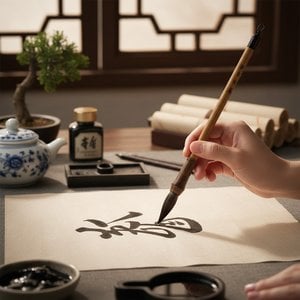
Xu Daoning: Weaver of Serene Landscapes in the Northern Song
Xu Daoning (许道宁, c. 970 – 1051/53) stands as a pivotal figure within the landscape painting tradition of the Northern Song Dynasty, a period renowned for its artistic flourishing and patronage. Born in either Chang’an (modern Xi'an), the former capital, or Hejian (now Hebei province), his early life was far removed from the world of art. Initially, he eked out a living as a pharmacist, meticulously crafting remedies and dispensing them to the populace – a humble profession that nonetheless provided a grounding in observation and an appreciation for the natural world. It was during this time, while selling prescriptions in Kaifeng, that his artistic talent began to blossom, spurred by a fascination with the evocative landscapes surrounding the city. This unexpected transition reflects a common thread throughout Song Dynasty art: a shift from purely functional craftsmanship towards a pursuit of aesthetic beauty and philosophical contemplation.Early Influences and Artistic Style
Daoning’s artistic journey was profoundly shaped by Li Cheng (李成, 919–967), one of the most celebrated landscape painters of the Mid-Song period. Daoning deeply admired Li Cheng's masterful use of atmospheric perspective – the subtle gradations of color and tone that create a sense of depth and distance – and meticulously emulated his techniques. His early works, such as “Snow-covered Mountains” (雪山), demonstrate this clear influence; the composition is characterized by broad washes of ink, suggesting vast distances and an ethereal quality. Unlike the more detailed and precise renderings favored by some of his contemporaries, Daoning’s style leans towards a looser, more expressive approach, prioritizing mood and atmosphere over meticulous representation. This deliberate choice reflects a growing interest in capturing not just what was *seen*, but also what was *felt* – a core tenet of Song Dynasty aesthetics. He wasn't striving for photographic accuracy; instead, he aimed to evoke the spirit of nature through carefully considered brushstrokes and color choices.The Masterpiece: Fishermen’s Evening Song
Daoning’s most enduring legacy is undoubtedly “Fishermen’s Evening Song” (渔舟唱晚), painted around 1049. This monumental mural, now housed in the National Palace Museum in Taipei, exemplifies his artistic maturity and technical skill. The scene depicts a group of fishermen returning to shore after a day's labor, their voices carried on the evening breeze. The composition is remarkably balanced, with the figures arranged along the riverbank against a backdrop of towering mountains shrouded in mist. What distinguishes this work is its profound sense of tranquility and harmony. Daoning masterfully employs subtle color variations – delicate blues and greens for the water, muted browns and grays for the mountains – to create an atmosphere of serene contemplation. The fishermen themselves are rendered with remarkable sensitivity, their postures suggesting weariness but also a quiet contentment. The painting isn’t merely a depiction of a scene; it's a meditation on the beauty of nature and the rhythms of daily life.Technique and Materials
Daoning’s technique was rooted in traditional Chinese ink wash painting (水墨画), a medium that demanded both technical proficiency and artistic intuition. He primarily utilized black ink, meticulously controlling its density and flow to achieve a wide range of tones and textures. His brushwork is characterized by its fluidity and spontaneity – a hallmark of the Song Dynasty’s most accomplished painters. Daoning was also known for his skillful use of layering techniques (疊墨), building up color gradually through multiple washes, creating depth and luminosity. The mural itself was executed on silk, a material prized for its durability and ability to absorb ink evenly. The scale of “Fishermen’s Evening Song” – approximately 13 by 24 feet – underscores the importance of patronage during the Northern Song Dynasty, when imperial commissions fueled artistic innovation and supported numerous artists.Historical Significance and Legacy
Xu Daoning's work represents a crucial bridge between the more formal styles of earlier dynasties and the evolving aesthetic sensibilities of the Northern Song. He demonstrated a remarkable ability to synthesize traditional techniques with a distinctly personal vision, creating landscapes that are both technically accomplished and emotionally resonant. While he may not be as widely celebrated as some of his contemporaries – such as Fan Kuan or Guo Xi – Daoning’s “Fishermen's Evening Song” remains a cornerstone of Northern Song landscape painting, exemplifying the period’s emphasis on capturing the spirit of nature and conveying profound philosophical ideas. His influence can be seen in subsequent generations of painters who continued to explore the possibilities of ink wash technique and sought to evoke the beauty and serenity of the Chinese countryside. Daoning's legacy lies not just in his individual masterpieces, but also in his contribution to the enduring tradition of landscape painting that continues to captivate audiences today.Kysymykset ja vastaukset
Missä kaupungissa ja maassa Xu Daoning on syntynyt?
Xu Daoning on syntynyt Xi'an, Song dynasty.
Voinko selata Xu Daoning teoksia tekniikan mukaan?
Kaikki tekniikat-sivulla Xu Daoning:n teokset on ryhmitelty tekniikan mukaan.
Voinko tutkia Xu Daoning teoksia avainsanojen avulla?
Löytääksesi tiettyyn teemaan liittyviä Xu Daoning teoksia, käytä taiteilijan Avainsanojen mukaan -sivua, joka ryhmittelee teokset avainsanojen mukaan.