Masaccio, 1401 – 1428

Masaccio Paintings: The 97 Most Famous Works, Ranked

Masaccio's most famous painting is Pyhä kolminaisuus (1428). With Veronmaksu (1425) and Karkotus paratiisista (1426), it completes the three works everyone recognises. Our catalogue lists 97 works by Masaccio; the 97 below are the ones the world looks at most, each with its year, the museum that holds it and why it matters.

Sijoitus perustuu suosiotulokseemme, joka yhdistää kunkin teoksen hakuja, vierailuja ja tilauksia. Päivitetty lokakuu 2026. Every masterpiece on this page can be ordered as a museum-quality, hand-painted oil reproduction or a fine art print, at the size you choose.

Masaccio muotokuva
Masaccio · 1401 – 1428
Syntynyt · kuollut
1401 – 1428, San Giovanni Valdarno
Taidesuuntaus
Varhaisrenessanssi
Teokset valikoimassamme
97
Tunnetuimmat
Pyhä kolminaisuus (1428)
Eniten teoksia kohteessa
Santa Maria del Carmine

The 10 most famous Masaccio paintings

Pyhä kolminaisuus (1428) tekijä Masaccio
1

Pyhä kolminaisuus

1428 · Fresko

Pyhä kolminaisuus Masaccion fresko on mestariteos, joka merkitsi Italian renessanssin alkua. Vuonna 1425 valmistunut teos on yksi varhaisen renessanssin merkittävimmistä taideteoksista, ja se lepää yhä arvokkaasti Firenzessä, Santa Maria Novella -kirkon seinillä. Taiteelliset innovaatiot Masaccion Pyhä kolminaisuus oli mullistava teos, joka toi mukanaan useita taiteellisia innovaatioita. Se on yksi ensimmäisistä monumentaalisista renessanssimaalauksista, joka hyödyntää lineaarista perspektiiviä, luoden katsojalle syvyyden ja tilan tuntua. Chiaroscuro- ja sfumato-tekniikoiden käyttö tuo hahmoihin volyymia ja…

Veronmaksu (1425) tekijä Masaccio
2

Veronmaksu

1425 · Fresko

Kohtaus avautuu Firenzessä, Santa Maria del Carminen basilikan Brancacci-kappelissa. Täällä fresko nimeltä Veronmaksu, jonka on tehnyt Masaccio, herättää raamatullisen kertomuksen eloon kappelin seinillä. Felice Brancaccin tilaama teos muodostaa merkittävän osan laajempaa, Pyhän Pietarin elämään omistettua freskoryhmää. Kappelin ilmassa tuntuu lepäävän tämän pyhän historian paino, kun hahmot liikkuvat läpi syvällisen merkityksellisen hetken.

Karkotus paratiisista (1426) tekijä Masaccio
3

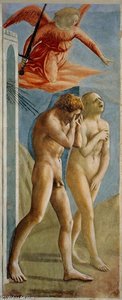
Karkotus paratiisista

1426 · Fresko

Firenzessä, Italiassa, Santa Maria del Carminen kirkon Brancacci-kappelissa, vallitseva raskas hiljaisuus kantaa mukanaan syvän tragedian painoa. Täällä seinät hengittävät Karkotus paratiisista -teoksen tarinaa, joka on noin vuonna 1425 fresko -maalauksen Masaccio. Ilma tuntuu tiivistyvän hahmojen ympärillä, kun he kohtaavat äkillisen ja peruuttamattoman poistumisensa paratiisista. Tämä kohtaus merkitsee laajemman kertomuksen alkua, toimien ensimmäisenä freskona sarjassa, joka on omistettu Pyhän Pietarin elämälle.

Ritarin rahat (detail) tekijä Masaccio
4

Ritarin rahat (detail)

Fresko

Tämä lumoava yksityiskohta on peräisin Masaccon uraauurtavasta freskosta ”Tributtimäärä”, joka on keskeinen teos Firenzen Brancacci-kirkossa. Noin vuonna 1426 valmistunut työ edustaa käännekohtaa länsimaisessa taiteessa, siirtyen goottilaisen aikakauden tyylitellyistä konventioista kohti uutta naturalismin ja humanistisen ilmaisun aikakautta.

Predella panel from the Pisa Altar (1426) tekijä Masaccio
5

Predella panel from the Pisa Altar

1426 · Oil On Panel · Staatliche Museen zu Berlin, Berliini

To stand before this Predella panel from the Pisa Altar is to encounter a moment frozen in time, yet vibrating with raw, undeniable human drama. Dating to 1426, this work captures Masaccio at the zenith of his revolutionary power. It is not merely a depiction of the Crucifixion; it is a profound meditation on sacrifice, community, and the weight of divine narrative rendered with startling immediacy. The composition draws the…

The Madonna of Humility (1424) tekijä Masaccio
6

The Madonna of Humility

1424 · Tempera On Panel

In the quiet, profound stillness of Masaccio’s The Madonna of Humility, we encounter one of the most moving snapshots of the Early Italian Renaissance. Created around 1424, this masterpiece transcends mere religious iconography to offer a window into a moment of raw, maternal intimacy. The scene is set not upon a celestial throne, but on the earth itself, where the Virgin Mary sits upon a blue patterned cushion. This choice…

Trinity (detail) (1425) tekijä Masaccio
7

Trinity (detail)

1425 · Fresco · Santa Maria Novella, Firenze

The image presents a detail from a fresco painting created in 1425 by Masaccio. Within this specific view, a figure is depicted that appears to be Mary Magdalene, identified by the traditional iconography of her long hair and a head covering. She possesses a contemplative expression, directing her gaze slightly downwards toward an object held in her right hand, which may be interpreted as a symbol of faith or devotion.

Two panels from the Pisa Altarpiece (1426) tekijä Masaccio
8

Two panels from the Pisa Altarpiece

1426 · Tempera On Panel · Staatliche Museen zu Berlin, Berliini

In the quiet, hallowed halls of art history, few works capture the dawn of a new era as poignantly as Masaccio’s Two Panels from the Pisa Altarpiece. Completed in 1426, these panels are far more than mere fragments of a lost polyptych; they are windows into a transformative moment when the rigid conventions of the Gothic period began to dissolve, giving way to the profound humanism of the Early Italian…

Trinity (1425) tekijä Masaccio
9

Trinity

1425 · Fresco · Santa Maria Novella, Firenze

To step before Masaccio’s Holy Trinity is to witness the exact moment when the flattened, symbolic world of the Middle Ages dissolved into the profound, breathing reality of the Renaissance. Painted between 1425 and 1427 within the hallowed walls of Santa Maria Novella in Florence, this fresco does not merely depict a religious scene; it carves a hole in the very wall of the chapel, inviting the viewer to step…

Trinity (detail) (1425) tekijä Masaccio
10

Trinity (detail)

1425 · Acrylic On Canvas · Santa Maria Novella, Firenze

Masaccio’s “Trinity (detail),” housed within the magnificent Santa Maria Novella in Florence, isn't merely a fresco; it’s a pivotal moment in art history – a visual manifesto declaring the arrival of the High Renaissance. Painted between 1425 and 1427, this intimate section captures the essence of Masaccio’s revolutionary approach to depicting reality, a departure from the stylized elegance of the preceding Gothic era and a profound influence on generations of…

Masaccio, paintings 11 to 97

Cappella Brancacci (ennen kunnostusta) (1426) tekijä Masaccio
#11

Cappella Brancacci (ennen kunnostusta)

1426 · Santa Maria del Carmine

Masaccion Näköala kappelassa Brancacci, ennen kuin se herätti uudelleen eloon perusteellisen restauroituksen jälkeen, on enemmän kuin pelkkä kirkon sisäkuva. Se on ikkuna varhaiseen renessanssin sydämeen, aikakauteen, joka mullisti…

Bring it home →
Fresko Cappella Brancacci (oikea näköala) (1426) tekijä Masaccio
#15

Fresko Cappella Brancacci (oikea näköala)

1426 · Santa Maria del Carmine

The Cappella Brancacci, nestled within Santa Maria della Carmine church in Florence, stands as a testament to artistic innovation and spiritual aspiration during the Early Italian Renaissance. Commissioned…

Bring it home →
Crucifixion (1426) tekijä Masaccio
#22

Crucifixion

1426 · Museo di Capodimonte

Masaccio’s Crucifixion, painted in 1426 during his tragically brief career, isn’t merely a depiction of a pivotal biblical event; it’s a foundational moment in Western art. Born in…

Order a reproduction →
Distribution of Alms and Death of Ananias (1425) tekijä Masaccio
#48

Distribution of Alms and Death of Ananias

1425

In the quiet, profound depths of Masaccio’s Distribution of Alms and Death of Ananias, we encounter a moment where the divine intersects with the earthly through the simple,…

Plate of Nativity (Berlin Tondo) (1427) tekijä Masaccio
#77

Plate of Nativity (Berlin Tondo)

1427 · Staatliche Museen zu Berlin

In the quiet intimacy of the Plate of Nativity (Berlin Tondo), we witness one of the most profound transformations in the history of Western art. Painted in 1427…

Bring it home →
Adoration of the Magi (1426) tekijä Masaccio
#85

Adoration of the Magi

1426 · Staatliche Museen zu Berlin

To stand before Masaccio’s Adoration of the Magi is not merely to observe a painting; it is to step directly into the revolutionary atmosphere of the early Italian…

Order a reproduction →
Predella panel from the Pisa Altar (1426) tekijä Masaccio
#87

Predella panel from the Pisa Altar

1426 · Staatliche Museen zu Berlin

The world of 15th-century Florentine painting was undergoing a seismic shift, and at the heart of this transformation stood Masaccio – a name that resonates with an almost…

Bring it home →
St. Andrew (1426) tekijä Masaccio
#93

St. Andrew

1426 · J. Paul Getty Museum

A Revolutionary Vision of Faith: Masaccio’s St. Andrew Masaccio's *St. Andrew*, painted in 1426, is a landmark work of the Early Renaissance, embodying the seismic shift towards naturalism…

Bring it home →
Crucifixion of St Peter (1426) tekijä Masaccio
#97

Crucifixion of St Peter

1426 · Staatliche Museen zu Berlin

Masaccio's 1426 painting, *Crucifixion of St. Peter*, is not merely a depiction of a pivotal moment in Christian history; it’s a foundational cornerstone of the Early Italian Renaissance.…

Commission a hand-painted copy →

Masaccio's paintings by period

The subjects Masaccio painted most

The four subjects that return most often among these masterpieces, with the finest example of each.

Where to see Masaccio's paintings

Tämän sivun teoksista eniten sisältävät 8 museota.

Museo Kaupunki Masaccio teokset Tämän listan maalaukset
Santa Maria del Carmine, FirenzeSanta Maria del Carmine Firenze 7 Cappella Brancacci (ennen kunnostusta), Fresko Cappella Brancacci (oikea näköala), Freskojen Cappella Brancacci vasemmalla näkymä
Staatliche Museen zu Berlin, BerliiniStaatliche Museen zu Berlin Berliini 6 Predella panel from the Pisa Altar, Two panels from the Pisa Altarpiece, Plate of Nativity (Berlin Tondo)
Gemäldegalerie, BerliiniGemäldegalerie Berliini 5 Martyrdom of San Giovanni Battista, A Bearded Carmelite Saint, San Agustín
Santa Maria Novella, FirenzeSanta Maria Novella Firenze 4 Trinity (detail), Trinity, Trinity (detail)
Lindenau-Museum, AltengauLindenau-Museum Altengau 3 Christ in the Garden of Gethsemane (detail), Christ in the Garden of Gethsemane (detail), Christ in the Garden of Gethsemane
National Gallery of Art, WashingtonNational Gallery of Art Washington 2 Profile Portrait of a Young Man, Madonna of Humility
National Gallery, LontooNational Gallery Lontoo 2 Madonna with Child and Angels, St.Girolamo end Giovanni Battista
Museo di Capodimonte, NapoliMuseo di Capodimonte Napoli 1 Crucifixion

Masaccio's most famous paintings, year by year

Masaccio painted for barely 9 years, from 1420 to 1428: follow that decade year by year, through the paintings that made the name.

  1. 1420
  2. 1422
  3. 1422
  4. 1422
    San Giovenale Triptych. Left panel (1422) tekijä Masaccio
    No. 63 of 97

    San Giovenale Triptych. Left panel

    Ikä 21 vuotta

    The San Giovenale Triptych, Left Panel by Masaccio is a seminal work of art that showcases the artist's innovative style and technique. Created in 1422, this painting is…

  5. 1422
  6. 1423
  7. 1423
  8. 1424
    The Madonna of Humility (1424) tekijä Masaccio
    No. 6 of 97

    The Madonna of Humility

    Ikä 23 vuotta

    In the quiet, profound stillness of Masaccio’s The Madonna of Humility, we encounter one of the most moving snapshots of the Early Italian Renaissance. Created around 1424, this…

  9. 1424
    Christ in the Garden of Gethsemane (detail) (1424) tekijä Masaccio
    No. 21 of 97

    Christ in the Garden of Gethsemane (detail)

    Ikä 23 vuotta · Lindenau-Museum

    The garden holds a heavy stillness. In this detail from 1424, a single figure kneels upon the earth, hands clasped in a tight knot of devotion. The light…

  10. 1424
  11. 1424
    Christ in the Garden of Gethsemane (1424) tekijä Masaccio
    Rank 62 / 97

    Christ in the Garden of Gethsemane

    Ikä 23 vuotta · Lindenau-Museum

    The painting Christ in the Garden of Gethsemane is a renowned work by the Italian artist Masaccio, created in 1424. This tempera painting, measuring 62 x 44 cm,…

  12. 1425
    Veronmaksu (1425) tekijä Masaccio
    No. 2 of 97

    Veronmaksu

    Ikä 24 vuotta

    Kohtaus avautuu Firenzessä, Santa Maria del Carminen basilikan Brancacci-kappelissa. Täällä fresko nimeltä Veronmaksu, jonka on tehnyt Masaccio, herättää raamatullisen kertomuksen eloon kappelin seinillä. Felice Brancaccin tilaama teos muodostaa…

  13. 1425
    Trinity (detail) (1425) tekijä Masaccio
    #7 of 97

    Trinity (detail)

    Ikä 24 vuotta · Santa Maria Novella

    The image presents a detail from a fresco painting created in 1425 by Masaccio. Within this specific view, a figure is depicted that appears to be Mary Magdalene,…

  14. 1425
    Trinity (1425) tekijä Masaccio
    #9 of 97

    Trinity

    Ikä 24 vuotta · Santa Maria Novella

    To step before Masaccio’s Holy Trinity is to witness the exact moment when the flattened, symbolic world of the Middle Ages dissolved into the profound, breathing reality of…

  15. 1425
    Trinity (detail) (1425) tekijä Masaccio
    No. 10 of 97

    Trinity (detail)

    Ikä 24 vuotta · Santa Maria Novella

    Masaccio’s “Trinity (detail),” housed within the magnificent Santa Maria Novella in Florence, isn't merely a fresco; it’s a pivotal moment in art history – a visual manifesto declaring…

  16. 1426
    Karkotus paratiisista (1426) tekijä Masaccio
    Rank 3 / 97

    Karkotus paratiisista

    Ikä 25 vuotta

    Firenzessä, Italiassa, Santa Maria del Carminen kirkon Brancacci-kappelissa, vallitseva raskas hiljaisuus kantaa mukanaan syvän tragedian painoa. Täällä seinät hengittävät Karkotus paratiisista -teoksen tarinaa, joka on noin vuonna 1425…

  17. 1426
    Predella panel from the Pisa Altar (1426) tekijä Masaccio
    Rank 5 / 97

    Predella panel from the Pisa Altar

    Ikä 25 vuotta · Staatliche Museen zu Berlin

    To stand before this Predella panel from the Pisa Altar is to encounter a moment frozen in time, yet vibrating with raw, undeniable human drama. Dating to 1426,…

  18. 1426
    Two panels from the Pisa Altarpiece (1426) tekijä Masaccio
    #8 of 97

    Two panels from the Pisa Altarpiece

    Ikä 25 vuotta · Staatliche Museen zu Berlin

    In the quiet, hallowed halls of art history, few works capture the dawn of a new era as poignantly as Masaccio’s Two Panels from the Pisa Altarpiece. Completed…

  19. 1426
    Cappella Brancacci (ennen kunnostusta) (1426) tekijä Masaccio
    Rank 11 / 97

    Cappella Brancacci (ennen kunnostusta)

    Ikä 25 vuotta · Santa Maria del Carmine

    Masaccion Näköala kappelassa Brancacci, ennen kuin se herätti uudelleen eloon perusteellisen restauroituksen jälkeen, on enemmän kuin pelkkä kirkon sisäkuva. Se on ikkuna varhaiseen renessanssin sydämeen, aikakauteen, joka mullisti…

  20. 1427
  21. 1427
    Baptism of the Neophytes (1427) tekijä Masaccio
    No. 20 of 97

    Baptism of the Neophytes

    Ikä 26 vuotta

    The Baptism of the Neophytes is a renowned fresco painted by Masaccio in the early 15th century. This iconic artwork is part of the decoration of the Brancacci…

  22. 1427
    Plate of Nativity (Berlin Tondo) (1427) tekijä Masaccio
    Rank 77 / 97

    Plate of Nativity (Berlin Tondo)

    Ikä 26 vuotta · Staatliche Museen zu Berlin

    In the quiet intimacy of the Plate of Nativity (Berlin Tondo), we witness one of the most profound transformations in the history of Western art. Painted in 1427…

  23. 1428
    Pyhä kolminaisuus (1428) tekijä Masaccio
    #1 of 97

    Pyhä kolminaisuus

    Ikä 27 vuotta

    Pyhä kolminaisuus Masaccion fresko on mestariteos, joka merkitsi Italian renessanssin alkua. Vuonna 1425 valmistunut teos on yksi varhaisen renessanssin merkittävimmistä taideteoksista, ja se lepää yhä arvokkaasti Firenzessä, Santa…

  24. 1428
  25. 1428

Questions about Masaccio's paintings

What is Masaccio's most famous painting?Show the answer

Pyhä kolminaisuus (1428). Next come Veronmaksu (1425) and Karkotus paratiisista (1426).

How old was Masaccio when Pyhä kolminaisuus was painted?Show the answer

27 years old: Pyhä kolminaisuus dates from 1428 and Masaccio was born in 1401.

What are the top 10 paintings by Masaccio?Show the answer

Pyhä kolminaisuus, Veronmaksu, Karkotus paratiisista, Ritarin rahat (detail), Predella panel from the Pisa Altar, The Madonna of Humility, Trinity (detail), Two panels from the Pisa Altarpiece, Trinity ja Trinity (detail). The ranking above gives the year and the museum of each.

How many paintings did Masaccio make?Show the answer

Our catalogue lists 97 works by Masaccio, dated from 1420 to 1428.

Where are Masaccio's most famous paintings?Show the answer

Most of them are in Santa Maria del Carmine (Firenze), Staatliche Museen zu Berlin (Berliini) ja Gemäldegalerie (Berliini). The table above lists the museums one by one.

When did Masaccio paint the most famous works?Show the answer

In 1426: 41 of the 97 works on this page date from then, among them Karkotus paratiisista.

What are Masaccio's earliest and latest famous paintings?Show the answer

The earliest on this page is Madonna of Humility (1420), the latest Pyhä kolminaisuus (1428).

What did Masaccio paint most often?Show the answer

Saints (30), Religious (25) ja Renaissance (16), among the 97 works on this page.

What medium did Masaccio use most?Show the answer

Tempera On Panel: 6 of the 97 works on this page.

Which art movement does Masaccio belong to?Show the answer

Varhaisrenessanssi, as the paintings on this page show.

Which Masaccio paintings can I see at the Santa Maria del Carmine?Show the answer

Cappella Brancacci (ennen kunnostusta), Fresko Cappella Brancacci (oikea näköala) ja Freskojen Cappella Brancacci vasemmalla näkymä are among the 7 works on this page held by the Santa Maria del Carmine, Firenze.

Can I buy a reproduction of a Masaccio painting?Show the answer

Yes. Every painting on this page can be ordered as a museum-quality, hand-painted oil reproduction or a fine art print, in the size you choose, from the painting's own page.

About Masaccio

Masaccio (1401-1428): The Dawn of Renaissance Realism

Tommaso di Ser Giovanni di Simone Cassai, better known as Masaccio (meaning "clumsy Tom"), was a pivotal figure in the Early Italian Renaissance. Born on December 21, 1401, in San Giovanni Valdarno, Italy, and dying tragically young in 1428, his brief career revolutionized painting with groundbreaking realism, perspective, and chiaroscuro (the use of strong contrasts between light and dark). Despite his short life, Masaccio’s impact on subsequent generations of artists was profound, establishing a new standard for naturalism and influencing the course of Western art.

Early Life and Training

Masaccio's origins were humble; he descended from Ser Giovanni di Mone Cassai, a notary, and Jacopa di Martinozzo di Dino. His family name, Cassai, derived from his paternal grandfather’s trade as a cabinet maker – a craft that would subtly inform Masaccio’s meticulous attention to detail in his artwork. Orphaned at age five when his father succumbed to illness, Masaccio was cared for by his brother Giovanni (Lo Scheggia), who also pursued a vocation in art. The specifics of Masaccio's artistic training remain shrouded in mystery – an unusual circumstance considering the prevailing practices of Renaissance artists. Scholars believe he likely apprenticed around the age of 12, but definitive documentation regarding his master has proven elusive. This lack of verifiable mentorship contributes to the enduring fascination surrounding his rapid ascent to mastery and the astonishing innovation of his techniques. He joined the painters’ guild (Arte de’ Medici e Speziali) in Florence on January 7, 1422, marking his emergence as an independent artist and signaling a decisive step away from the patronage system that dominated artistic life at the time.

Artistic Development and Major Works

Masaccio's artistic journey began under the influence of Giotto di Bondone – a predecessor who championed naturalism and imbued his frescoes with palpable emotion. However, Masaccio swiftly surpassed Giotto’s achievements in mastering perspective and anatomical accuracy. He was particularly captivated by Filippo Brunelleschi’s rediscovery of linear perspective, recognizing its transformative potential for representing three-dimensional space on a flat surface. This intellectual breakthrough fueled his artistic experimentation and propelled him to develop techniques that would redefine the visual language of painting. Masaccio pioneered several groundbreaking innovations:
  • Linear Perspective: Employed vanishing points with mathematical precision to create an illusion of depth, fundamentally altering how artists depicted reality.
  • Chiaroscuro: Masterfully utilized light and shadow to sculpt forms, generating a sense of volume and realism previously unattainable in Medieval art.
  • Naturalism: Depicted figures with anatomical detail and expressive gestures, mirroring the humanist ideals that were gaining traction during his time – a departure from stylized representations prevalent earlier in the century.
His most celebrated achievements reside within the Brancacci Chapel frescoes in Santa Maria del Carmine, Florence. Commissioned by Giovanni Tornabuoni, these monumental paintings—including “The Tribute Money,” “Expulsion from Paradise,” and “St. Peter Baptizing the Neophytes”—represent a pinnacle of Early Renaissance artistry. Masaccio’s masterful use of perspective, combined with his profound understanding of human psychology, elevates these scenes beyond mere narrative illustration; they convey emotion and spiritual contemplation with unparalleled effectiveness. Furthermore, "The Trinity," completed in collaboration with Masolino, exemplifies Masaccio's innovative approach to spatial organization and color harmony—a testament to his enduring influence on subsequent generations of painters.

Historical Significance and Legacy

Masaccio’s legacy extends far beyond the confines of Florence and the Brancacci Chapel. Giorgio Vasari, a prominent Renaissance biographer, eloquently captured Masaccio’s genius, proclaiming him “the best painter of his generation” due to his unwavering commitment to imitating nature and conveying human emotion with breathtaking realism. His groundbreaking techniques irrevocably altered artistic conventions, establishing a new standard for naturalism that resonated throughout Europe. He served as an inspiration for artists like Leonardo da Vinci and Michelangelo—who diligently studied Masaccio’s frescoes—and cemented his place as one of the foundational figures of Western art history. Despite his untimely demise at the age of 26 – circumstances surrounding which remain obscure – Masaccio's brief but brilliant life ensured that his artistic innovations would endure for centuries to come, shaping the trajectory of Renaissance painting and profoundly impacting the visual culture of Europe.

Kaikki 97 teosta taiteilijalta Masaccio →