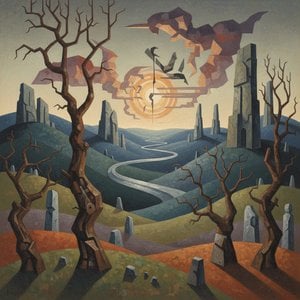
Stella Snead: A Surrealist Journey Through Landscape and Spirit
Born in London, England, in 1910 to a family marked by unspoken tensions, Stella Snead’s life unfolded as a remarkable confluence of artistic passion, personal struggle, and a profound engagement with the world around her. Her early years were shaped by a complex familial dynamic – her father's “dark moods,” as she described them, contributed to a separation from home in 1915, fostering a sense of displacement that would subtly inform her later work. This formative experience, coupled with a progressive education at St. Christopher’s School, a haven for theosophical thought, instilled in her a curiosity about the unseen and a deep appreciation for nature's mysteries – elements that would become central to her artistic vision.
Snead’s formal training began at the Ozenfant Academy of Fine Arts in London in 1936. This institution, founded by the influential French abstract painter Amédée Ozenfant, provided a crucial foundation for her developing skills and introduced her to a vibrant community of artists. She forged lasting friendships with fellow students Sari Dienes and Leonora Carrington, immersing herself in the burgeoning surrealist movement that was reshaping artistic boundaries. The Academy’s emphasis on form and structure, combined with Ozenfant's teachings, provided a disciplined framework for her creative explorations, while the atmosphere fostered experimentation and a willingness to challenge conventional notions of representation.
The outbreak of World War II in 1939 prompted Snead’s relocation to the United States. Initially settling in New York City, she continued her studies at the Ozenfant Academy until 1941, absorbing the energy and diversity of American artistic life. A pivotal moment occurred in 1940 when she embarked on a cross-country journey by bus, traveling through Los Angeles and eventually to Taos, New Mexico. This period proved transformative, exposing her to the landscapes and indigenous cultures of the American Southwest – elements that would profoundly influence her later paintings, characterized by their dreamlike quality and evocative symbolism. Taos became her home for nearly two decades, a sanctuary where she could immerse herself in the region’s unique environment and artistic community.
The Palette of Dreams: Artistic Style and Themes
Snead's artistic style is immediately recognizable as deeply rooted in Surrealism, yet distinct from the movement’s more overtly political or psychological explorations. Her paintings are not driven by a desire to expose hidden anxieties but rather to capture a sense of wonder and enchantment—a feeling akin to glimpsing a secret world just beyond our perception. Landscapes dominate her oeuvre, rendered with meticulous detail and imbued with an almost hallucinatory quality. She frequently depicted animals – often in unexpected combinations or engaged in ritualistic behaviors – alongside human figures, creating tableaux that defy logical explanation yet resonate with a profound sense of harmony.
Key to Snead’s distinctive style was her masterful use of color and texture. She favored rich, saturated hues—deep blues, vibrant greens, fiery reds—that seemed to emanate from within the canvas itself. Her brushwork was often loose and expressive, creating a sense of movement and dynamism. Her most famous work, *Ecstatic Cow* (1943), exemplifies this approach: a seemingly ordinary cow transformed into a symbol of primal energy and spiritual awakening through her skillful manipulation of color, form, and composition.
Beyond landscapes, Snead’s later work increasingly focused on India. Her photographic journeys during the 1960s resulted in a series of acclaimed photobooks—*Shiva's Pigeons*, *Animals in Four Worlds*, and *Drowning Can be Fun?*—that captured the essence of Indian street life, nature, and Hindu sculpture with remarkable sensitivity and insight. These images were not merely documentary; they possessed a poetic quality, conveying a sense of spiritual depth and cultural richness.
A Shift to Photography: Documenting the Sacred and Mundane
In the 1950s, following a period of personal struggle marked by depression, Snead transitioned from painting to photography. This shift was not a rejection of her artistic aspirations but rather an evolution—a new medium through which she could explore her fascination with the world’s diverse cultures and spiritual traditions. Her photographic work reflected a similar sensibility to her paintings: a blend of meticulous observation and imaginative interpretation.
Her extensive travels, particularly in India, provided a rich source of inspiration. She documented Hindu temples and rituals, capturing the vibrant colors and intricate details of Indian architecture and art. Simultaneously, she photographed everyday life—street scenes, market stalls, and portraits of ordinary people—revealing the beauty and complexity of Indian society. Her photographs were not simply snapshots; they were carefully composed images that conveyed a sense of reverence for both the sacred and the mundane.
Legacy and Recognition
Despite facing personal challenges throughout her life, Stella Snead’s artistic legacy endures. Her paintings, particularly *Ecstatic Cow*, are recognized as significant examples of Surrealism in America. In 2005, a survey exhibition of American surrealists, *Surrealism USA*, at the National Academy Museum in New York City brought renewed attention to her work, showcasing a selection of her paintings from the 1940s alongside those of other prominent surrealist artists.
Her photographic books continue to be admired for their beauty and insight. Snead’s unique vision—her ability to blend dreamlike imagery with meticulous observation—established her as a distinctive voice in both painting and photography, leaving behind a body of work that continues to captivate and inspire viewers today.