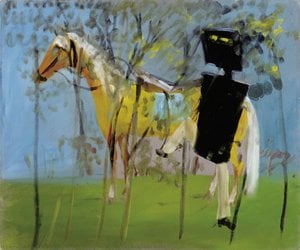
Sir Sidney Robert Nolan (1917–1992) – Australian Modernism’s Bold Voice
Sidney Robert Nolan, born in Melbourne in 1917, stands as a monumental figure in 20th-century Australian art. His journey was not one of conventional artistic training but rather an explosive emergence from the working-class streets of St Kilda into a world of vibrant imagination and relentless experimentation. Nolan wasn’t simply a painter; he was a visual storyteller, a mythmaker who wrestled with Australia's history, its landscapes, and its very identity. From his early days as a runner for an illegal betting ring to his eventual acclaim on the international stage, Nolan’s life was marked by a restless energy and a refusal to be confined by artistic norms. He absorbed influences from diverse sources – the poetry of Rimbaud, the spatial innovations of Cézanne, the raw emotion of Danila Vassilieff – yet forged a style uniquely his own, one that resonated with a distinctly Australian sensibility. His early exposure to the harsh realities of Melbourne life and the allure of its underbelly would profoundly shape his artistic vision, imbuing his work with a sense of both defiance and vulnerability.Early Life and Influences: From St Kilda Streets to Artistic Awakening
Nolan’s formative years were steeped in intellectual ferment. The Heide Circle, centered around patrons John and Sunday Reed, proved pivotal. This haven for artists and writers fostered a spirit of radical experimentation and provided Nolan with crucial support during his developing phase. It was at Heide that he encountered kindred spirits – Albert Tucker, Joy Hester, Arthur Boyd – all grappling with the challenge of creating a distinctly Australian modernism. The influence of modernist literature, particularly the Symbolist poets, cannot be overstated. Rimbaud’s call for a “systematic derangement of the senses” became a guiding principle for Nolan, liberating him from representational constraints and encouraging him to explore the emotional power of color, form, and symbolism. He wasn't interested in merely depicting reality; he sought to capture its essence, its underlying emotions, and its hidden narratives. His early works demonstrate this influence, often featuring fragmented figures and dreamlike landscapes that hint at deeper psychological truths. Nolan’s fascination with Klee—particularly his deliberate undermining of artistic conventions through experimentation—served as a cornerstone for his artistic approach. He meticulously studied the techniques of artists like Picasso, Miro, Kandinsky and Ernst, absorbing their innovations while simultaneously developing his own distinctive visual language.The Heide Circle and Artistic Collaboration
Nolan’s association with the Heide Circle solidified his commitment to pushing boundaries and challenging established artistic traditions. Alongside Tucker, Hester and Boyd, he engaged in spirited debates about how to represent Australian identity—a task fraught with difficulty given the nation's complex history and diverse cultural landscape. The discussions centered around capturing the spirit of Australia – its rugged beauty, its melancholic solitude, and its enduring myths – rejecting simplistic depictions and embracing symbolic representations. This collaborative environment nurtured Nolan’s artistic vision and propelled him toward groundbreaking achievements. He honed his skills in stage design for productions like *Icare*, reflecting a broader interest in visual storytelling across various mediums. His early commercial work—advertising displays and hats—provided valuable experience in mastering new techniques and experimenting with diverse materials, further enriching his artistic repertoire.The Iconic Ned Kelly Series: Mythmaking Through Paint
Nolan’s magnum opus remains the Ned Kelly series – a monumental undertaking that cemented his place as Australia's foremost modernist artist. Beginning in 1946, he embarked on a relentless exploration of the legend of Ned Kelly—the charismatic outlaw who defied Victorian law and became an emblem of Australian defiance. Unlike conventional biographical portraits, Nolan eschewed literal representation, opting instead for stylized depictions of Kelly’s armor—a bold visual device that conveyed not just physical appearance but also psychological complexity. The series consisted of 70 canvases, each meticulously crafted in a distinctive style characterized by flattened planes of color and simplified forms. This stylistic choice wasn't merely aesthetic; it was deliberate – Nolan sought to distill the essence of Kelly’s character and transform him into an archetypal figure embodying resistance against oppression. He captured the spirit of Kelly—his unwavering conviction, his brooding gaze, and his impenetrable aura—through a masterful manipulation of color and texture. The Ned Kelly series became more than just a depiction of history; it was a profound meditation on Australian identity and the enduring power of myth.Legacy and Enduring Influence: A Visionary Artist’s Lasting Impact
Sir Sidney Nolan died in London in 1992, leaving behind an unparalleled artistic legacy—a body of work that continues to inspire artists and captivate audiences worldwide. His paintings are held in major museums across Australia and internationally, ensuring that his vision will endure for generations to come. Nolan’s influence extends far beyond the confines of Australian art; he championed experimentation, challenged conventions, and redefined the possibilities of visual storytelling. He demonstrated a remarkable ability to convey emotion through form and color—a skill that distinguishes him from many of his contemporaries. His exploration of Australian mythology—particularly the Burke and Wills Expedition—further solidified his reputation as a visionary artist committed to capturing the spirit of his homeland. Nolan’s unwavering dedication to artistic innovation—his refusal to compromise on his aesthetic principles—served as an inspiration for countless artists who followed in his footsteps. He remains a towering figure in 20th-century art, remembered not only for his iconic paintings but also for his profound engagement with the complexities of human experience and Australian identity.Kysymykset ja vastaukset
Mitä värejä Sir Sidney Robert Nolan käytti useimmiten?
Sir Sidney Robert Nolan teosten väriprofiili on nähtävissä taiteilijan Paletin genomi -sivulla.
Missä ja minä vuonna Sir Sidney Robert Nolan on syntynyt?
Sir Sidney Robert Nolan syntyi Melbournessä vuonna 1917.
Mistä Sir Sidney Robert Nolan on kotoisin?
Sir Sidney Robert Nolan on syntynyt Australia.
Voinko selata Sir Sidney Robert Nolan teoksia tunnelman mukaan?
Sir Sidney Robert Nolan:n teoksia voi selata tunnelman mukaan artistin Tunnelman mukaan -sivulta, jossa teokset on järjestetty niiden välittämän tunnelman mukaan.
Missä kaupungissa ja maassa Sir Sidney Robert Nolan on syntynyt?
Sir Sidney Robert Nolan on syntynyt Melbourne, Australia.
Voinko tutkia Sir Sidney Robert Nolan teoksia avainsanojen avulla?
Löytääksesi tietyn teeman mukaisia Sir Sidney Robert Nolan teoksia, käytä taiteilijan Avainsanoittain -sivua, joka ryhmittelee teokset avainsanojen mukaan.
Kuinka monta Sir Sidney Robert Nolan teosta on katseltavissa?
Voit selata 63 teosta teosta taiteilijalta Sir Sidney Robert Nolan sivulla Kaikki teokset.