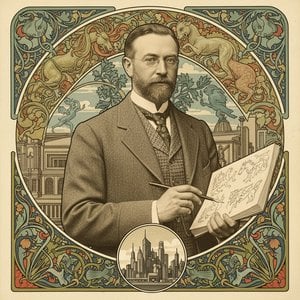
Samuel Worcester Rowse: The Quiet Observer of Emerson and Thoreau
Samuel Worcester Rowse (January 29, 1822 – May 24, 1901) was an American illustrator, lithographer, and painter whose meticulous drawings captured the essence of Transcendentalist thought and landscape. Primarily known for his portraits of Ralph Waldo Emerson and Henry David Thoreau—images that remain iconic representations of their philosophies—Rowse’s artistic legacy extends beyond these celebrated subjects to encompass a prolific output of genre scenes and landscapes reflecting the spirit of Victorian America.
Early Life and Artistic Training
Born in Bath, Maine, Rowse received his initial artistic education from his father, who was also a painter. He honed his skills further at Boston School of Fine Arts, where he studied under George Bridgman and William Morris Hunt—influences that would shape his distinctive style characterized by careful observation and subtle tonal gradations. This grounding in traditional techniques instilled in him a disciplined approach to artmaking, prioritizing accuracy and expressive detail.
Emerson and Thoreau: Defining Portraits
Rowse’s fame solidified with his portraits of Emerson and Thoreau, commissioned by Houghton Mifflin Company for their editions of Emerson's Essays and Thoreau's Walden. These drawings aren’t merely likenesses; they are imbued with a palpable sense of mood and psychological depth. Rowse skillfully rendered the contemplative gaze of Emerson and Thoreau, capturing their inner lives through nuanced shading and expressive poses—a testament to his ability to convey emotion through visual means. The resulting images became instantly recognizable symbols of Transcendentalist ideals and continue to inspire admiration for Rowse’s artistic prowess.
Lithographic Prints and Landscape Painting
Beyond portraiture, Rowse achieved considerable success as a lithographer, producing evocative prints depicting scenes from American life and nature. His lithograph “The Resurrection of Henry Box Brown”—a dramatic portrayal of the daring escape attempt by Henry Box Brown—became a sensation upon its release in 1854, demonstrating Rowse’s mastery of tonal printing techniques and his talent for conveying narrative through visual imagery. Furthermore, he produced numerous landscapes capturing the beauty of Maine and New England, reflecting his fascination with the natural world and employing meticulous detail to recreate atmospheric conditions.
Legacy and Recognition
Samuel Worcester Rowse's contribution to American art is undeniable. His unwavering dedication to realism combined with a profound understanding of human psychology resulted in artworks that resonate deeply with viewers today. He was recognized as one of Boston’s leading portrait painters, cementing his place in the artistic history of the United States. His enduring influence can be seen in subsequent generations of illustrators and artists who admired his meticulous craftsmanship and expressive vision—a quiet but significant voice within the vibrant cultural landscape of Victorian America.
Notable Museums Exhibitions
Rowse’s works were showcased at several prominent museums during his lifetime, including The Metropolitan Museum of Art (New York) and Boston Museum of Fine Arts. His landscapes particularly captivated audiences with their serene beauty and masterful depiction of Maine's coastal scenery. These exhibitions ensured that Rowse’s artistic achievements would be appreciated by a wider public and solidified his reputation as one of the era’s foremost visual artists.