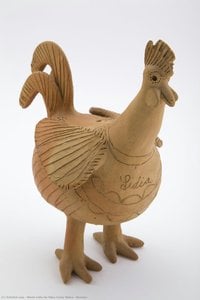
A Portuguese Soul in Brazilian Clay: The Life and Legacy of Lídia Vieira
Born in Viana do Castelo, Portugal, in 1936, Maria Lídia da Silva Costa Vieira – known simply as Lídia Vieira – emerged from a family steeped in artistic tradition to become one of the most distinctive voices in mid-20th century Portuguese and Brazilian art. Her journey, spanning continents and mediums, reveals a profound exploration of form, function, and cultural identity. From her early exposure to sculpture through her father’s books to her eventual recognition as a key figure in the burgeoning world of ceramic abstraction, Vieira's life was a testament to both inherited passion and fiercely independent artistic vision.
Vieira’s childhood in Viana do Castelo provided fertile ground for her nascent creativity. Her father, a passionate collector of art books, nurtured her love for sculpture and design, introducing her to the classical forms of Greece and Rome – influences that would subtly shape her later work. This early exposure, combined with a supportive family environment, encouraged her to pursue her artistic aspirations despite societal expectations. She began her formal training at the Museu José Malhoa in Caldas da Rainha, where she honed her skills in sculpture and ceramics, absorbing the neoclassical style prevalent in Portugal during that era – a style characterized by its emphasis on balance, proportion, and idealized forms.
The Language of Ceramics: Style and Technique
Vieira’s artistic signature lies in her innovative use of ceramics. She didn't simply employ clay as a medium; she transformed it into a vehicle for expressing complex ideas about form, function, and the relationship between the object and its environment. Her work is remarkably diverse, encompassing utilitarian pieces – simple bowls and vases – alongside figurative sculptures that evoke religious themes and intimate narratives. These pieces are often imbued with a quiet elegance, reflecting her deep understanding of classical aesthetics while simultaneously pushing the boundaries of ceramic form.
A key element of Vieira’s style is her ability to imbue seemingly simple forms with profound meaning. Her sculptures frequently depict religious figures – saints and angels – rendered in a strikingly direct and unadorned manner. These works are not intended as grand, imposing statements but rather as intimate meditations on faith and spirituality. The use of geometric patterns and subtle color variations adds layers of complexity to these pieces, inviting viewers to contemplate their significance.
- Utilitarian Ceramics: Vieira’s early work focused heavily on creating functional ceramics – bowls, vases, and plates – often incorporating intricate decorative elements.
- Figurative Sculpture: Her most celebrated sculptures depict religious figures, characterized by their serene expressions and simplified forms.
- Decorative Pieces: Vieira skillfully blended functionality with aesthetics, producing ceramic pieces that were both beautiful to behold and practical for everyday use.
A Regional Voice, a National Presence
Vieira’s artistic practice was deeply rooted in the cultural landscape of the Northeast region of Brazil, where she eventually settled and established herself as an influential teacher. The art of making ceramics – particularly vases and sculptures – held a significant place in this region's traditions, serving as a powerful expression of local identity. Vieira embraced this heritage while simultaneously forging her own unique artistic voice.
Her work gained recognition throughout Brazil, culminating in exhibitions at the Museu do Homem do Nordeste in Recife and solidifying her position as a prominent figure in Northeastern art. Furthermore, her pieces are now part of important collections across Portugal, including the Museu José Malhoa in Caldas da Rainha, demonstrating the enduring impact of her artistic vision.
Legacy and Influence
Maria Lídia da Silva Costa Vieira’s legacy extends far beyond the individual artworks she created. Her innovative approach to ceramics – combining classical influences with a distinctly modern sensibility – paved the way for subsequent generations of Brazilian artists. She demonstrated that ceramic art could be both aesthetically sophisticated and deeply meaningful, challenging conventional notions of functionality and beauty.
Vieira’s influence can be seen in the work of numerous contemporary ceramicists who continue to explore the expressive potential of this ancient medium. Her commitment to artistic integrity, coupled with her deep connection to her cultural heritage, ensures that her legacy will endure for years to come. She remains a powerful reminder of the transformative power of art and its ability to connect us to our past, present, and future.